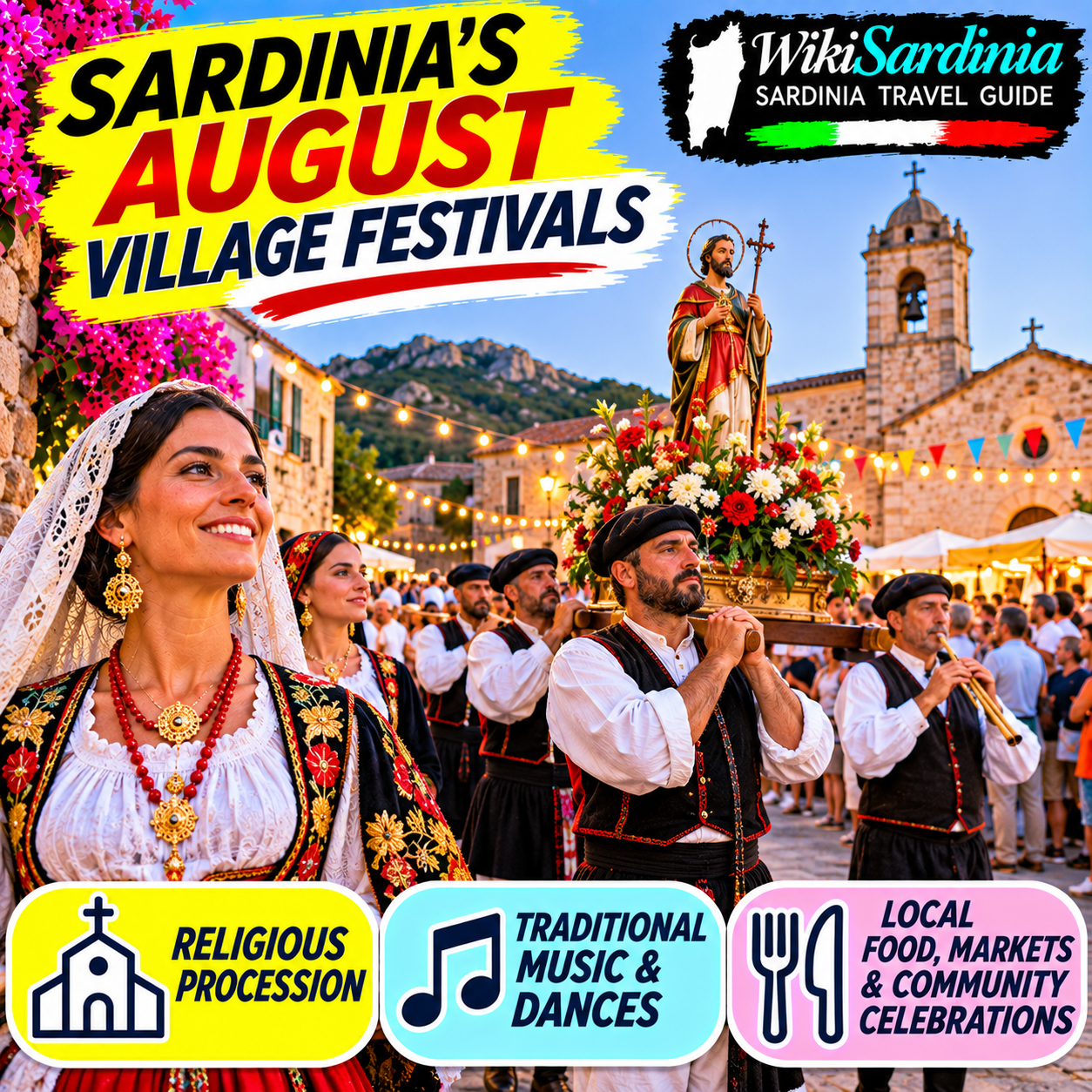
August patron saint festivals in Sardinia are community celebrations combining religious devotion, traditional music, dancing, food and late-night entertainment. In a small village, a festa patronale can be the most important gathering of the year, bringing together residents, relatives returning for summer and visitors. You may see a procession carrying a saint's statue, a solemn Mass, folk costumes, musicians, food stalls and concerts in the main square. Every village has its own program: not all events include fireworks, horse riders or free meals.
What is a festa patronale?
A patron saint festival honors the saint or religious figure associated with a local parish or community. In Sardinia, the celebrations often have two connected parts: festeggiamenti religiosi, such as prayers, Mass and processions, and festeggiamenti civili, which may include concerts, games, dancing and food. SardegnaCultura, the regional heritage portal, explains that many Sardinian religious and traditional festivals take place between May and September, reflecting historic rural and pastoral calendars as well as religious practice.
What happens during the religious procession?
Participants may carry a decorated statue or image of the saint through the village, accompanied by parish groups, confraternities, a band and worshippers. Depending on local tradition, people may wear distinctive Sardinian clothing, carry banners or walk alongside horses and riders. The procession is an act of devotion, not simply a parade for tourists. Visitors can usually watch respectfully from public areas, but should not obstruct the route or step between worshippers and the sacred image to take photographs. Check the local program for the starting church, route and time.
Why is August 15 so important?
August 15 is Ferragosto and the Catholic Feast of the Assumption of Mary. Many Sardinian communities hold celebrations dedicated to the Madonna Assunta, although not every village's patron saint is celebrated on that date. The Diocese of Cagliari describes novenas, solemn Masses, processions and regional traditions surrounding the feast. In some towns the festivities extend over several days. August 15 is also a major national holiday, so expect busy roads, restaurant demand and changes to ordinary business hours.
What does a typical festival day look like?
A festival might begin with church services or a morning procession, followed by family meals and an afternoon pause. In the evening, people gather in the square for music, dancing, stalls or performances. Some programs continue late into the night. This is a typical pattern rather than a fixed timetable: religious services, processions, concerts and children's activities may be spread across different days. Always consult the actual programma religioso e civile for the village and year.
Will you hear traditional Sardinian music?
Possibly. Festival programs may feature folk ensembles, ballu sardu dancing, launeddas instruments or cantu a tenore polyphonic singing, depending on the area. SardegnaTurismo identifies patron saint celebrations among the important occasions where traditional music remains part of community life. Modern cover bands, pop performers and DJs may appear on other nights of the same festival. Do not assume every village has a traditional music performance every evening.
Can tourists join the dancing?
At an open public dance, visitors may be welcomed, but participation depends on the setting and local etiquette. Watch first, follow the instructions of the musicians or organizers, and avoid joining a ceremonial performance in traditional dress unless invited. Sardinian circle dances have recognizable steps and patterns; asking a local participant for guidance is more respectful than interrupting a performance.
Is food served at the festival?
Many celebrations include food stalls, community dinners or separate gastronomic events, but these are not guaranteed. You might encounter local bread, sweets, pasta dishes, grilled food or regional specialties. Some dinners require tickets or reservations, while others involve free tastings or charitable contributions. Food-allergy information may not be displayed as prominently as in a restaurant, so ask vendors about ingredients and cross-contact. Bring euros and a card, because payment options vary.
Are fireworks common?
Some festivals include fireworks, often as part of evening celebrations, but others do not. Displays may be restricted, postponed or cancelled because of wildfire danger, weather, safety measures or local rules. Never promise a fireworks show based only on a festival's historical reputation. Families with children or visitors sensitive to loud sounds should check the current program and find out whether fireworks are planned.
Who organizes the festival?
Local committees, parish groups, volunteers, cultural associations and sometimes municipal authorities coordinate different parts of the celebration. In some communities, groups of residents of the same age—called fedales—take a leading role in organizing the festivities. Donations, fundraising and volunteer work can be central to the event. For example, the 2026 Assumption celebration in Lula involved the parish and three age cohorts. The organizational model differs from village to village.
Where can you experience an August village festival?
Lula — Santa Maria Assunta
Lula, in the Nuoro area, celebrated the Assumption from August 13 to 15 in 2026, with religious services, a procession, horse riders, folk groups and music. This is a documented example, not a confirmed calendar for future years. Check the municipality and local committee for the next program.
Gadoni — Maria Vergine Assunta
The 2026 program in Gadoni combined religious services and an August 15 procession with evening performances and family activities across several days. The lineup and times are year-specific, so verify future editions.
Guspini — Santa Maria Assunta
The festival association publishes religious and civic programs including processions, music and community gatherings. The association's website is a useful place to check what is actually planned, but older published schedules should not be reused as current information.
Villages across Ogliastra and Barbagia
Many smaller communities hold celebrations throughout August. An August festival calendar may include events around Santa Maria, San Lorenzo and other local saints, but names and dates differ. Ask a municipal tourist office which festival is happening near your accommodation during your stay.
Are the festivals free?
Watching a procession or attending a public square celebration is often free, but specific concerts, dinners, games or special activities may require payment or reservations. A donation to the organizing committee may be welcome but should not be confused with a compulsory admission charge. Check the event poster for ticket details.
Can non-Catholic visitors attend?
Generally, respectful visitors can watch public processions and attend church services without needing to be Catholic. During religious moments, remain quiet, dress appropriately for a church, follow instructions and avoid intrusive photography. You do not have to participate in prayers or rituals. The civic festivities are usually community events open to a broader audience.
What should you wear?
Choose breathable clothing for August heat, comfortable shoes for cobbled streets and a light layer for late evenings. If entering a church, cover shoulders and dress respectfully according to the parish's guidance. For processions, bring water and sun protection if the route is outdoors. Avoid blocking narrow streets with large equipment or strollers, and consider hearing protection for children if loud music or fireworks are expected.
Will roads and parking be affected?
Yes, potentially. Processions and public concerts can lead to temporary street closures, pedestrian areas, parking restrictions and traffic diversions. Small villages may have limited parking close to the main square. Arrive early, use marked parking areas and follow Polizia Locale instructions. Do not park across procession routes or emergency access points. If you are staying in a rural property, check whether the celebration affects access to your accommodation.
How can you find the exact program?
Search for festa patronale plus the village name and year, or programma festeggiamenti religiosi e civili. Prioritize the Comune, parish, Pro Loco or official organizing committee. Posters on local noticeboards and official social pages may contain more current information than general tourism articles. Verify the date, procession time, venue, admission and weather arrangements. A 2026 event is not evidence that the same performers or hours will return in 2027.
Useful Italian phrases
“Quando si celebra la festa patronale?” — When is the patron saint festival? “A che ora parte la processione?” — What time does the procession start? “Dove si svolge il concerto?” — Where is the concert? “La cena è aperta a tutti?” — Is the dinner open to everyone? “Serve prenotare?” — Do we need to book? “Dove possiamo parcheggiare?” — Where can we park?
Frequently asked questions
What happens at a Sardinian patron saint festival?
Typically religious services and processions, followed by some combination of music, dancing, food and public entertainment.
Are tourists welcome?
Usually yes at public events, provided they respect the religious ceremonies and local rules.
Are all August festivals held on Ferragosto?
No. August 15 is important for Assumption celebrations, but each village has its own patron and calendar.
Do you need tickets?
Many public activities are free; specific meals and performances may be ticketed.
Will there be traditional costumes?
Some processions and performances feature traditional clothing, but not every festival does.
Are there fireworks every night?
No. Fireworks depend on the program and safety restrictions.
Can children attend?
Yes, many celebrations are family-oriented, although late hours, crowds and loud sounds require planning.
How late do festivities last?
Some concerts continue late, but schedules vary. Check the official program.
Where can I find confirmed dates?
Check the municipality, parish, Pro Loco or official festival committee for the relevant year.
The takeaway
An August festa patronale offers visitors a chance to see Sardinian village life beyond the beaches. The experience may include a sacred procession, local costumes, traditional songs, shared food and music in the square. Treat the celebration as a community occasion rather than a staged tourist attraction, verify the actual schedule and participate with respect. A short evening visit can become one of the most memorable parts of a Sardinian holiday.
Sources: SardegnaCultura — Religious festivals; Diocese of Cagliari — Assumption celebrations; SardegnaTurismo — Traditional music; Santa Maria Assunta Guspini festival association; Lula — August 2026 festival program; Gadoni — August 2026 festival program.