Imagine waking up in the Sardinian countryside, hearing sheep in the distance and smelling freshly baked bread before breakfast. Your host might also grow olives, raise animals or produce the ingredients served at dinner. This is the idea behind an agriturismo—but it is more than a charming farmhouse with guest rooms.
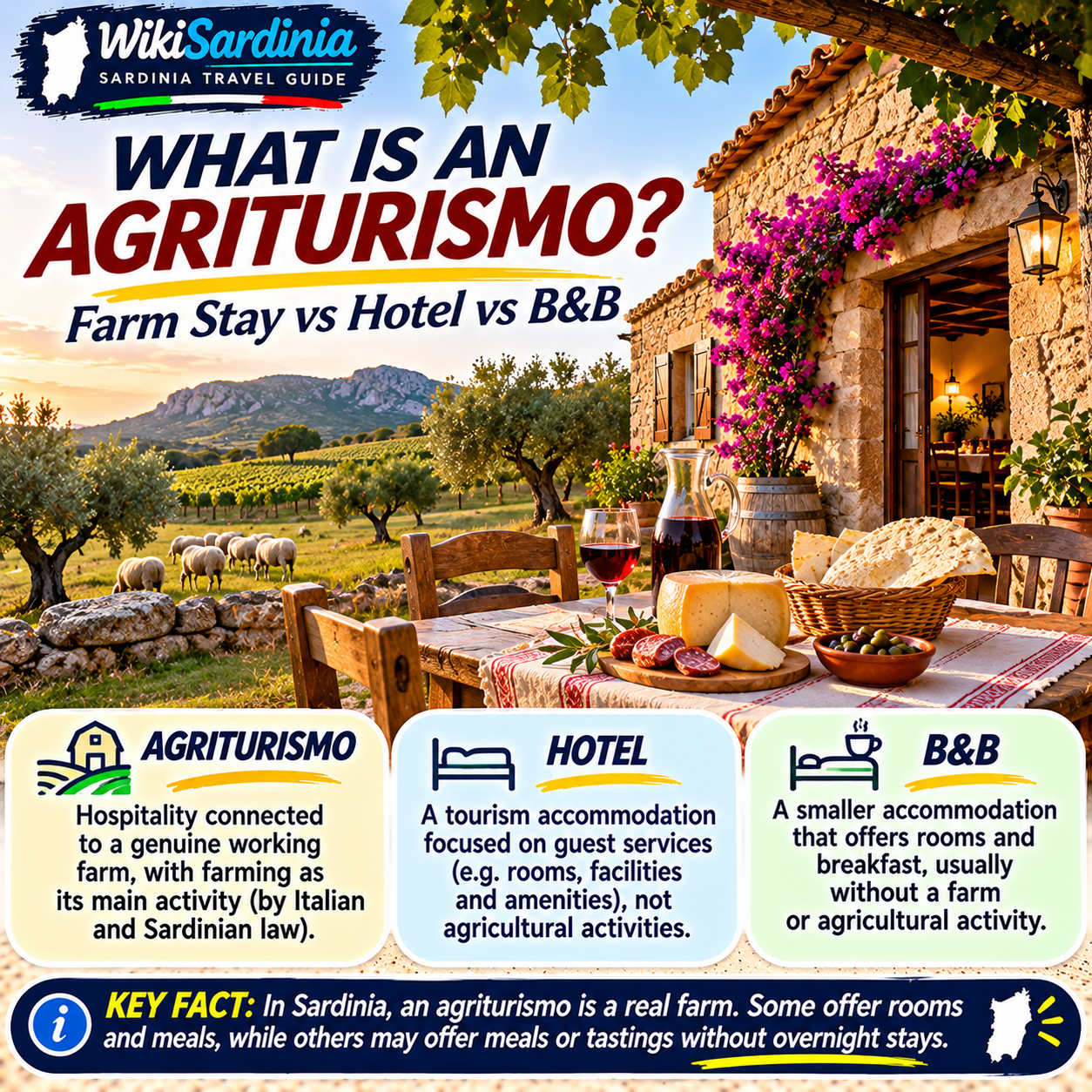
An agriturismo is a hospitality activity run by a genuine agricultural business, with tourism connected to the farm's main agricultural work. That legal connection is the essential difference from a conventional hotel or bed and breakfast (B&B). In Sardinia, an agriturismo can offer accommodation, meals, tastings and certain rural experiences, depending on its authorisations and facilities.
What does “agriturismo” mean?
The word combines agricoltura (agriculture) and turismo (tourism). In everyday English, it is often translated as “farm stay” or “farm tourism.” Neither translation tells the whole story, because some agriturismi focus on meals and tastings rather than overnight accommodation.
Under Italy's Law No. 96 of 20 February 2006, agriturismo is hospitality provided by agricultural entrepreneurs using their farm in connection with cultivation, forestry or animal breeding. Sardinia's Regional Law No. 11 of 11 May 2015 further regulates the activity on the island. Agricultural activity must remain the principal business; hospitality complements it.
How is an agriturismo different from a hotel?
A hotel is primarily a tourism accommodation business. Its central purpose is providing guest rooms and related services. An agriturismo, by contrast, must be connected to an operating farm. That difference influences the setting, experience and services, although it does not dictate a single level of comfort.
Some Sardinian agriturismi are simple rural properties with a handful of rooms and communal meals. Others offer stylish accommodation, swimming pools, landscaped grounds or other comforts. Likewise, hotels range from small family-run properties to large resorts. The distinction is not “rustic versus luxurious”; it is the underlying agricultural business and the legal framework.
How is an agriturismo different from a B&B?
A bed and breakfast typically provides guest accommodation and breakfast, often on a smaller scale than a hotel. It does not need to operate a farm. An agriturismo must be linked to an agricultural enterprise and may offer a wider range of farm-related activities.
That does not mean every agriturismo serves dinner or every B&B lacks local character. Many Sardinian B&Bs are welcoming, family-run places with excellent breakfasts. The difference is structural, not a judgement about which experience is more authentic or enjoyable.
Agriturismo vs hotel vs B&B: quick comparison
| Feature | Agriturismo | Hotel | B&B |
|---|---|---|---|
| Main business | Agriculture, with connected hospitality | Tourist accommodation | Guest accommodation and breakfast |
| Location | Connected to a farm, often rural | Urban, coastal or rural | Urban, coastal or rural |
| Meals | May offer farm-linked meals or tastings | Varies by hotel | Breakfast is central; other meals vary |
| Activities | May offer farm or nature experiences | Depends on hotel facilities | Depends on host |
| Accommodation | Not always offered | Core service | Core service |
| Facilities | Highly variable | Highly variable | Highly variable |
Do all Sardinian agriturismi offer overnight stays?
No. This is one of the most common misunderstandings among international visitors. Sardinia's agriturismo rules cover different permitted activities, including accommodation, meals, tastings of farm and territorial products, and certain recreational or educational experiences. An establishment may specialise in one or several of these services.
Some are popular places to enjoy a traditional Sardinian dinner without sleeping there. Others operate guest rooms, farm camping facilities or a combination of hospitality options. Always check whether a property actually offers overnight stays before booking.
What is dinner like at a Sardinian agriturismo?
Food is often a major attraction. Depending on the farm and its permitted service, meals may showcase local ingredients and traditional recipes: malloreddus pasta, roast meats, seasonal vegetables, pecorino cheese, local bread and Sardinian sweets. The exact menu reflects the producer, season and region of the island.
Some properties offer a fixed multi-course menu at a set price rather than a broad à-la-carte selection. Others require advance reservations or serve dinner only on selected days. Do not assume that every agriturismo has a restaurant open every evening.
Sardinian law contains requirements concerning the agricultural and local origin of ingredients used in agriturismo food service. This makes the farm connection more than a marketing slogan. However, it does not mean that every ingredient on every plate must have been grown on that one property. Ask your host which products come from the farm and which come from nearby producers.
Will I see farm animals or participate in farm work?
Possibly, but not automatically. Some agriturismi have sheep, goats, cattle, horses or other livestock; others focus on vineyards, olive groves, orchards or crops. Activities such as guided farm visits, tastings, cooking demonstrations and educational workshops may be available, sometimes for an additional charge.
Staying at an agriturismo does not usually mean guests are required to work on the farm. If you want hands-on experiences, ask what is actually offered, whether activities are supervised and whether they are suitable for children.
Is an agriturismo suitable for families?
Many can be, particularly for families who enjoy countryside settings, local food and outdoor space. Children may love seeing animals or learning where food comes from. But farms are also working environments with equipment, uneven ground, gates and sometimes livestock.
Check whether the property has family rooms, child-friendly meals, suitable play areas and any necessary safety rules. A swimming pool or children's programme should never be assumed simply because the listing says “agriturismo.”
Is an agriturismo always cheaper than a hotel?
No. Prices vary widely according to location, season, facilities, room category and whether meals are included. A simple countryside stay may be good value, while a boutique agriturismo with a pool and extensive services may cost more than a basic hotel.
Compare the full price rather than only the nightly rate. Ask whether breakfast, dinner, local taxes, cleaning, air conditioning and activities are included. A meal-only agriturismo may have a separate per-person menu price.
Do I need a rental car?
Often a car is very useful. Many Sardinian agriturismi sit outside towns, on rural roads where buses are infrequent or absent. Some are only a short drive from Alghero, Olbia, Cagliari or popular beaches; others are deep in the countryside.
Before booking, check the exact address, road conditions, parking and realistic driving time. Ask whether the final access road is paved and whether late-night arrival is possible. Do not rely solely on a straight-line distance shown on a map.
Can I stay in an agriturismo and still visit the beach?
Absolutely. A countryside base can be a rewarding alternative to a beachfront hotel, particularly if you want quiet evenings and traditional meals after a day exploring the coast. The trade-off is usually driving time.
For a beach-focused holiday, check the route to the beaches you plan to visit and whether the property offers convenient parking and flexible meal times. If you want to walk directly to the sand, a coastal hotel or apartment may be more practical.
What should I expect from rooms and amenities?
There is no single agriturismo room standard. You might find renovated stone farm buildings, modern guest rooms, self-contained apartments or designated farm-camping spaces. Wi-Fi, air conditioning, private bathrooms, pools and accessible rooms depend on the individual property.
Some hosts provide daily cleaning and reception-like services; others operate with limited check-in windows. Confirm the features that matter to you, particularly accessibility, heating outside summer, reliable internet and dietary requirements.
Do Sardinian agriturismi have a star rating?
Italy uses a dedicated classification system for qualifying agriturismi, represented by sunflowers rather than ordinary hotel stars. Sardegna Agricoltura explains that Sardinia adopted the national classification methodology for agriturismi offering overnight accommodation or authorised farm camping. The system has up to five sunflowers and considers comfort, services, environmental setting and the distinctive rural character of the property.
A sunflower rating should not be read as identical to a hotel's star rating. It reflects a different type of accommodation and classification criteria. Nor should a restaurant-only agriturismo be expected to display an accommodation classification.
How can I tell whether an agriturismo is genuine?
Because the term is regulated, an authorised agriturismo should be operated by an eligible agricultural entrepreneur in connection with an agricultural business. Sardegna Agricoltura states that the denomination is reserved for operators who meet the applicable requirements.
Look for clear information about the farm, its products and its actual services. If a listing is vague, ask whether it is a registered agriturismo, what agricultural activity the business carries out and what is included in your booking. An attractive farmhouse photograph alone does not prove legal status.
What about dietary restrictions?
Traditional agriturismo menus may include wheat pasta, cheese, cured meats, eggs and other common allergens. Some kitchens can accommodate vegetarian, gluten-free, lactose-free or other dietary needs, but advance notice is important—especially if a fixed menu is served.
For coeliac disease or serious food allergies, ask about ingredients and cross-contact procedures rather than assuming a naturally simple rural recipe is safe. A small farm kitchen may have limited capacity to prepare separate meals.
What should I ask before booking?
- Does the agriturismo offer accommodation, meals, or both?
- Is breakfast included? Is dinner available every night?
- Are meals fixed-menu, and what is the price per person?
- Which products are produced on the farm?
- Are farm tours, tastings or children's activities offered?
- Do I need a car, and is the access road suitable?
- Is there air conditioning, Wi-Fi, parking or a swimming pool?
- Can the kitchen safely accommodate my dietary needs?
- What are the check-in hours and cancellation terms?
Useful Italian phrases
- È possibile pernottare? — Is it possible to stay overnight?
- Fate anche ristorazione? — Do you also serve meals?
- La cena è a menù fisso? — Is dinner a fixed menu?
- La colazione è inclusa? — Is breakfast included?
- Quali prodotti sono della vostra azienda agricola? — Which products come from your farm?
- Serve prenotare per cena? — Do we need to reserve dinner?
- La strada di accesso è asfaltata? — Is the access road paved?
Frequently asked questions
Is an agriturismo just a farmhouse hotel?
No. It is a legally regulated hospitality activity connected to a genuine agricultural enterprise.
Can I eat at an agriturismo without staying overnight?
Yes, at agriturismi authorised and organised to serve meals to visitors. Reservations may be necessary.
Does every agriturismo grow all its own food?
No. The business must have a real agricultural connection, and food-service rules govern product sourcing, but ingredients can also come from other permitted local or regional sources.
Are agriturismi suitable for couples?
They can be excellent for couples seeking rural scenery, traditional food and a quieter base, provided the property's facilities and location suit their plans.
Are agriturismi child-friendly?
Many welcome families, but activities, safety arrangements and facilities vary. Check before booking.
Do you have to help with farm work?
No. A normal agriturismo booking is a hospitality experience, not a work obligation.
Are agriturismi always remote?
Not necessarily. Some are near towns and beaches, while others are in isolated rural areas.
What do the sunflowers mean?
They indicate a specific agriturismo accommodation classification, with up to five sunflowers in Sardinia, rather than a standard hotel-star rating.
Is an agriturismo better than a B&B?
Neither is inherently better. Choose an agriturismo for its farm connection and rural experiences, a B&B for a smaller accommodation-focused stay, or a hotel for the services and location that best fit your trip.
The bottom line
An agriturismo is one of the most distinctive ways to experience Sardinia beyond its beaches. The defining feature is not rustic décor or a long dinner: it is the genuine link between agriculture and hospitality. Some agriturismi provide memorable farm stays; others welcome visitors mainly for traditional meals and tastings. Check exactly what each property offers, and you may discover a quieter, delicious and deeply local side of the island.