You're enjoying a long lunch in a Sardinian trattoria when the bill arrives. Alongside the pasta, seafood or roast meat, you notice an unfamiliar line: “coperto”, sometimes multiplied by the number of diners. Is this a hidden tourist fee, a compulsory tip or something else?
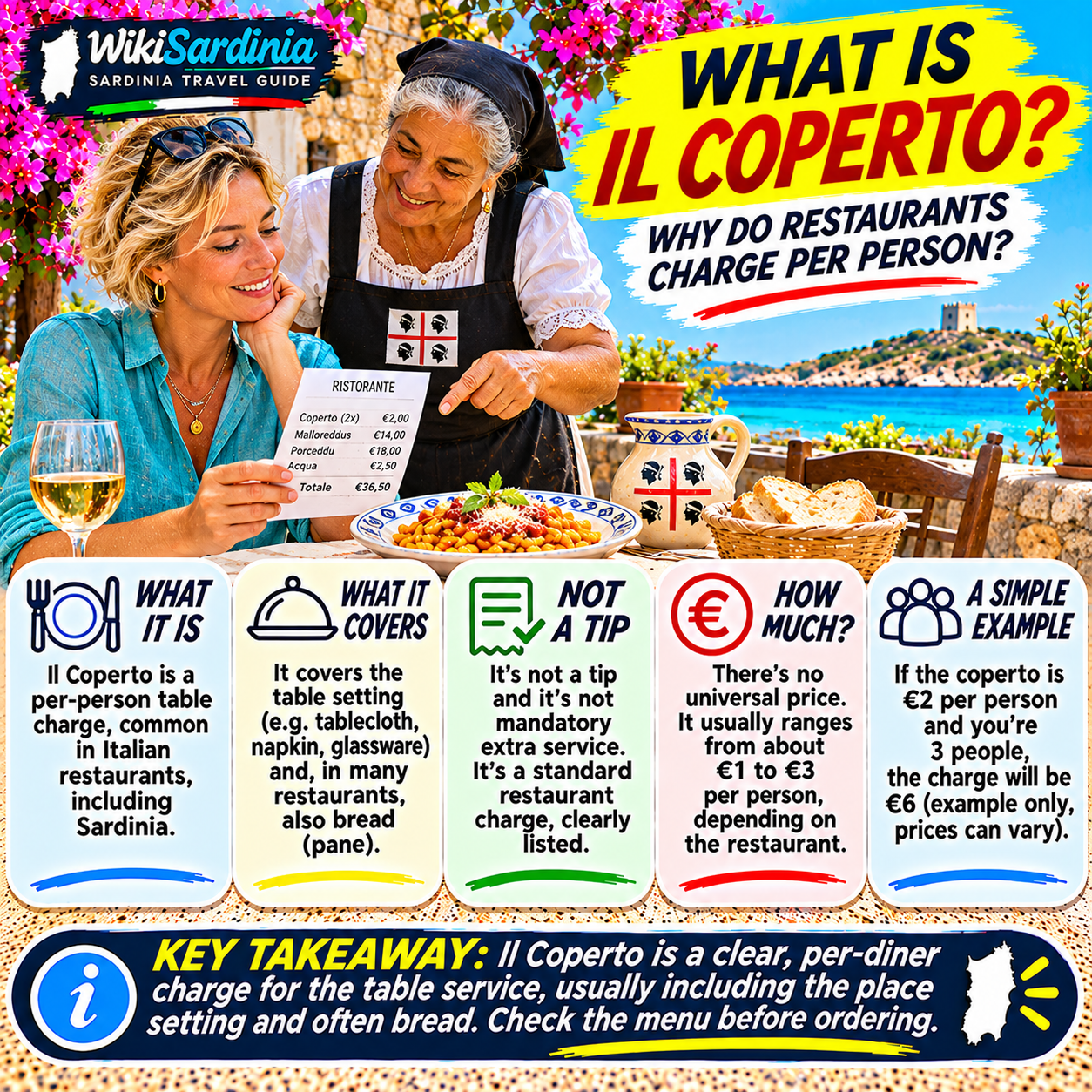
Il coperto is a traditional Italian restaurant cover charge, normally calculated per person seated at the table. It is associated with preparing and maintaining each place setting, including items such as plates, cutlery, glasses, napkins and table linen. It is common in Sardinia and elsewhere in Italy, but it is not a tax and restaurants are not required by national law to charge it.
Why is coperto charged per person?
Each diner uses a place setting and related restaurant resources, so restaurants that apply a coperto typically multiply the stated amount by the number of people eating. For example, if the menu says €2 coperto per person and three diners eat at the table, the total coperto is €6. This is a simple example, not a fixed price for Sardinia. Whether and how a restaurant charges for children or other guests depends on its disclosed policy and the circumstances.
What does the cover charge actually include?
The coperto traditionally relates to the table setting and the resources used to serve a guest. Many restaurants include a bread basket, but bread is not automatically included everywhere; some restaurants list it separately as pane or combine the two under pane e coperto. The important point is what the particular restaurant discloses on its menu. A 2023 survey by the Italian restaurant federation FIPE found that most surveyed establishments included bread in their cover charge, but practices varied.
Source: FIPE: Coperto, servizio e supplementi al ristorante.
How much is coperto in Sardinia?
There is no single island-wide amount. You may encounter a charge of a few euros per diner, while some restaurants charge more or nothing at all. The price depends on the establishment and must be disclosed before you order. FIPE's 2023 national survey reported an average coperto of €2.90 among the restaurants it surveyed; that is historical national survey data, not a current Sardinian price or legal cap.
Is coperto legal?
In general, yes: Italian national law does not impose a universal ban on coperto, although some local jurisdictions have different rules. In Sardinia, visitors should focus on the basic transparency principle: any cover charge must be clearly communicated on the menu or price list before ordering. If the amount appears for the first time on your bill, ask staff to show where it was disclosed and seek clarification. Consumer organizations such as Altroconsumo explain that an undisclosed charge can be contested.
Source: Altroconsumo: Il coperto al ristorante.
Is coperto the same as a tip?
No. Coperto is a restaurant charge, not a gratuity handed to your waiter. Tipping in Italy is generally discretionary, and there is no need to add a percentage just because a coperto appears on the bill. Some restaurants also have a separate servizio (service) charge; if one applies, it should likewise be communicated in advance. Check the menu to understand whether charges are separate or included.
What is the difference between coperto and servizio?
Coperto is usually a fixed amount per diner for the place setting. Servizio refers to a service fee that may be fixed or calculated as a percentage, depending on the restaurant. The two terms are not interchangeable, and you should not assume that either one represents a tip. If both appear, ask the restaurant to explain them and confirm they were disclosed before you ordered.
Can you refuse to pay the coperto?
If the coperto was clearly listed before you ordered and is lawfully applied, it normally forms part of the price you agreed to pay. If it was not disclosed, you can politely question the charge and request an explanation or correction. Avoid assuming that refusing the bread basket automatically removes the coperto: the charge usually concerns the table setting, not bread alone.
Useful Italian phrases at the restaurant
“Il coperto è incluso?” means “Is the cover charge included?” “Quanto costa il coperto a persona?” means “How much is the cover charge per person?” “Il pane è incluso nel coperto?” means “Is bread included in the cover charge?” And if something unexpected appears on your bill, you can say “Mi può spiegare questa voce sul conto, per favore?” — “Could you explain this item on the bill, please?”
Why does the tradition still exist?
The practice is commonly traced back to historic Italian inns, where guests might pay for a place under shelter and the use of tableware even when bringing their own food. Modern restaurants operate differently, but the name and the idea of a separate table charge remain. Today it is a pricing choice by the restaurant, not a compulsory government fee.
How can visitors avoid surprises?
Read the bottom of the menu before ordering, where coperto, pane e coperto or servizio may appear in smaller print. Ask about the charge if it is unclear, especially when comparing restaurants or travelling as a group. The Italian National Consumers Union also advises diners to check how bread and cover charges are described, rather than assuming they are the same thing.
Source: Unione Nazionale Consumatori: Pane e coperto.
The WikiSardinia takeaway
Il coperto is not a scam, a tip or a tourist tax. It is a traditional per-person restaurant charge that may cover the table setting and, depending on the restaurant, bread. It is not mandatory for every restaurant to impose it, but if one does, the amount should be clear before you order. A quick glance at the menu helps you enjoy Sardinian food without any surprises when the bill arrives.