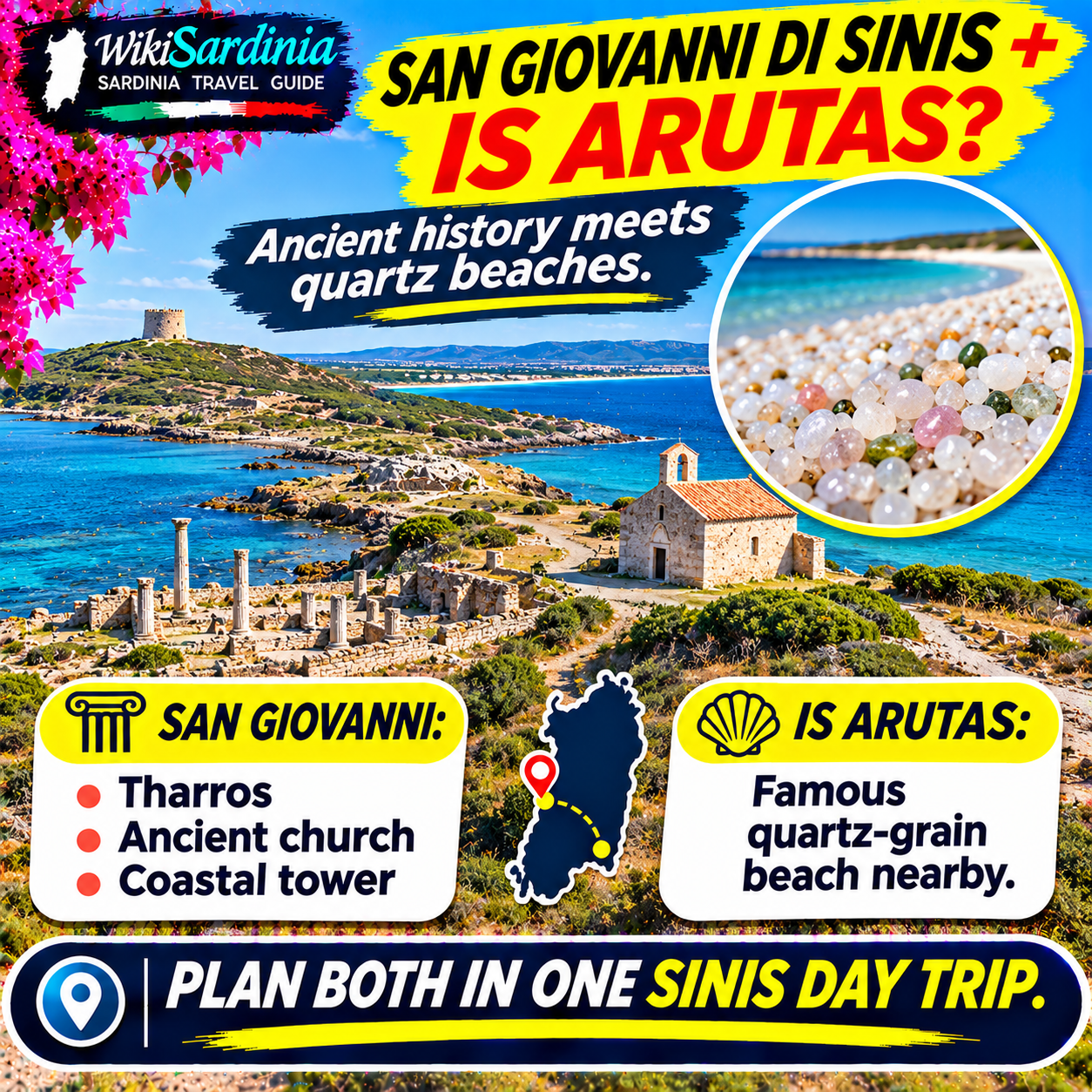
San Giovanni di Sinis is one of the best places in western Sardinia to combine an ancient archaeological site, a historic seaside village and beautiful beaches in one outing. It is famous for the ruins of Tharros, its small early Christian church, a Spanish coastal watchtower and the windswept scenery of Capo San Marco. And yes, the extraordinary quartz-grain beach of Is Arutas is nearby, on the same Sinis Peninsula. It is a separate beach, however, and is best reached by a short drive rather than by assuming you can walk along the shore from San Giovanni.
Where is San Giovanni di Sinis?
San Giovanni di Sinis is a coastal village in the municipality of Cabras, on Sardinia's central-western coast near Oristano. It lies toward the southern end of the Sinis Peninsula, beside the protected Penisola del Sinis–Isola di Mal di Ventre Marine Protected Area. The village is roughly 20 kilometres by road from Oristano according to SardegnaTurismo's published directions. The coast combines sand, rocky stretches, dunes, archaeological remains and views across the Gulf of Oristano. The place is especially appealing because you can explore thousands of years of history and still have time for a swim.
1. Tharros: ancient ruins beside the sea
The best-known cultural attraction is Tharros, the ancient coastal settlement on the southern Sinis Peninsula. Its history spans Phoenician, Punic and Roman periods, with surviving streets, columns, foundations and other archaeological remains in a dramatic seaside setting. It is an open-air site, so expect sun exposure and uneven walking surfaces. Check the official operator's current opening times, ticket options and guided-tour availability before visiting; archaeological admission is not automatically included in a beach trip. The landscape is part of the attraction, but the ruins deserve more than a quick photograph from outside.
2. The early Christian Church of San Giovanni
In the village stands the distinctive Church of San Giovanni di Sinis, a modest stone building with origins in the early Christian and Byzantine periods. Official regional descriptions date its earliest phases to around the fifth or sixth century, with later rebuilding that shaped its present form. Its plain, timeworn architecture is a striking contrast to the surrounding beaches. It is a useful stop even for visitors who are not particularly interested in church history, though access to the interior may depend on current opening arrangements. Do not assume that a village church is staffed or open all day.
3. Torre di San Giovanni and Capo San Marco
The Torre di San Giovanni is a Spanish-era coastal watchtower built between the late sixteenth and early seventeenth centuries to help defend the shore. It sits on higher ground near the archaeological area and offers an excellent sense of the peninsula's geography. Farther south, Capo San Marco has rocky coastal scenery and wide views. Paths can be uneven, exposed and windy, so wear proper shoes and stay away from unstable cliff edges. Enjoy the viewpoints from permitted trails and respect any access restrictions near archaeological or protected natural areas.
4. San Giovanni beach: a beautiful beach in its own right
The village's beach stretches along approximately two kilometres of coast toward Funtana Meiga, with sand, rocky interruptions and clear water. It is a popular destination for swimming and water sports when conditions permit. Wind and surf can make the sea very different from the sheltered coves elsewhere on the island, so assess the conditions before entering the water, especially with children. Public access to the beach is described as free by Italy's cultural heritage listing, although parking and beach services may involve separate charges. In summer, kiosks and visitor facilities may operate, but outside the main season their availability can be limited.
Is Is Arutas close to San Giovanni di Sinis?
Yes. Both places are on the Sinis Peninsula in the municipality of Cabras, making them an easy combination for a car-based day trip. Is Arutas is farther north along the western coast, so it is not immediately next door to the village or the ruins of Tharros. You need to travel along local roads through the peninsula rather than follow the beach continuously. The exact driving time depends on the route, road conditions and summer traffic; allow extra time for parking. If you do not have a car, check seasonal public transport or a local tour rather than assuming there is a frequent direct shuttle between the two beaches.
Why is Is Arutas famous?
Is Arutas is famous for its unusual quartz grains, rounded and polished by the sea, often compared to grains of rice. Instead of conventional fine sand, the beach has a mixture of tiny white, pale pink and greenish quartz pebbles that sparkle in the sun. The sea often looks strikingly turquoise against this light-coloured shore. It is among the most recognizable beaches on Sardinia's west coast, and the unusual texture is part of what makes it memorable. The beach's protected natural character matters just as much as its appearance: those quartz grains belong on the shore, not in visitors' bags.
Are San Giovanni and Is Arutas the same kind of beach?
No. San Giovanni di Sinis is a mixed sandy and rocky coastal area beside a village and major archaeological landmarks. Is Arutas is best known specifically for its small rounded quartz grains and vivid water colours. If you have time for only one stop and love archaeology, San Giovanni is the more versatile choice. If your main goal is to experience a highly unusual beach, Is Arutas may be the highlight. If you can spare a full day, the two complement each other exceptionally well.
Can you take quartz sand home as a souvenir?
No. Do not remove quartz grains, sand, stones or shells from Sardinian beaches. Is Arutas has suffered from visitors collecting its distinctive grains, and removing beach material is prohibited under Sardinian rules. Even a small jar or handful contributes to damage when repeated by many visitors. Photograph the grains, enjoy their colour and leave them where they belong. Before leaving the beach, shake sand from towels and footwear so that you do not inadvertently carry large quantities away.
Are Is Arutas and San Giovanni suitable for families?
Both can be enjoyable with children, but they offer different experiences. San Giovanni combines a village setting, beach facilities in season and short cultural stops; Tharros adds uneven paths and potentially significant sun exposure. Is Arutas has a visually fascinating shore, but the quartz-grain surface may feel different underfoot from soft sand, and sea conditions can change quickly. Neither beach should be assumed to have calm water every day. Bring drinking water, sun protection and suitable footwear, and supervise children closely around waves, rocks and archaeological edges.
Are there parking areas and facilities?
Official regional and protected-area visitor information identifies parking and seasonal facilities around San Giovanni di Sinis and Is Arutas. The marine protected area's visitor site lists bars, restaurants and public restrooms at Is Arutas, while Italy's cultural heritage listing describes parking and beach services at San Giovanni. Facilities may not operate every day outside the summer season, and parking rules or charges can change. Look for official signs on arrival and avoid parking on dunes, vegetation or unauthorized roadside areas. Do not leave valuables visible in a parked rental car.
What about Maimoni and Mari Ermi?
If you love Is Arutas, consider Maimoni and Mari Ermi, two other distinctive beaches along the protected Sinis coast. They also feature light-coloured sand and quartz-rich stretches, but each has a different setting, access road and exposure to the wind. They make worthwhile alternatives when Is Arutas is busy, although you should check parking, access and sea conditions individually. Do not assume all three beaches have identical services or swimming conditions.
What else can you see near San Giovanni?
In nearby Cabras, the Giovanni Marongiu Civic Archaeological Museum displays important archaeological material, including statues from the Giants of Mont'e Prama discoveries. The Cabras lagoon and other wetlands of the Sinis are valuable bird habitats, with opportunities to observe flamingos and other species from appropriate places. San Salvatore di Sinis, along routes through the peninsula, is known for its distinctive village setting and the traditional Corsa degli Scalzi. These stops are optional additions; do not try to fit everything into a short beach afternoon.
Can you see San Giovanni, Tharros and Is Arutas in one day?
Yes, and it is one of the most rewarding one-day combinations in the Oristano area. Start with the early Christian church and a walk around San Giovanni di Sinis. Visit Tharros while the temperature is comfortable and allow time for the tower or a Capo San Marco viewpoint if open and accessible. After lunch, drive north toward Is Arutas for a swim, a walk or simply to admire the quartz beach. This sequence avoids rushing through the archaeological site and leaves time to enjoy the coast. In very hot weather, consider reversing the schedule or choosing shorter outdoor walks.
How long should you spend in the area?
Allow a full day if you want to combine Tharros, the village and Is Arutas without hurrying. A half day is enough for a shorter visit to San Giovanni and one major attraction, but you would have less time for a relaxed beach stop. The Sinis rewards slow travel: coastal viewpoints, a museum visit and a meal can easily turn a planned quick stop into a longer outing. If you are traveling from farther away in Sardinia, account for the journey to Oristano and back.
What is the best season?
Late spring and early autumn are attractive for combining archaeological walks with time on the beach, because temperatures are often more comfortable and some coastal areas may be quieter. Summer is popular for swimming but can bring strong sun, crowds and limited parking. Winter can be atmospheric for walking and photography, although some tourist services and attractions may have shorter hours. The Sinis is exposed to wind, so check the daily forecast and sea state rather than choosing a beach solely by the season.
Can you visit without a rental car?
It is possible to reach parts of the Oristano and Cabras area using public transport, but visiting San Giovanni, Tharros and Is Arutas in one day is much easier with a car or a prearranged local excursion. Bus services to coastal villages can be seasonal or infrequent, and the beach-to-beach connection is not necessarily convenient. If relying on public transport, check the current schedules and return journey before setting out. A taxi or guided transfer may be worth considering for travelers with limited time.
What should you bring?
Bring comfortable shoes for archaeological paths, swimwear and a towel if you plan to enter the sea, water, a hat, sunscreen and a light layer for wind. A phone with offline maps is useful for navigating rural roads, and a small bag for your own rubbish helps protect the marine area. If you plan to photograph the quartz grains, use your camera rather than taking samples. Carry cash or a payment card for parking and seasonal services, but verify accepted methods on site.
A practical Sinis day-trip itinerary
- Morning — San Giovanni di Sinis: see the early Christian church, the beach and the village setting.
- Late morning — Tharros: explore the ancient ruins, subject to the site's opening hours, and admire the coastal landscape.
- Midday — Lunch: stop in San Giovanni or Cabras, depending on available restaurants and your schedule.
- Afternoon — Is Arutas: drive north for the quartz-grain beach and a relaxed coastal stop.
- Optional: add Mari Ermi, Maimoni or the Cabras archaeological museum if time permits; do not squeeze them in at the expense of a comfortable visit.
Useful Italian phrases
“Dove si trova l'area archeologica di Tharros?” — Where is the Tharros archaeological site? “La chiesa di San Giovanni è aperta?” — Is San Giovanni church open? “Come si arriva alla spiaggia di Is Arutas?” — How do you get to Is Arutas beach? “Il parcheggio è a pagamento?” — Is parking paid? “Si può fare il bagno oggi?” — Is it safe to swim today? “È vietato portare via i granelli di quarzo?” — Is taking quartz grains away prohibited?
Official sources and visitor information
SardegnaTurismo — San Giovanni di Sinis; SardegnaTurismo — early Christian church; SardegnaTurismo — Is Arutas; Italian Ministry of Culture heritage portal — Is Arutas; Italian Ministry of Culture heritage portal — San Giovanni beach; Sinis–Mal di Ventre Marine Protected Area — visitor information; Sinis Peninsula visitor guide. Check current archaeological opening hours, parking regulations and any temporary restrictions before travel.
The WikiSardinia takeaway
San Giovanni di Sinis is famous for Tharros, its ancient church, Spanish watchtower and beautiful coastline. Is Arutas is close enough to combine in the same day, but it is a separate beach farther north on the Sinis Peninsula. Spend the morning exploring history and the afternoon enjoying the unusual quartz-grain shore. Respect the protected environment and leave every grain of quartz exactly where it belongs.