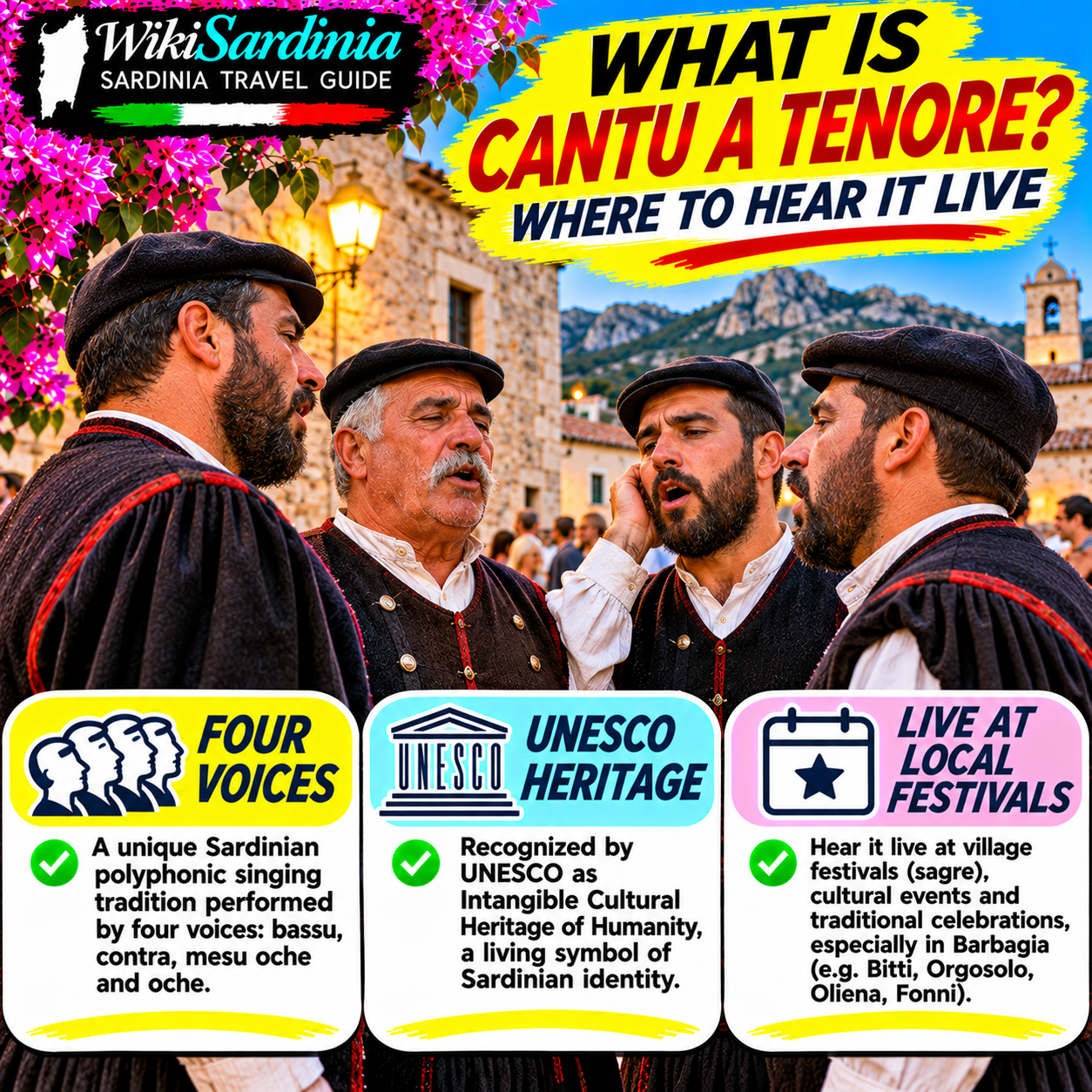
Cantu a tenore is Sardinia's extraordinary four-part vocal tradition, rooted in the pastoral communities of the island's interior. Four singers stand close together and create an interlocking sound with a solo melodic voice and three accompanying voices, including the famously deep, guttural bassu and contra. UNESCO proclaimed it a Masterpiece of Oral and Intangible Heritage in 2005 and inscribed it on the Representative List of the Intangible Cultural Heritage of Humanity in 2008. Visitors can hear it at local festivals, cultural events and sometimes spontaneous gatherings, particularly in central Sardinia—but there is no reliable nightly schedule.
What does “cantu a tenore” mean?
The Sardinian term describes both the musical practice and the quartet that performs it. It does not mean an Italian operatic tenor singing alone. The style is particularly associated with Barbagia and other areas of central and northern Sardinia, where singing is connected to village life, poetry, friendship and celebrations. UNESCO describes performances at weddings, religious festivities, sheep-shearing occasions and local bars known as su zilleri. The repertoire includes love poetry, dance songs and verses about contemporary social issues, so it is a living tradition rather than a fixed historical reenactment.
What are the four voices?
Boghe (or boche) is the lead singer who delivers the poem or song and establishes its rhythm and pitch. Bassu provides a low, resonant foundation, often with a striking guttural timbre. Contra sings another deep accompanying part, closely interacting with bassu. Mesu boghe (or mesu boche) is the higher, more agile accompanying voice, adding ornamentation and melodic movement. The three accompanying singers frequently use non-lexical syllables, making the human voice sound almost instrumental. Pronunciations and names vary among villages; local styles are not interchangeable.
Why does it sound so unusual?
Listeners often notice the powerful resonance of bassu and contra, which can sound unlike conventional Western choir singing. SardegnaTurismo describes the music as reflecting the pastoral world's relationship with nature, while specialist descriptions emphasize the distinctive vocal techniques and the interaction between the four parts. Claims that a particular voice literally reproduces one exact animal call should be treated as cultural interpretation rather than a proven scientific origin. The effect comes from skilled singers listening closely and adjusting their sound together, usually without instruments.
Where can tourists hear cantu a tenore live?
Bitti and the surrounding Nuoro area
Bitti is one of the strongest starting points for visitors interested in the tradition. It is associated with celebrated tenore groups and a multimedia museum devoted to the singing tradition. Check the museum's current visitor arrangements and ask the local tourist office whether a quartet is scheduled during your stay. A museum visit offers cultural context, but it is not a guarantee of a live performance.
Orgosolo and Oliena
These Barbagia communities have rich local traditions and host cultural and religious celebrations where traditional singing may form part of the program. Check official municipal calendars, event posters and local cultural associations for the actual performers and times. Do not assume a daily show exists for visitors.
Fonni and other mountain villages
Fonni and communities across Barbagia, the Marghine, Planargia and Logudoro are relevant places to investigate performances. The best opportunities often coincide with patron-saint celebrations, traditional festivals or specifically announced music events. Ask the local tourist office for esibizioni di canto a tenore rather than expecting a standing tourist attraction.
Nuoro and cultural festivals
Nuoro is a practical base for exploring central Sardinia and its musical heritage. Cultural programs and regional festivals may include tenore groups, but lineups vary by year. Check organizer programs rather than relying on an undated event listing. SardegnaTurismo's cultural guide is a useful introduction to the geographic spread of the tradition.
Is Autunno in Barbagia a good time to hear it?
Autunno in Barbagia is a series of village cultural events held during the autumn season. Some participating communities present music and other living traditions, making it a promising opportunity to look for cantu a tenore. However, the program differs by town and weekend, and a tenore performance is not guaranteed at every stop. Check the specific town's official program and confirm the group's appearance before making a long journey.
Can you hear it in Alghero, Olbia or Cagliari?
Yes, quartets can be invited to festivals and concerts outside the central-Sardinian communities where the tradition is strongest. But no permanent daily tenore show in these coastal cities was verified. If you are based in Alghero, ask local tourism offices about visiting folk ensembles or regional cultural festivals; if you want to explore the tradition at its roots, plan a trip into central Sardinia. Allow enough time for the drive and check evening return transport.
Is the singing performed in restaurants or bars?
UNESCO documents spontaneous performances in traditional local bars, but these are community gatherings, not scheduled commercial entertainment. Visitors should not enter a bar expecting singers to perform on request. If you encounter a spontaneous performance, listen respectfully, avoid interrupting, and ask permission before filming. Organized cultural dinners may sometimes feature musicians, but confirm the actual program before booking.
How do you find a verified live performance?
Start with the regional tourism authority's introduction, then check the municipality's event calendar, local tourist office, cultural association or the quartet's official channels. Search in Italian for canto a tenore concerto, rassegna canto a tenore or tenores plus the town and your travel date. Confirm the date, start time, venue, whether tickets are required, accessibility and whether the event is a live performance rather than a documentary screening. As of this article's preparation, no specific future concert date is presented as confirmed.
Is there a museum dedicated to cantu a tenore?
Bitti is known for its multimedia museum of cantu a tenore, noted by SardegnaTurismo. Exhibits and recordings can help visitors distinguish the voices and learn about the tradition even when no live group is available. Verify current opening hours, ticket prices and reservation requirements with the museum or local tourism office before travelling. Recorded music is valuable context, but a live quartet creates a different experience.
What songs might you hear?
The repertoire varies by village and ensemble. UNESCO mentions boche ’e notte, a serenade form, and dance-related songs including mutos, gosos and ballos. SardegnaTurismo also describes boghe ’e ballu, used to accompany traditional dancing. Some lyrics concern love and rural life; others address emigration, unemployment or current events. Ask performers or organizers whether an introduction or translation is available, especially if you do not speak Sardinian.
Is it the same as throat singing or a church choir?
The deep vocal timbres may remind some listeners of other throat-singing traditions, but cantu a tenore is a distinct Sardinian practice with its own quartet roles, repertoire and community setting. It should not be conflated with cantu in re, canto a cuncordu or every other Sardinian polyphonic style. Religious polyphony and secular tenore singing may share broader cultural contexts without being identical musical forms.
What is the best etiquette at a live performance?
Arrive before the announced start, silence your phone and avoid talking over quieter passages. During an informal gathering, do not push into the singers' circle or demand a particular song. Ask before recording, especially in intimate settings or when children are present. Buying a ticket to an organized performance is an appropriate way to support musicians; for community occasions, respect local customs and any restrictions announced by organizers.
Can children enjoy a performance?
Yes, especially at open-air festivals where families already gather, although the low voices can be surprisingly loud at close range. Choose an appropriate distance for sensitive young listeners, bring hearing protection when needed and check the event's length and venue rules. For small children, a daytime cultural demonstration may be easier than a late-night concert.
Can you learn cantu a tenore?
The tradition is transmitted through listening, participation and relationships within singing communities, as well as some educational and cultural initiatives. Visitors may find workshops or demonstrations when announced, but no universal drop-in class schedule was verified. Contact local cultural associations and ask whether they welcome observers or organize introductory sessions. Approach the practice as a living community heritage, not simply a technique to copy from a short tourist demonstration.
Why is UNESCO recognition important?
UNESCO's recognition draws attention to the cultural importance of this living vocal tradition and the need to safeguard it. The organization also warns that tourism and staged performances can alter the intimate context and diversity of the repertoire. Visitors can help by supporting local ensembles, attending community-approved events and learning about the cultural setting rather than expecting a standardized nightly spectacle.
Useful Italian phrases
“Dove posso ascoltare il canto a tenore dal vivo?” — Where can I hear cantu a tenore live? “C'è un concerto di tenores questa settimana?” — Is there a tenore concert this week? “A che ora inizia l'esibizione?” — What time does the performance begin? “Serve prenotare?” — Do I need to book? “Posso fare un video?” — May I record a video?
Frequently asked questions
What is cantu a tenore?
It is a traditional Sardinian four-part vocal practice with a soloist and three accompanying singers, famous for its deep guttural harmonies.
Is it recognized by UNESCO?
Yes. It was proclaimed in 2005 and inscribed on UNESCO's Representative List in 2008.
Where is the best place to hear it?
Central Sardinia, especially the Barbagia area around Bitti, Orgosolo, Oliena, Fonni and Nuoro, is a strong starting point. Actual performances must be checked by date.
Can I hear it every night in Bitti?
No nightly public performance was verified. Check current event listings and ask local organizations.
Do singers use instruments?
Traditional cantu a tenore is primarily vocal: the four singers create the sound with their voices.
Is it only old folk music?
No. The tradition includes historic poetic forms and lyrics addressing contemporary life.
Is it free to listen?
Some public festivities may be free, while organized concerts or museum visits may require tickets. Check the specific event.
Can I record the singers?
Ask permission, particularly at informal or community performances.
The takeaway
Cantu a tenore is one of the most distinctive ways to experience Sardinia's living culture. Listen for the interaction between boghe, bassu, contra and mesu boghe; explore the heritage around Bitti and Barbagia; and plan around a verified festival or concert rather than expecting daily shows. Respect the singers and the communities that keep this UNESCO-recognized tradition alive.
Sources: UNESCO — Canto a tenore, Sardinian pastoral songs; SardegnaTurismo — Canto a tenore; Italian Ministry of Culture — UNESCO heritage record; A-Tenore — Musical practice and vocal parts; Distretto Culturale del Nuorese — Music.