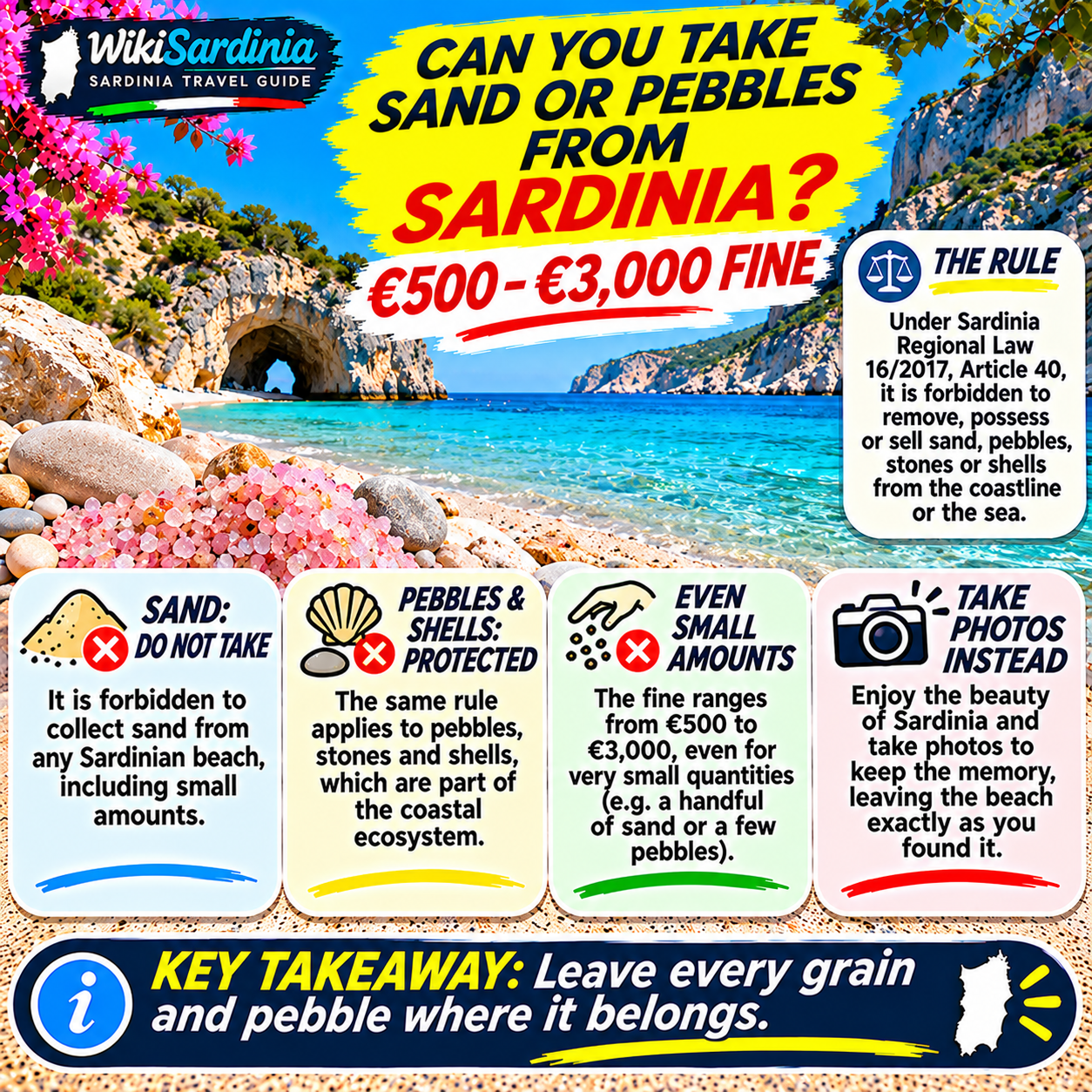
The beaches of Sardinia can be unforgettable: white limestone pebbles along the Gulf of Orosei, clear turquoise water, and the famous pink hues associated with Budelli. It can be tempting to take a handful of sand, a smooth stone or a shell home as a souvenir. But doing so without authorization can result in a serious fine.
Under Sardinia Regional Law No. 16 of 28 July 2017, Article 40(2), the administrative penalty for removing, possessing or selling sand, pebbles, stones or shells from the coast or sea without the required authorization ranges from €500 to €3,000. The rule explicitly covers even small quantities and applies across Sardinia, including beaches in the Gulf of Orosei.
How much is the fine for taking sand or pebbles?
The applicable regional fine is between €500 and €3,000, unless the conduct constitutes a more serious offence. There is no exemption simply because the amount is small or the material seems ordinary. The exact penalty within the legal range depends on the applicable enforcement procedure and circumstances; €3,000 is not automatically charged for every pebble.
The Region of Sardinia reaffirmed the prohibition and fine range in its official public-awareness guidance published on 14 July 2026: Four simple rules to protect the beaches.
Does the rule apply to the Gulf of Orosei?
Yes. The law applies to coastal materials throughout Sardinia. Visitors to the Gulf of Orosei should leave the white stones, pebbles, sand and shells exactly where they found them. A particularly beautiful stone from a cove is not exempt, even if it appears to be loose on the surface. Protected areas may have additional restrictions on access and behavior, so follow local signs and any directions from authorized staff.
What about the famous pink sand?
Sardinia's most famous pink-sand destination is Spiaggia Rosa on Budelli, in the La Maddalena archipelago, not the Gulf of Orosei. Its distinctive coloring is associated with natural fragments within the beach sediment. The area has special environmental protections and access restrictions. Do not assume that visitors can walk onto the pink beach or collect samples. The regional ban on removing coastal materials applies regardless of the sand's color.
Are shells also protected?
Yes. Article 40 explicitly includes sabbia, ciottoli, sassi o conchiglie — sand, pebbles, stones and shells. That means a shell washed onto the shore is not automatically a lawful souvenir. The law also prohibits unauthorized possession or sale of such coastal material. Leave shells and other natural objects in place, where they remain part of the coastal environment.
Can tourists be checked at ports and airports?
Yes. Enforcement is not limited to the moment someone picks up a stone on the beach. Authorities have reported seizures of coastal material at ports and airports. In a 2025 account, the Sardinian Forestry Corps described seizures of pebbles, shells and sand in Olbia and the return of confiscated material to beaches of origin. That is another reason not to pack any coastal material in your luggage or car.
Why is taking just a little sand a problem?
One handful may seem insignificant, but the cumulative effect of many visitors removing beach material can damage sensitive coastal environments. Sand and pebbles form part of the natural beach system, which develops over long periods and can be difficult to replenish. The rule protects the coastline for local communities, wildlife and future visitors.
What should you do instead?
Take photographs, sketch the view, or buy a locally made souvenir that is not collected illegally from the beach. Avoid filling bottles with sand or taking a few stones for decoration. If you discover protected material that someone else has left behind, do not treat it as free to take: ask local authorities how to handle it.
Where can you read the official law?
The legal basis is Regional Law 16/2017, Article 40, paragraph 2. The regional text states that unauthorized removal, possession or sale of even small quantities of coastal sand, stones, pebbles or shells is subject to a €500–€3,000 administrative sanction, unless a more serious violation applies. Read the regional law text and the Region's 2026 guidance.
The WikiSardinia takeaway
Whether you are visiting a famous beach, a remote Gulf of Orosei cove or a quiet stretch of Sardinian coastline, leave the sand, shells and pebbles where they belong. The fine for unauthorized removal or possession can be €500 to €3,000, even for small quantities. The best souvenir is a photograph — and a beach preserved for the next visitor.