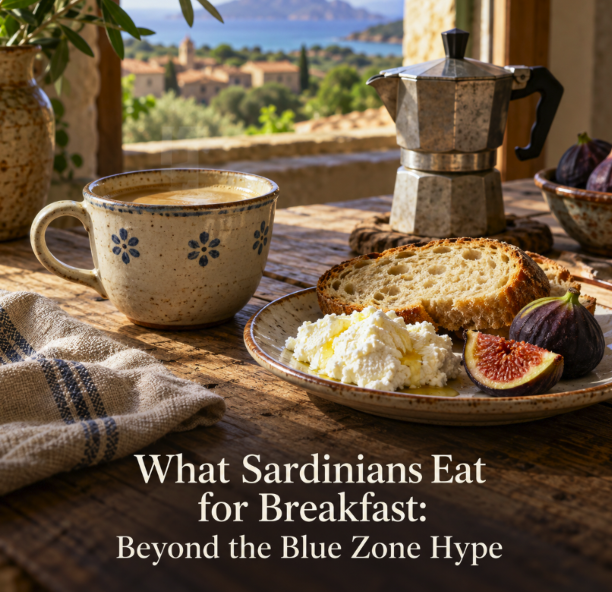
What do Sardinians eat for breakfast, especially those who live to 100? The answer is less theatrical than a longevity video might suggest. Coffee, milk and something small to eat appear in local accounts, with bread and fresh dairy among the possibilities. There is no single documented morning menu shared by Sardinian centenarians, and no breakfast has been shown to explain their exceptional ages. For visitors, the subject is a chance to explore everyday food culture without turning a holiday meal into a health promise.
A small meal with household variations
A first-person account published by Sardinian olive-oil producer Obìa describes coffee, milk or yogurt, bread, biscuits and occasional seasonal fruit. The writer recalls a centenarian grandfather whose breakfast was modest rather than elaborate. Ricotta on bread is another example, while contemporary households may choose packaged biscuits or pastries. This is a family and cultural account from a commercial producer, rather than a representative survey of everyone on the island.
That distinction matters when searching for an authentic breakfast. A memory from one household can be informative without becoming a rule for an entire region. An older person's routine also cannot automatically describe what younger residents eat today. Before calling a dish the breakfast of Sardinia's centenarians, ask whose breakfast it was, where they lived and when the account was recorded.
There are specific regional foods worth exploring. The island's official tourism website describes su casu axedu, a tangy cheese associated with pastoral traditions, as a food also served at breakfast. That makes it a useful culinary lead for a traveler. It does not establish that every long-lived Sardinian ate it each morning, or that ordering it offers a measurable longevity benefit.
What the Blue Zone research actually measured
A 2021 study in Nutrients examined 150 residents aged 90–101 in Sardinia's Longevity Blue Zone. Researchers assessed food-consumption frequencies and reconstructed earlier dietary habits, alongside health and physical-performance indicators. The questionnaire covered foods including bread, pulses, fruit, milk, cheeses, meat, fats, sweets and coffee. It investigated dietary patterns across a lifetime of change; it was not a trial of competing breakfast menus.
Consequently, finding a food in the diets of exceptionally old people does not show that eating it caused them to reach that age. Nor can a record of milk or bread consumption tell us, on its own, which meal included those foods. These are different questions, and a short social-media clip can easily collapse them into a single appealing recipe.
The research also challenges the idea of a timeless menu preserved unchanged for generations. Its focus on nutritional transition recognizes that eating habits evolved. A useful breakfast story should leave room for that history, instead of presenting the island as a place where every family follows the same ancient instructions.
How to explore breakfast during a Sardinian trip
If you want to try a locally inspired morning meal, start with one or two foods that interest you: bread from a bakery, coffee prepared as you prefer it, or fresh ricotta where available. Treat this as a tasting choice rather than a reconstruction of a scientifically validated centenarian diet. You do not need to order every item pictured on an online breakfast table.
Ask your accommodation what is locally made and what its hosts usually eat. A useful question is whether the bread or dairy comes from a nearby producer; another is whether a particular cheese is traditional in that area. Those conversations can reveal more about a place than buying something simply because its label mentions a Blue Zone. Availability will vary, so confirm special breakfast requests with the host.
For anyone filming a longevity-themed breakfast, the strongest caption is specific: describe the food, the producer and the local account behind it. Avoid claiming that a bowl or slice is what all Sardinians eat at 100. The island's mornings are interesting enough without assigning them a guaranteed lifespan.