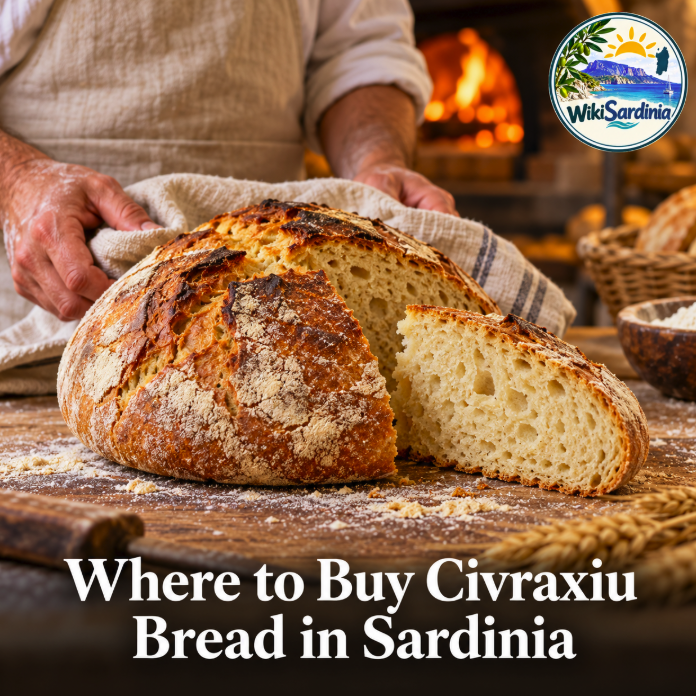
For a substantial loaf of Sardinian civraxiu, Sanluri is a well-documented place to start. The town’s bread tradition is celebrated by its museum, and Italy’s official tourism portal identifies a local bakery that produces it. Finding a warm loaf, however, requires a more precise question than finding a shop that sells bread: when does its next batch come out of the oven?
We have verified a practical starting address, not an island-wide “best bakery” ranking or a guaranteed hot loaf today. Contact the bakery before making a special journey and ask specifically for civraxiu. You may also encounter the spelling civraxu, used by Sanluri’s municipal and museum sources.
Start with Su Forru Sardu in Sanluri
Italia.it lists Panificio Su Forru Sardu at Via Carlo Felice 306, Sanluri, with telephone +39 349 325 2407. The listing explicitly describes production of Sanluri’s typical civraxiu, making it a stronger lead than a generic bakery directory entry.
The portal lists morning opening from Monday to Saturday and closure on Sunday, with an additional Friday evening period. Treat those as published shop hours to confirm, not as oven times. An open bakery may have bread baked earlier, and the listing does not establish which batch will be warm when you arrive.
A simple call can resolve the important details. Ask: “Avete civraxiu oggi? A che ora esce dal forno?”—“Do you have civraxiu today? What time does it come out of the oven?” If you want to reserve a loaf, add “Posso prenotarne uno?”
Confirm the loaf size and price during the same conversation. “Giant bread” is an appealing description for a travel video, but it is not a standard size guarantee. Ask whether the bakery sells whole loaves only or can offer a smaller quantity, especially if you are travelling alone or staying somewhere without a kitchen.
Why Sanluri belongs in the bread itinerary
The Castello di Sanluri museum’s account describes civraxu as a round loaf central to the town’s identity, made using durum-wheat milling products. It also explains the local work on traditional techniques, a production specification and a quality mark. This is a living bread tradition rather than simply an oversized loaf for photographs.
The municipality’s Bread Museum page describes a route through the history of breadmaking, from cultivation to dough preparation, rising and baking. It notes that workshops can be requested for adults and students. A workshop or museum visit is a separate booking, not a service automatically included with a bakery purchase.
If the cultural side interests you, contact the museum about current access and reservations. Pairing the two stops gives the loaf a local context, but keep the bakery’s baking schedule as the anchor if buying it warm is your main goal.
Plan around the batch, not an assumed breakfast hour
Do not assume that arriving as early as possible will always produce the warmest bread. The useful time is the batch time confirmed by the baker. Tell them when you expect to arrive and ask whether a loaf can be held for you. A reservation may help with availability, but it does not necessarily mean the bread will still be hot.
If you are elsewhere in Sardinia, ask a local bakery whether it makes civraxiu on site or receives it from another producer. Both can be legitimate ways to buy it; the answer simply helps you understand where baking times come from. Avoid travelling across the island on the strength of an old photograph or a business name alone.
Once you have bought it, let the baker advise you on carrying and storing the loaf. For a picnic, ask for a suitable quantity and choose accompaniments you can keep appropriately during your journey. You do not need an elaborate meal to appreciate a freshly baked local bread.
Su Forru Sardu is a verified starting point in Sanluri. The final step for a warm civraxiu is a direct conversation about that day’s production, rather than a promise an online guide cannot make.