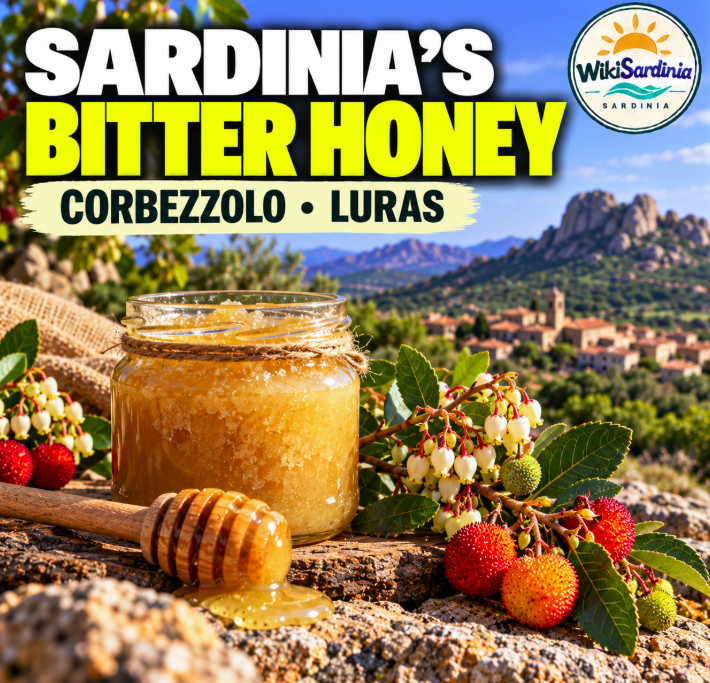
Looking for Sardinia's famous bitter honey? Ask for miele amaro di corbezzolo, made by bees collecting nectar from the strawberry tree (Arbutus unedo). Unlike the mild, sweet honey many visitors know, corbezzolo honey has a distinctive bitter finish and a complex, aromatic flavor. It is one of the island's most memorable food souvenirs.
If you are visiting Luras in Gallura, you are in a region strongly associated with Mediterranean scrubland and artisan beekeeping. But there is an important distinction: being in Luras does not mean that every local shop or beekeeper has corbezzolo honey in stock. We found verified Gallura producers offering this variety, but not a confirmed walk-in producer specifically within Luras village. Contact sellers before making a special trip.
What is Sardinian bitter honey?
Corbezzolo honey is produced when bees forage on the flowers of the strawberry tree, an evergreen Mediterranean shrub. The plant's Italian name is corbezzolo; in English it is commonly called the strawberry tree, although it is not the plant that produces ordinary strawberries.
The honey's flavor is unusual: aromatic, complex and noticeably bitter, especially in the aftertaste. Producers describe notes that may evoke coffee, herbs, licorice or caramel. Individual batches differ with flowering conditions and location.
Why does corbezzolo honey taste bitter?
The bitterness is a natural characteristic associated with honey made from strawberry-tree nectar. It does not mean the product is spoiled or that sugar has been removed. The flavor is part of what makes this honey sought after by people who enjoy assertive, less conventional tastes.
If you have only tried sweet acacia or citrus honey, taste a small amount before buying a large jar. Corbezzolo is deliberately not everyone's favorite.
Why is Gallura a good region to look for it?
Gallura, in northeastern Sardinia, has extensive Mediterranean vegetation, including strawberry trees in suitable habitats. Local producers offer monofloral corbezzolo honey alongside varieties such as lavender, thistle and wildflower.
The area around Luras offers a useful base for exploring inland Gallura, but production depends on where apiaries are situated and where bees forage, not on a town name printed in a travel guide.
Where to buy corbezzolo honey near Luras
1. Apicoltura Pala — verified Gallura producer
Apicoltura Pala lists Miele amaro di corbezzolo in its own online shop. The product description identifies the characteristic aromatic, bitter flavor and its tendency to crystallize. The producer offers different jar sizes; the website lists a variable price depending on format.
This is a verified producer listing, not confirmation of an open retail counter in Luras. Check the company's current collection, delivery or visit arrangements before traveling.
2. Antica Apicoltura Gallurese — corbezzolo from the Gallura area
Antica Apicoltura Gallurese, associated with the Olbia/Berchiddeddu area, has a dedicated product page for bitter corbezzolo honey. The producer describes an autumn flowering period and a naturally crystallized product with a light beige color and aromatic character.
Its website offers online ordering. Verify current availability, packaging, price and whether in-person collection is possible. Do not assume the producer's apiaries are located in Luras.
3. Nurapi — another Gallura beekeeper to check
Apicoltura Nurapi, associated with Telti in Gallura, explicitly lists Miele Amaro di Corbezzolo Monofloreale among its artisan honeys. Contact the producer for current stock and whether direct pickup or a visit can be arranged.
For travelers staying in Luras, these are useful regional options rather than verified walk-in shops in the village itself.
Can you buy bitter honey directly from a beekeeper in Luras?
Possibly, but we could not independently verify a specific Luras-based beekeeper currently selling corbezzolo honey to visitors. Local food shops, markets and tourism contacts may be able to suggest small producers, but always confirm their identity, product origin, stock and opening hours.
Ask in Italian: “Avete miele amaro di corbezzolo prodotto in Sardegna? Posso acquistarlo direttamente dall'apicoltore?” — “Do you have Sardinian bitter strawberry-tree honey? Can I buy it directly from the beekeeper?”
When is corbezzolo honey harvested?
The strawberry tree flowers in autumn and can continue into the cooler months depending on conditions. That makes corbezzolo honey unusual compared with many varieties associated with spring or summer blossoms.
Production can fluctuate because autumn weather affects flowering and bee foraging. Poor conditions can reduce the harvest. Do not assume a new batch is ready on a fixed October date; contact the producer for the season's actual availability.
Why is corbezzolo honey often expensive?
Its distinctive floral source, variable autumn production and limited yields can contribute to higher prices than everyday blended honey. However, prices depend on the producer, jar size and availability; no single price applies across Sardinia.
Compare price per kilogram rather than the jar price alone. A smaller jar is often a good introduction if you are tasting this honey for the first time.
What does genuine corbezzolo honey look like?
Corbezzolo honey may be amber when liquid and lighter beige or brownish as it crystallizes. Natural crystallization is common and is not a sign of poor quality. The exact color and texture vary by batch and storage conditions.
A transparent label should identify the producer, origin, net weight and relevant food information. If the label says only “Mediterranean honey” or “Sardinian honey,” do not automatically assume it is monofloral corbezzolo.
How to recognize an authentic Sardinian product
- Read the origin statement. Look for clear indication of where the honey was produced.
- Check the floral variety. The label should identify corbezzolo if that is what you are buying.
- Identify the producer. A named beekeeper or company makes provenance easier to verify.
- Ask about the harvest. A producer should be able to explain availability and the honey's natural characteristics.
- Do not reject crystallized jars. Crystallization is normal for many authentic honeys.
- Be skeptical of medical promises. Traditional uses do not establish proven treatments for disease.
How to eat Sardinian bitter honey
Start with a small spoonful to appreciate its distinctive taste. Try it with aged or fresh Sardinian cheeses, where the bitterness can contrast with rich or salty flavors. It can also be interesting on plain yogurt or as a tiny accent in a dessert.
Because the flavor is strong, begin with less than you would use of a mild honey. It is particularly interesting in tastings that compare several Sardinian honey varieties side by side.
Is corbezzolo honey the same as abbamele?
No. Abbamele is a traditional Sardinian honey-derived preparation with its own processing methods and flavor. It is not simply another name for monofloral strawberry-tree honey. Some Sardinian producers sell both, so check the label carefully.
Can you take a jar of honey home on a plane?
Honey is generally treated as a liquid or gel for airport security purposes. Standard carry-on liquid limits can therefore apply, while larger jars may need to travel in checked baggage. Check the departure airport, transit rules and airline policies.
International travelers should also check destination-country food and agricultural import requirements. For the United States, declare food and agricultural products on arrival and follow U.S. customs and agricultural inspection rules. Keep the original label and receipt.
Does bitter honey have health benefits?
Corbezzolo honey has a history of traditional use, but claims that it cures coughs, treats infections or improves sleep should not be presented as established medical facts. It remains a sugar-rich food and should be enjoyed as part of a balanced diet.
Never give honey to children under 12 months old because of the risk of infant botulism.
What else should you see around Luras?
Luras is an appealing inland Gallura destination for travelers interested in village life, local food and the region's granite landscapes. A honey-shopping trip can be part of a broader excursion rather than the sole reason to drive inland.
Because beekeeper visits may require appointments, confirm arrangements before leaving your accommodation.
FAQ
Where can I buy bitter Sardinian honey near Luras?
Verified Gallura producers listing corbezzolo honey include Apicoltura Pala, Antica Apicoltura Gallurese and Nurapi. We did not verify a specific walk-in shop in Luras itself.
What is bitter honey called in Italian?
Ask for miele amaro di corbezzolo or miele di corbezzolo.
Why is Sardinian corbezzolo honey bitter?
Its distinctive bitter finish is a natural feature associated with strawberry-tree nectar.
Is corbezzolo honey made in autumn?
Yes. Strawberry-tree flowering occurs in autumn and into cooler months, although harvest timing and quantity depend on the weather.
Why does the honey look crystallized?
Natural crystallization is common for corbezzolo honey and does not mean it has spoiled.
Is it safe for children?
Honey must never be given to infants under 12 months. For older children and adults, it is a sweet food that should be consumed in moderation.
Is it the same as abbamele?
No. Abbamele is a separate traditional Sardinian honey-based specialty.
Can I visit an apiary near Luras?
Some producers may arrange visits, but do not assume an apiary is open to the public. Contact the beekeeper first.
The bottom line
For a distinctive taste of Sardinia, corbezzolo honey is worth seeking out. Luras puts you in the heart of Gallura, a promising region for artisan honey, while verified regional producers provide practical places to start your search. Choose a clearly labeled Sardinian product, confirm stock before traveling and embrace the bitter flavor—it is exactly what makes this honey special.
Producer sources
Apicoltura Pala — Miele amaro di corbezzolo; Antica Apicoltura Gallurese — Bitter Strawberry-Tree Honey; Nurapi — Gallura Artisan Honey. Product listings and availability may change after publication.