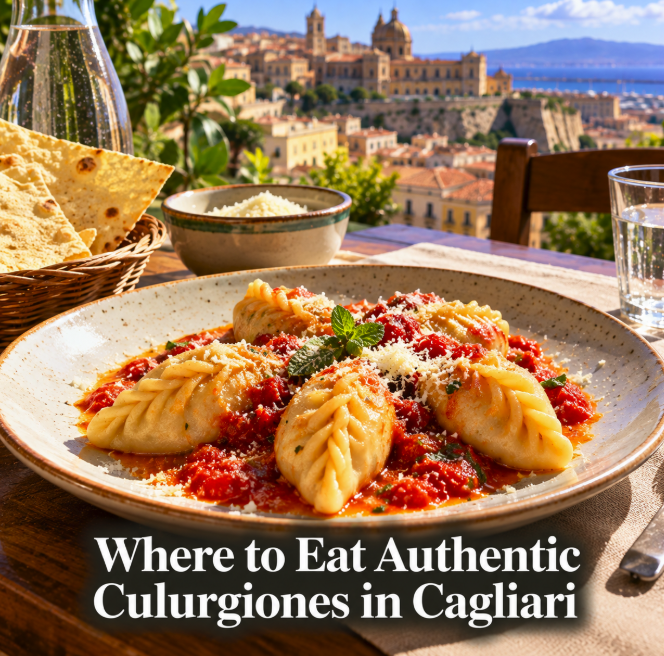
Culurgiones may come from Ogliastra rather than Cagliari, but Sardinia’s capital is an excellent place to try them without crossing the island. The traditional version is immediately recognizable by its carefully pinched, wheat-ear-shaped closure and a filling built around potatoes, cheese and mint. Several Cagliari restaurants currently list handmade or explicitly Ogliastra-style culurgiones, making it possible to compare the classic tomato-and-cheese presentation with butter-and-sage versions and more modern interpretations.
For travelers looking for authenticity, the most useful clue is not simply seeing the word culurgiones on a menu. Look for references to Ogliastra, handmade pasta, potato and mint, and a simple sauce that allows the filling to remain central. Menus change, so it is always worth checking the restaurant’s current offering when booking.
La Scala: handmade potato and mint culurgiones
La Scala is one of the clearest current choices because its own menu explicitly lists traditional handmade culurgiones with potato and mint. The dish is presented alla contadina, keeping the focus on the ingredients associated with the traditional Sardinian pasta rather than turning it into a heavily reworked restaurant dish.
The current menu also includes other Sardinian ingredients and dishes, including local pecorino, Sardinian beef, Cannonau and suckling pig available by reservation. That makes La Scala useful for visitors who want culurgiones as part of a broader introduction to the island’s cooking rather than as an isolated pasta course.
At the time of this guide, the handmade culurgiones are listed at €14. Prices and dishes can change, so confirm the current menu before visiting.
Ristorante 51: an explicitly Ogliastra-style option
Ristorante 51 currently offers two versions. The most relevant for a traditional-food search is culurgiones all’ogliastrina, described as handmade. The restaurant also lists a more contemporary potato-and-truffle version served with Parmesan fondue.
If your goal is to understand the classic dish, choose the Ogliastra-style preparation first. The truffle version can be interesting, but it is better treated as a restaurant variation rather than the reference point for learning what traditional culurgiones taste like.
The current menu lists the Ogliastra-style handmade culurgiones at €13 and the potato-and-truffle version at €16.
Ruja Osteria e Tradizioni: two classic sauces
Ruja Osteria e Tradizioni is particularly useful for comparing how the same filled pasta can be served. Its current menu lists Ogliastra culurgiones with fresh tomato sauce and pecorino, as well as a version with butter and sage.
For a first plate, tomato and pecorino is an excellent choice because the acidity of the tomato and the salty cheese work naturally with the potato filling. Butter and sage is gentler and places more attention on the pasta itself.
The menu also includes familiar Sardinian dishes such as malloreddus alla campidanese, fregula with seafood and roast suckling pig, reinforcing its focus on regional cooking. Both culurgiones preparations are currently listed at €16.
Other Sardinian restaurants worth checking
Cagliari has many restaurants specializing in Sardinian cuisine, but not every traditional restaurant serves culurgiones every day. Some change filled pasta according to season, while others offer them as part of mixed tastings or specials rather than a permanent first course.
Sa Domu de Peppinedda, for example, currently identifies its cuisine as Sardinian and includes culurgiones within one of its land-based antipasto selections. That can be useful if you want to taste several regional foods rather than order a full plate of the pasta.
Well-established Sardinian restaurants elsewhere in central Cagliari are also worth asking about when making a reservation. A current menu matters more than an old review: a restaurant praised for culurgiones two years ago may have changed its seasonal dishes.
What makes a culurgione traditional?
The best-known culurgiones are associated with Ogliastra in eastern Sardinia. Their defining visual feature is sa spighitta, the hand-pinched closure resembling an ear of wheat. It requires practice and is one reason handmade culurgiones have such a distinctive appearance.
The filling traditionally revolves around potatoes and cheese, with mint providing the characteristic fresh aroma. Recipes vary between Ogliastra communities and families, including differences in cheese, garlic, onion and seasoning. That variation is part of the tradition, so there is no reason to reject a plate simply because it differs slightly from another version you have tried.
The pasta should hold its shape without becoming thick and heavy. Once cut open, the filling should remain soft, savory and aromatic rather than tasting like plain mashed potato.
Tomato sauce or butter and sage?
Both styles appear on Cagliari menus. Tomato sauce with grated pecorino is one of the most recognizable presentations and makes a good first introduction. A restrained tomato sauce complements the potato and mint rather than overwhelming them.
Butter and sage is common in restaurants and gives a more delicate result. It can make it easier to notice the cheese and mint in the filling. Contemporary kitchens may add truffle, fondue or other ingredients, but these should be understood as variations rather than evidence that the traditional version needs embellishment.
If a restaurant offers both a classic and creative version, order the classic one first if authenticity is your priority.
How to order culurgiones in Cagliari
Culurgiones are normally ordered as a primo, the pasta course. You do not need to order antipasto, first course, second course and dessert unless you actually want a long meal. A plate of culurgiones followed by a vegetable side or dessert can be plenty for lunch.
If you want to confirm that they are made in-house, ask “I culurgiones sono fatti a mano?” If you are specifically seeking the traditional style, ask whether they are all’ogliastrina and what filling is used.
Vegetarians should still ask about ingredients rather than assuming every potato-filled pasta is automatically suitable. Cheese is standard, and sauces or kitchen preparations can vary.
What to drink with them
A local Sardinian wine makes an easy pairing. With tomato and pecorino, a not-too-heavy red can work well; with butter and sage, a fresh white can keep the meal lighter. Rather than ordering solely by grape name, ask the restaurant for a Sardinian glass that suits its particular sauce.
If you want to continue exploring local pasta after culurgiones, try malloreddus alla campidanese on another meal. That dish is closely associated with southern Sardinia and gives a useful contrast: small durum-wheat pasta with a rich Campidanese sauce rather than filled pasta from Ogliastra.
Cagliari or Ogliastra?
Cagliari is convenient for travelers who want to taste culurgiones while exploring the capital, but the pasta’s cultural home is Ogliastra. If your itinerary later takes you toward Tortolì, Lanusei, Baunei or the surrounding eastern interior, trying another plate there is worthwhile because local family and village recipes can differ.
You do not need to leave Cagliari, however, to find a credible version. Current menus at La Scala, Ristorante 51 and Ruja Osteria e Tradizioni all provide clear evidence of handmade or explicitly Ogliastra-style culurgiones. The simplest strategy is to choose a restaurant that states what it is serving, order the least elaborate version on your first visit and pay attention to the potato, cheese, mint and distinctive braided closure that make this one of Sardinia’s most recognizable traditional foods.