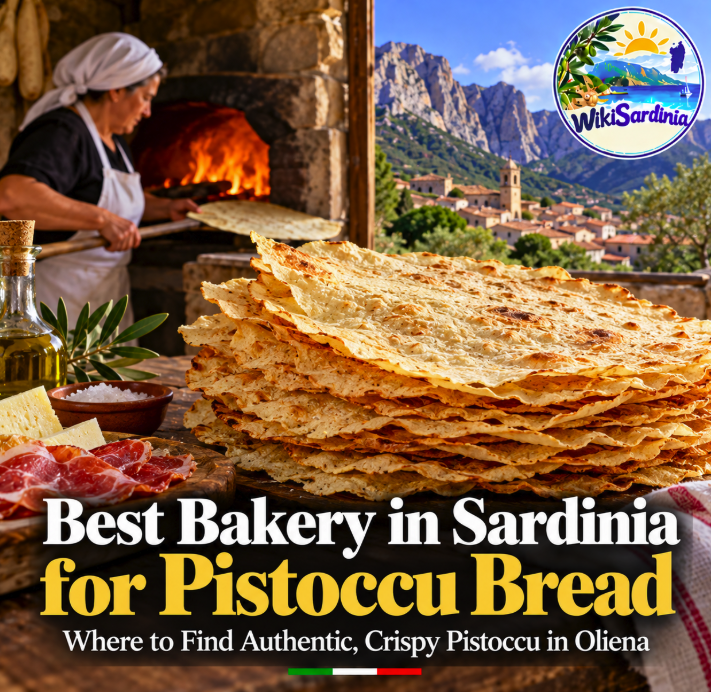
If you are travelling through inland Sardinia and find a stack of thin, dry, golden bread in a bakery or food shop, do not mistake it for an oversized cracker. You may be looking at pistoccu, one of the island's traditional long-lasting breads.
For travellers staying around Oliena and Barbagia, it is exactly the kind of local food worth seeking out: crisp when eaten dry, surprisingly versatile when softened with water, and made for the cheeses, olive oil, tomatoes and cured meats of Sardinia.
What is pistoccu?
Pistoccu belongs to Sardinia's family of traditional twice-baked breads. The dough is rolled into thin sheets, baked, separated and dried again so that the finished bread contains very little moisture.
That second drying is the secret to its characteristic crunch and long shelf life.
Historically, breads like this were practical food. Shepherds and rural families needed something that could be stored and carried for long periods without quickly spoiling.
Is pistoccu the same as pane carasau?
No, although visitors understandably confuse them.
Both are dry Sardinian breads designed to keep well, and both can be eaten crisp or softened. But pistoccu is its own traditional product, with variations in thickness, flour and preparation depending on the area and producer.
Rather than obsessing over which one is “more authentic,” try both. The differences become much easier to understand once they are on the table.
Why look for it around Oliena?
Oliena sits at the foot of Monte Corrasi in the heart of Barbagia, an area where bread, cheese, wine and pastoral traditions remain central to everyday food culture.
That makes the town and the surrounding Nuoro area an excellent place to shop for traditional Sardinian breads, whether directly from a bakery, a specialist food producer or a local alimentari.
However, we would not name one bakery as the definitive “best” without current evidence that it specifically produces pistoccu. In Sardinia, a small bakery's daily production can change, and the bread you want may not be available every morning.
How to ask for it
Walk into a bakery and simply ask: “Avete il pistoccu?” — “Do you have pistoccu?”
If they do not make it themselves, ask where locals buy it. That question is often more useful than relying on a generic online ranking.
Food shops carrying regional products are another good option, especially if you want a sealed package to take home.
How should pistoccu taste?
Dry pistoccu should be crisp, toasted and relatively neutral rather than heavily seasoned.
That restraint is intentional. It is a bread designed to accompany other foods rather than overpower them.
Try a piece on its own first. Then add good Sardinian extra-virgin olive oil and a little salt.
Eat it with pecorino
One of the simplest combinations is also one of the best: pistoccu with pecorino sardo.
A younger cheese gives you a softer, milder contrast; a mature pecorino adds saltiness and intensity against the dry bread.
Add local cured meat, olives and a glass of red wine and you have something much closer to a Sardinian table than a complicated restaurant dish.
You can soften pistoccu too
The fact that pistoccu is sold dry does not mean Sardinians always eat it like a cracker.
It can be briefly moistened with water to make it flexible again, then dressed with ingredients such as tomatoes, olive oil, cheese or whatever the household has available.
The key word is briefly. Soaking it for too long destroys the texture.
Why this bread travels so well
Pistoccu is one of the easiest Sardinian foods to bring home because dryness is part of the product rather than a sign that it is stale.
Keep it protected from humidity and it can remain crisp for a long time.
That makes a package from a local producer a much easier souvenir than fresh cheese or pastries if you still have several days of travelling ahead.
Oliena gives you more than bread
A pistoccu stop is a good excuse to explore Oliena itself.
The town is closely associated with Nepente di Oliena, the local Cannonau wine, and sits beside the dramatic limestone landscape of Monte Corrasi and Supramonte.
It is also an excellent base for discovering the food culture of inland Sardinia, where bread still makes most sense alongside local wine, olive oil, cheese and meat rather than as an isolated speciality.
What to buy
If you find artisanal pistoccu, look for a short ingredient list and bread that is dry and crisp without tasting burnt.
Different producers may use different combinations of wheat flour and semolina, so do not expect every package to look identical.
If you are comparing several local versions, buy the smallest package of each. This is a much more interesting souvenir than trying to decide from the label which one is theoretically best.
WikiSardinia verdict
For “Sardinia best bakery for pistoccu bread”, our advice is to use Oliena as the starting point, not a single unverified bakery name.
Ask local bakeries and food shops for pistoccu, choose an artisanal version when available and take it back to your accommodation with pecorino, olive oil and tomatoes.
Eat the first piece dry and crunchy. Then soften the next one.
That little transformation is the best explanation of why this humble Sardinian bread has survived for generations.