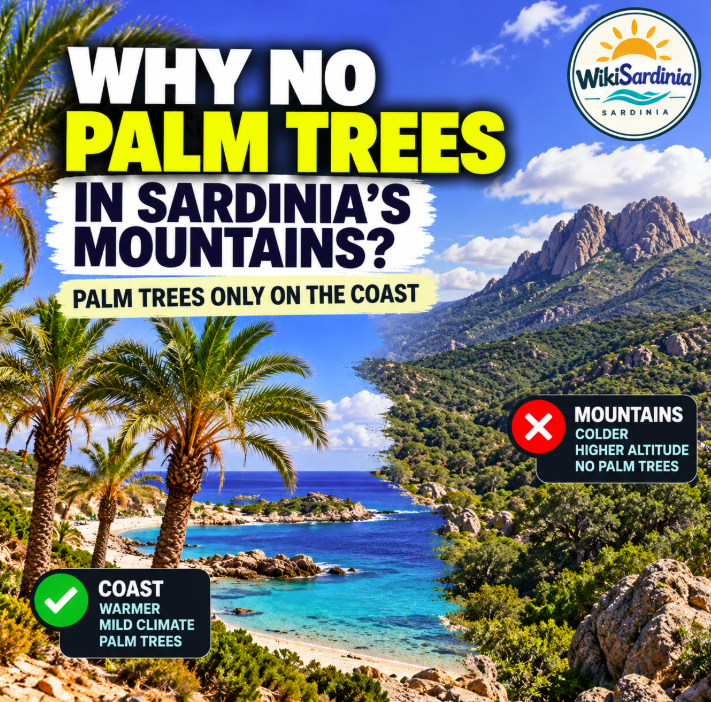
Travel around Sardinia and you may notice a striking contrast: palm trees appear beside seaside promenades, hotels and coastal gardens, while the island's mountains are dominated by oaks, shrubs, rocky slopes and other Mediterranean vegetation. Why does the scenery change so dramatically?
The short answer is that coastal areas generally have milder winters, while higher elevations are colder and often more exposed to frost. But there is another important reason: many of the palms visitors see in Sardinian towns were planted as ornamental trees. Their distribution reflects landscaping and settlement patterns as well as climate.
It would be inaccurate to say that palms can grow only on Sardinia's coast or that there are absolutely no palms inland. Species, microclimate and human cultivation all matter.
Why palm trees are so visible on Sardinia's coast
Sardinia's coastal settlements often have comparatively mild winter temperatures thanks to the moderating influence of the Mediterranean Sea. This makes many seaside locations suitable for ornamental palms, especially in sheltered gardens and urban spaces.
Palms are also popular in the visual identity of beach resorts, promenades and hotels. When you see rows of palms beside a marina, they may reflect decades of deliberate planting rather than a naturally occurring palm forest.
What changes when you travel into the mountains?
As elevation increases, average temperatures generally decrease. Inland valleys and mountain slopes can experience colder winter nights, frost and, at higher elevations, occasional snow. Conditions also vary with exposure, wind, slope orientation and distance from the sea.
Many commonly planted ornamental palm species prefer relatively mild conditions. Some tolerate cold better than others, so altitude alone is not an absolute barrier. Nevertheless, colder and more variable mountain climates make palms less characteristic of the landscape.
Are palm trees native to Sardinia?
Not all palms seen in Sardinia have the same origin. Many tall date-like palms lining roads and hotel gardens are cultivated ornamentals introduced or widely planted for landscaping.
However, the Mediterranean dwarf palm (Chamaerops humilis) is a native Mediterranean palm found in parts of Sardinia. It is typically a much shorter, shrubbier plant than the tall palms tourists associate with tropical resorts. This is an important exception to the idea that all Sardinian palms are imported or confined to coastal towns.
Its distribution depends on habitat and local conditions; visitors should not expect it everywhere on the island.
What trees grow in Sardinia's mountains instead?
Mountain and inland landscapes support plant communities adapted to their soils, rainfall, temperatures and historical land use. Depending on the location and elevation, visitors may encounter holm oak (Quercus ilex), cork oak (Quercus suber), deciduous oaks, Mediterranean scrub and other woodland species.
In the Gennargentu and other upland areas, the landscape can look very different from the palm-lined streets of coastal resorts. That contrast is part of Sardinia's ecological diversity.
Coast versus mountains: the main differences
| Factor | Coastal areas | Mountain areas |
|---|---|---|
| Winter conditions | Often milder because of the sea | Generally colder, with greater frost exposure at elevation |
| Common scenery | Beaches, maquis, towns, landscaped promenades | Woodlands, rocky slopes, shrubs and upland habitats |
| Visible tall palms | Frequently planted in resorts and towns | Much less common as landscape features |
| Human influence | Extensive ornamental planting in many settlements | Land use often emphasizes woodland, grazing and agriculture |
These are broad patterns rather than rigid rules. Sheltered inland gardens may support some palms, and not every coastal location is warm enough for every palm species.
Is the sea really that important?
Yes. Water heats and cools more slowly than land, which helps moderate temperatures near the coastline. Inland areas, especially at altitude, often experience a wider range between daytime and nighttime temperatures and more pronounced cold spells.
This does not make Sardinia's coast tropical. The island has a Mediterranean climate, and coastal conditions can still include strong winds, winter storms and occasional cold events.
Can palm trees survive frost?
Some palm species are relatively cold-tolerant and can survive temperatures below freezing under suitable conditions. Others are much more sensitive to frost. Survival depends on the species, the duration of cold weather, soil drainage, wind and the age and health of the plant.
Therefore, the statement 'palm trees cannot grow in Sardinia's mountains' is too absolute. The more accurate observation is that palms are less naturally characteristic and less commonly planted in colder upland environments.
Why don't Sardinia's mountains look tropical?
Palms are often used in travel imagery as shorthand for tropical destinations, but Sardinia is not a tropical island. Its native ecosystems developed under Mediterranean conditions, with hot dry summers and wetter, cooler winters, plus strong differences between the coast and the highlands.
Mountain vegetation reflects those seasonal patterns. Oak forests and hardy shrubs are much better visual indicators of the island's natural interior than rows of resort palms.
Where can travelers see the contrast?
A trip that begins on the coast and continues toward inland highlands reveals the change in vegetation. Coastal towns such as Alghero or Cagliari feature landscaped streets and gardens where ornamental palms may be visible. Inland routes toward the Gennargentu region show increasingly rugged terrain, woodland and upland vegetation.
Look closely at the difference between planted urban trees and natural vegetation. A palm in a hotel garden tells you as much about landscape design as it does about local ecology.
What about palm trees in inland towns?
You may find palms in inland courtyards, sheltered village squares and private gardens. This does not contradict the coastal pattern. People can cultivate suitable species outside their most typical landscape setting, especially in protected microclimates.
The fact that a palm survives in one inland garden does not mean it would naturally form a large wild population on a nearby mountain slope.
Do palm trees face other problems in Sardinia?
Like palms elsewhere in the Mediterranean, ornamental specimens can be affected by pests, including the red palm weevil, and by disease, drought stress or poor maintenance. These pressures can influence urban palm populations, although they do not explain the fundamental contrast between coast and mountains.
FAQ
Why are there fewer palm trees in Sardinia's mountains?
Higher elevations generally have colder winters and greater frost exposure, while many visible coastal palms were planted for ornamental purposes.
Are palm trees found only on Sardinia's coast?
No. Some species can grow inland, particularly in suitable sheltered sites, and native Mediterranean dwarf palms occur in parts of the island.
Are all palm trees in Sardinia imported?
No. The Mediterranean dwarf palm is native to the Mediterranean region and occurs in Sardinia, although many tall urban palms are ornamental plantings.
Does Sardinia have tropical forests?
No. Its landscapes are predominantly Mediterranean, with vegetation that varies by altitude, rainfall and local habitat.
Can palm trees grow in the Gennargentu mountains?
Some cold-tolerant palms might survive in particular cultivated microclimates, but palms are not a defining feature of the natural high-mountain vegetation.
Why are palms common outside hotels?
They are often deliberately planted for landscaping and visual appeal in milder coastal settings.
The bottom line
Sardinia's palms are not strictly limited to the coast, but the coast is where visitors are most likely to see tall ornamental palms. The sea's moderating influence, colder mountain winters and different patterns of planting help explain the contrast. The island's mountains are not missing something they should naturally have: their oak woods, scrublands and rocky habitats are an essential part of Sardinia's character.