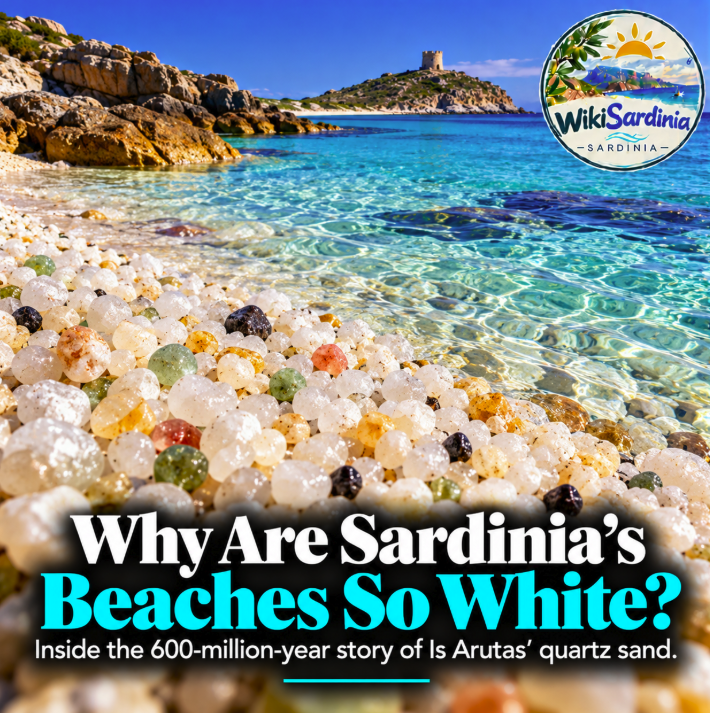
At first glance, Is Arutas looks as though someone has covered the shoreline with millions of tiny grains of polished white glass.
Look closer and the beach becomes even stranger. The grains are not all white. There are translucent crystals, pale green pieces, pinks, yellows and darker fragments mixed together.
This is not ordinary Mediterranean sand. It is predominantly quartz, and the official Sinis Marine Protected Area traces its geological story back around 600 million years.
Why is Is Arutas beach so white?
The short answer is quartz.
Quartz is a light-coloured, resistant mineral. At Is Arutas, huge quantities of rounded quartz grains create a beach that reflects sunlight very differently from ordinary darker mineral sand.
From a distance the overall effect is brilliant white. Up close, however, the beach is surprisingly colourful.
The grains are not really all white
The official Area Marina Protetta Penisola del Sinis – Isola di Mal di Ventre describes the quartz grains of the Sinis beaches as appearing in multiple shades including white, green, yellow, pink and black.
That mixture is one reason Is Arutas can seem to change colour depending on sunlight, moisture and viewing angle.
A 600-million-year story
According to the Marine Protected Area, the story begins roughly 600 million years ago with geological processes that produced the granite associated with today's Mal di Ventre island.
Mal di Ventre is the exposed summit of a granitic formation that once formed part of the ancient western margin of Sardinia.
Over immense periods of time, weathering and erosion broke those rocks down.
Why did the quartz survive?
Granite contains several minerals, but they do not all resist weathering equally well.
Quartz is exceptionally durable. As less resistant components break down or alter, quartz grains can survive repeated cycles of erosion, transport and reworking.
Wave action then rounds and sorts the material over time.
The result is the extraordinary concentration of smooth quartz grains visible on the Sinis coast today.
Is Arutas is not made of tiny seashells
The bright colour sometimes leads visitors to assume the beach consists mainly of crushed shells or coral.
It does not.
The defining material here is mineral quartz derived from ancient rock. That geological origin is what separates Is Arutas from many tropical-looking beaches whose pale colour comes primarily from biological carbonate material.
Why are the grains so round?
Pick one up to inspect it while you are on the beach — and then put it back — and you will notice that many grains are unusually smooth and rounded.
That shape records a long history of physical reworking. Water movement repeatedly rolls, collides and abrades mineral fragments, gradually softening sharp edges.
The famous “grains of rice” appearance is therefore a product of both mineral composition and erosion.
Is Is Arutas the only quartz beach in Sardinia?
No.
The Sinis Peninsula has a group of remarkable quartz beaches. The Marine Protected Area also identifies Mari Ermi and Maimoni for their extremely pale quartz-rich shorelines.
Is Arutas is simply the most famous member of the family.
Why here and not everywhere in Sardinia?
Sardinia's beaches are made from whatever geological and biological material is available locally and whatever currents, waves and coastal processes deliver and retain.
Different parts of the island therefore produce very different shorelines: fine pale sand, golden sand, granite-derived material, pebbles, shells and quartz-rich grains.
The Sinis has the right combination of ancient source rock, erosion history and coastal dynamics to create its distinctive quartz deposits.
Does quartz make the water look bluer?
Indirectly, yes.
The clear water over a very bright seabed reflects and scatters light in ways that intensify the visual contrast between the pale shore and blue-green sea.
That is why Is Arutas can look almost tropical in photographs even though you are on Sardinia's rugged west coast.
The sea is not always gentle
Do not let the tropical colours fool you.
The Sinis faces the open western Mediterranean and can receive wind and substantial waves.
The Marine Protected Area describes the Is Arutas seabed as a mixture of sandy and rocky sections. Always judge swimming conditions when you arrive rather than assuming transparent water means calm water.
Can you take a quartz grain home?
No.
The Marine Protected Area explicitly asks visitors to leave the quartz sand on the beach and prohibits the removal of sand and rocks from within the protected area.
Sardinia also has broader regional rules protecting sand, pebbles, stones and shells from unauthorized removal.
The fact that an individual quartz grain looks like a tiny souvenir is precisely the problem: if every visitor takes a few, the beach is gradually carried away in pockets and bottles.
Even the grains stuck to you matter
The Marine Protected Area asks visitors to remove traces of sand and natural material from their belongings before leaving.
Shake towels, shoes and beach bags at the beach instead of taking the quartz away accidentally.
It is a tiny action, but Is Arutas is made of tiny grains.
Why protecting the dunes and paths matters too
The Sinis authorities ask visitors to use designated walkways and paths rather than creating shortcuts through natural coastal areas.
A beach is not only the strip where the waves break. Dunes, vegetation, cliffs, wetlands and seabed are parts of the same coastal system.
Is the quartz really 600 million years old?
This needs careful wording.
The Marine Protected Area dates the beginning of the geological story to around 600 million years ago, when the ancient granitic rocks associated with Mal di Ventre originated.
That does not mean the modern beach has been sitting unchanged in its present shape for 600 million years.
The beach is the much later result of erosion, transport, sea-level changes and continuing coastal processes acting on extremely ancient geological material.
The coastline itself has changed dramatically
The Marine Protected Area notes evidence of ancient submerged shorelines offshore from the Sinis Peninsula, associated with pauses during sea-level rise beginning around 18,000 years ago.
So even though the source minerals are ancient, the coastline we see today belongs to a landscape that has repeatedly changed.
Is Arutas under a magnifying glass
If you want to understand the beach, forget the panorama for a minute and look down.
One handful-sized patch can contain translucent white grains beside green, amber, pink and black ones.
Do not collect them. Photograph them where they are.
A macro photo often explains Is Arutas better than another wide-angle shot of turquoise water.
WikiSardinia's explanation
Is Arutas is white because its beach is dominated by extraordinarily resistant quartz grains produced from ancient granitic rocks and concentrated by a very long history of erosion and coastal reworking.
The source geology goes back roughly 600 million years; the modern beach itself is the product of much younger and continuing coastal processes.
And those grains are not simply white. Look closely and Is Arutas becomes a mosaic of white, green, yellow, pink and black.
That is why the best souvenir from Sardinia's most famous quartz beach is a close-up photograph — with every single grain left exactly where geological history put it.