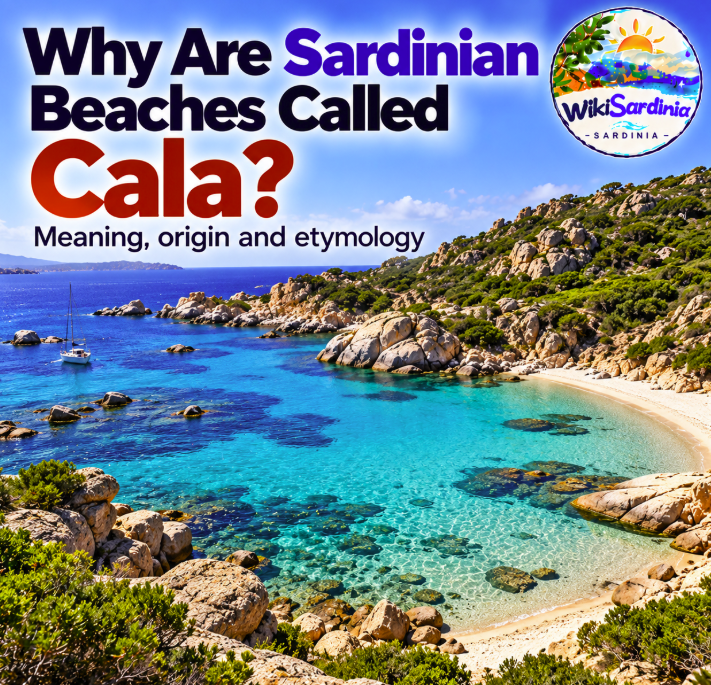
From Cala Luna and Cala Mariolu to Cala Goloritzé and Cala Gonone, the word cala appears again and again on Sardinia's coastline. Visitors often assume it simply means 'beach'. The real answer is more interesting: a cala is a small inlet, cove or sheltered indentation in the coast, which may contain a beach but does not have to.
Understanding the word helps explain Sardinian place names—and why some of the island's most famous stretches of water are framed by steep cliffs, rocky headlands or narrow openings rather than broad sandy shores.
What does 'cala' mean in Italian?
In standard Italian, cala is a geographical term for a small bay or inlet, often offering some protection from the open sea. The word can refer to a rocky cove, a tiny beach tucked between cliffs or a narrow indentation used historically as a landing place. It is not a synonym for every kind of beach.
Compare these useful terms:
| Word | Meaning | Typical image |
|---|---|---|
| Cala | Small cove or inlet | A pocket of coast between rocks or headlands |
| Spiaggia | Beach | Sand, pebbles or shingle beside the sea |
| Baia | Bay | A broader indentation in the shoreline |
| Golfo | Gulf | A large coastal inlet, often spanning many kilometres |
A cala can contain a spiaggia, but the two words describe different things: one is the shape of the coastline, the other is the shore itself.
Where does the word 'cala' come from?
The modern geographical meaning is clear, but the word's deeper etymology is not universally settled in every reference tradition. Italian etymological discussions connect cala with older Mediterranean nautical and coastal vocabulary; some explanations relate it to verbs meaning to lower or descend, while others discuss regional or pre-Latin possibilities. It would be misleading to present one proposed ancient root as an uncontested fact.
For travelers, the important point is that cala is a longstanding coastal term used across the Italian-speaking Mediterranean, not a word invented exclusively for Sardinia's tourist beaches. Its use in local place names reflects generations of navigation, fishing and familiarity with the coast.
Is 'cala' a Sardinian word?
The word is also encountered in Sardinian coastal naming, but it is not exclusive to the Sardinian language. You will see cala elsewhere in Italy and in other Mediterranean naming traditions. Sardinia's multilingual history—including local Sardinian varieties, Catalan influence around Alghero and later Italian administrative naming—means that place names may preserve layers of language and local usage.
It is therefore safer to examine the complete name of each cove than to assume that every 'Cala + name' combination has a single linguistic origin.
Why are there so many calas in Sardinia?
Sardinia has a highly varied coastline. Rocky headlands, granite formations, limestone cliffs and small inlets create countless pockets of sheltered or semi-sheltered shore. Many became landmarks for fishers, sailors, shepherds and coastal communities long before modern beach tourism. A compact name beginning with cala helped identify a recognizable point on the coast.
Not every cala is calm, however. Shelter depends on wind direction, swell and the opening of the inlet. A cove protected from one wind may be exposed to another.
Famous Sardinian calas and what their names tell us
Cala Luna
On the Gulf of Orosei, Cala Luna is known for its dramatic limestone setting, pale shore and caves. Luna means 'moon' in Italian, but the precise historical origin of the place name should not be reduced to a romantic story without local documentary support.
Cala Mariolu
Another celebrated Gulf of Orosei cove, Cala Mariolu has a name associated in local storytelling with a 'thief' and accounts involving monk seals taking fish from nets. Such explanations are part of popular local lore; individual versions vary, and they should be presented as stories rather than indisputable etymological proof.
Cala Goloritzé
Famous for its dramatic rock formations and exceptionally clear water, Cala Goloritzé illustrates how cala identifies the coastal setting while the second part of the name preserves a distinct local toponym. Do not assume every second element translates neatly into standard Italian.
Cala Gonone
Cala Gonone is a coastal settlement in the municipality of Dorgali, rather than merely the name of a small beach. This is a useful reminder that place names can outgrow their original geographical reference and become names for villages, ports and tourist destinations.
Cala Brandinchi
Near San Teodoro, Cala Brandinchi is renowned for shallow, bright water and pale sand. The name shows how a cala can also describe a beach that looks broader and more open than the narrow rocky coves of the Gulf of Orosei.
Does 'cala' mean the beach is sheltered from the wind?
Not necessarily. The term describes the shape of the coast, not a guarantee of calm water. A cove may offer protection when the wind blows from behind surrounding land, but waves can still enter from the open side. If you are choosing a beach during the Maestrale (Mistral), check its orientation, wave conditions and local safety information rather than relying on the word cala.
How to read other Sardinian coastal place names
You will also encounter words such as porto (harbor), punta (point or headland), capo (cape), isola (island) and spiaggia (beach). These terms are useful clues when planning a trip, although the actual landscape may be more complex than a map label suggests.
FAQ
Does 'cala' mean beach in English?
Not exactly. 'Cove' or 'small inlet' is usually a closer translation. A cala may include a beach.
Why does Sardinia have so many beaches beginning with Cala?
Its irregular coastline contains many small inlets, and the word has long been used in Mediterranean coastal place names.
Is Cala a uniquely Sardinian word?
No. The term occurs beyond Sardinia, including other parts of Italy and the Mediterranean.
Are all calas safe for swimming?
No. Currents, waves, rocky access and wind exposure vary. Always check local conditions and restrictions.
Does Cala Gonone mean it is just one beach?
No. Cala Gonone is also the name of a coastal town and port area near Dorgali.
WikiSardinia's takeaway
The next time you see a Sardinian beach name beginning with Cala, picture a small opening in the coastline rather than simply a patch of sand. The word tells you something about geography, while the rest of the name may preserve a local legend, a historical use or an older linguistic layer. That makes Sardinia's beach names part of the island's cultural landscape—not just labels on a map.