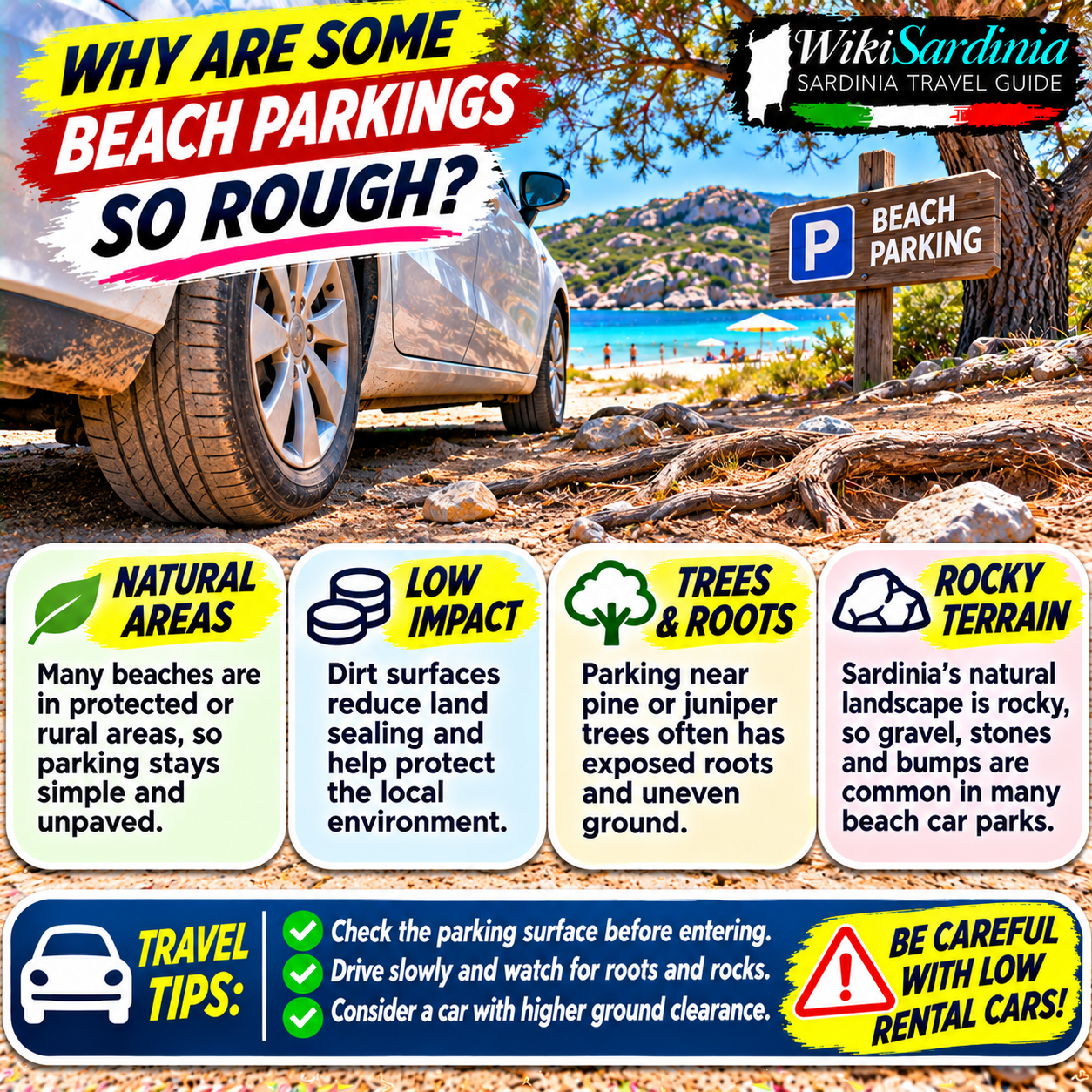
Some beach car parks in Sardinia are unpaved because they occupy rural land or sensitive coastal landscapes, but that does not mean every rough parking surface was deliberately designed for environmental protection. Some are informal or minimally maintained areas. Exposed roots, stones, ruts and sudden changes in ground level can damage low-clearance rental cars, even when the beach itself is easy to reach.
Why are some Sardinian beach parking areas unpaved?
Many beaches border dunes, Mediterranean scrub, pine groves or rocky countryside. Building a conventional paved car park may require excavation, drainage works and changes to the natural terrain. Environmental and planning restrictions can limit development in protected coastal settings. In other cases, an unpaved lot simply reflects its rural origin, seasonal use, cost or lack of investment. Without documentation for a specific car park, it would be wrong to claim that the authorities intentionally left it rough to protect nature.
Why are roots and rocks hard to see?
Roots from nearby trees may protrude through compacted soil, while loose gravel, stones and erosion can create uneven patches. Dust, shade, dried leaves and puddles may hide the actual height of an obstacle. Rain can wash out shallow channels; frequent traffic can deepen ruts. A car that looks safely parked may scrape when entering or leaving at a different angle.
What can happen to a low rental car?
The most vulnerable components include the front bumper and lower spoiler, engine undertray, exhaust, oil sump, tyres and wheel rims. A sharp rock may puncture a tyre or damage the underside; a root or deep rut may cause a bumper to scrape. Some damage is not visible from the driver's seat. If you hear a strong impact or notice an oil leak, stop safely and contact the rental company's roadside assistance rather than continuing to drive.
Does rental-car insurance cover underbody damage?
Not necessarily. A collision damage waiver may carry an excess and exclude damage to the underside, tyres, wheels, glass or damage arising from prohibited driving. Terms differ significantly between companies and optional protection packages. Read the exact agreement, especially any clauses on unpaved roads, off-road driving and undercarriage damage. An advertised 'full insurance' package is not a reason to assume every type of damage is covered.
Also distinguish a legal, designated unpaved parking area from an unauthorized off-road track. A gravel surface does not automatically mean you are violating a rental agreement, but the operator's terms may impose restrictions. If in doubt, ask the rental company before using the route.
How to enter a rough beach car park safely
- Stop somewhere safe before the entrance and visually assess the surface.
- Look for protruding roots, large stones, steep ramps, deep ruts and soft sand.
- Drive at walking speed where permitted, leaving room to turn around.
- Never straddle a rock or ridge if you cannot judge the car's clearance.
- Do not follow an SUV through an obstacle assuming a compact hatchback can do the same.
- Avoid driving over vegetation, dunes or marked protected areas.
- If the entrance looks unsafe, choose another legal parking area and walk farther.
Should you rent an SUV to visit Sardinian beaches?
Not necessarily. Many well-known beaches are accessible using normal paved roads and designated parking suitable for compact cars. A higher-clearance vehicle can be more forgiving on rough surfaces, but it does not authorize off-road driving or eliminate damage risk. For most itineraries, careful route selection matters more than vehicle size. If you plan to visit remote beaches, ask the host or local parking operator about the access surface before choosing your rental.
Are paid beach car parks always well maintained?
No. Paying for a parking space does not guarantee asphalt, level ground, vehicle supervision or insurance against damage. Check the posted terms and inspect the access route. Parking operators may provide designated spaces on compacted earth or gravel. A fee may relate to the right to park, not a promise that the surface is suitable for every vehicle.
Can you park on dunes or beside coastal tracks?
Do not assume an empty patch of sand or scrub is a lawful parking space. Coastal habitats can be fragile, and access or parking may be restricted by local signs, municipal rules and protected-area regulations. Follow designated parking and walking routes. Never drive onto a beach or dune simply to avoid a rough parking entrance.
What if your rental car is damaged?
Stop safely and check for leaks, tyre damage or parts hanging below the car. If the vehicle may be unsafe, do not continue. Photograph the location, obstacle and visible damage without putting yourself at risk. Contact the rental company's emergency number and follow its instructions; ask whether a police report is required under the contract. Keep receipts and correspondence for any insurance claim. If an accident involves injury or immediate danger, call 112.
Practical planning tips for families and beachgoers
Use recent reviews and photographs to understand parking access, but remember that conditions change after rain, grading work or heavy seasonal traffic. Ask accommodation hosts whether the final approach is paved. Arrive with enough time to find alternative parking, especially in summer when the nearest lot may fill. A longer walk from a suitable legal space is usually preferable to risking an expensive underbody repair.
Useful Italian phrases
- “Il parcheggio della spiaggia è asfaltato o sterrato?” — Is the beach parking paved or unpaved?
- “Ci sono buche, radici o pietre sporgenti?” — Are there potholes, roots or protruding rocks?
- “La strada è adatta a un'auto bassa?” — Is the road suitable for a low-clearance car?
- “C'è un parcheggio alternativo su asfalto?” — Is there an alternative paved car park?
- “Ho urtato il sottoscocca dell'auto a noleggio.” — I hit the underside of my rental car.
Frequently asked questions
Are Sardinian beach car parks often unpaved?
Some are, especially in rural or natural coastal settings. Many others are paved or have more developed access. Conditions vary considerably by beach and operator.
Are dirt car parks deliberately left rough to protect the environment?
Sometimes development is limited by environmental considerations, but not every rough lot is an intentional conservation measure. Site-specific planning records would be needed to establish the reason.
Can a normal rental car reach most beaches?
Many popular beaches are accessible by normal cars. For remote destinations, confirm the last stretch of road and parking surface before travelling.
Can exposed roots damage a rental car?
Yes. Protruding roots and rocks can scrape bumpers or the underbody, especially on low-clearance cars.
Does full rental insurance cover damage underneath the car?
Not always. Check exclusions, excesses and restrictions on unpaved roads in your own agreement.
Is a paid beach parking lot guaranteed to be safe for my car?
No. A fee does not guarantee a smooth surface or compensation for damage.
What should I do if the entrance looks too rough?
Do not force the car through. Find a legal alternative and walk, or choose a different beach.
The bottom line
Unpaved beach parking is part of the reality of exploring some Sardinian coastal areas, but the reasons vary. Natural terrain, limited infrastructure and sometimes environmental constraints can all play a role. Before entering with a low rental car, inspect the surface, respect protected areas and check your rental insurance. If roots or rocks look too high, turning around is the sensible choice.