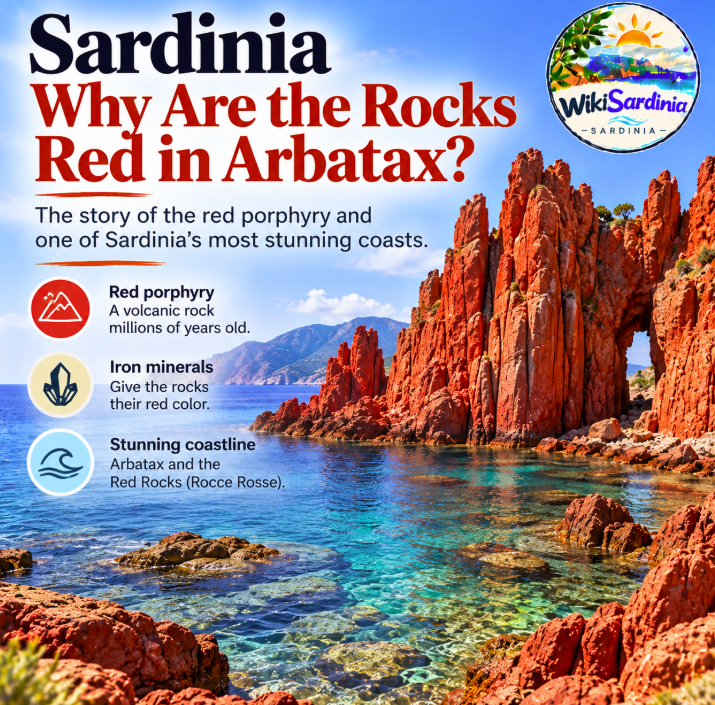
Just outside the port of Arbatax, on Sardinia's eastern coast, spectacular reddish rock formations rise beside the Mediterranean. Known as the Rocce Rosse—literally the Red Rocks—they are one of the most distinctive natural landmarks in Ogliastra. Why are they red? The short answer is their geological composition: these ancient volcanic rocks are commonly described as red porphyry, and iron-bearing minerals help explain their warm reddish coloration.
What are the Rocce Rosse made of?
The Arbatax formations are generally identified as porphyritic volcanic rock, often referred to locally as red porphyry. The word porphyry describes a rock texture in which relatively large mineral crystals are set within a finer-grained groundmass. It does not by itself identify a single precise chemical composition. These rocks formed from ancient volcanic processes, long before the present-day coastline took shape.
Why are the rocks red?
The color reflects the rock's mineral composition, particularly iron-bearing components and their oxidation states. Iron oxides can produce shades ranging from rusty orange to deep red. The visible color also changes with moisture, weathering and sunlight: a sunlit surface may look bright brick-red, while shadowed or wet faces can appear much darker. The rocks were not painted, and their color is not caused by seawater.
How did these unusual shapes form?
After the original volcanic rocks formed and cooled, fractures, weathering and erosion gradually shaped the exposed masses. Wind, rain and sea spray have contributed to the dramatic appearance visitors see today. The result is a striking contrast between jagged red stone, blue-green water and the surrounding coastline.
Where exactly are the Red Rocks?
The Rocce Rosse di Arbatax are near the port area of Arbatax, part of the municipality of Tortolì in eastern Sardinia. They are a recognizable stop for travelers exploring Ogliastra, especially those arriving via Arbatax or staying around Tortolì and Santa Maria Navarrese. Use an up-to-date map to identify the designated public access points rather than attempting to reach the rocks from unsafe shorelines.
When is the best time to photograph them?
Warm low-angle light can make the red tones especially vivid. Morning and late afternoon are both worth considering, depending on the specific angle you want and the weather. Cloudy conditions produce a softer, more subdued palette, while clear skies emphasize the contrast with the sea. Keep in mind that sunrise and sunset directions change seasonally.
Can you swim near the Rocce Rosse?
Do not assume that the rocks themselves offer a safe swimming entry point. Sharp surfaces, slippery wet stone, waves and changing sea conditions can make scrambling dangerous. Choose an established bathing beach instead, check local restrictions and never jump from the formations.
Are the Rocce Rosse natural?
Yes. Their color and structure are natural geological features. Their appearance has been shaped by long-term geological and coastal processes, not by artificial coloring or construction.
What else is nearby?
Arbatax makes a convenient base for exploring the beaches and landscapes of Ogliastra. Visitors often combine the Red Rocks with time around Porto Frailis, Tortolì and the coast toward Santa Maria Navarrese. Plan your route according to local road access, weather and the time of year.
How to visit responsibly
- Stay on safe public access routes and observe any barriers or warning signs.
- Wear footwear with good grip; coastal rock can be slippery.
- Do not remove fragments or damage the formations.
- Avoid climbing exposed faces or approaching the edge in rough seas.
- Take your litter with you and respect other visitors.
Frequently asked questions
Is the red color caused by rust?
Iron-bearing minerals and oxidation processes contribute to the reddish coloration, but describing the entire formation simply as 'rust' would be an oversimplification of its geology.
Is porphyry a type of lava?
Porphyry refers primarily to a crystal texture found in igneous rocks. The Arbatax formations have a volcanic origin, but the term alone does not specify every detail of their formation.
Are the rocks red all year?
Yes. Their natural color is present year-round, though the intensity seen in photos changes with the light and weather.
The WikiSardinia takeaway
The Rocce Rosse of Arbatax are red because of the composition of their ancient volcanic, porphyritic rocks, including iron-bearing minerals. Their dramatic shapes and vivid color make them one of eastern Sardinia's most memorable coastal sights—and an excellent reminder that the island's beauty is geological as well as scenic.