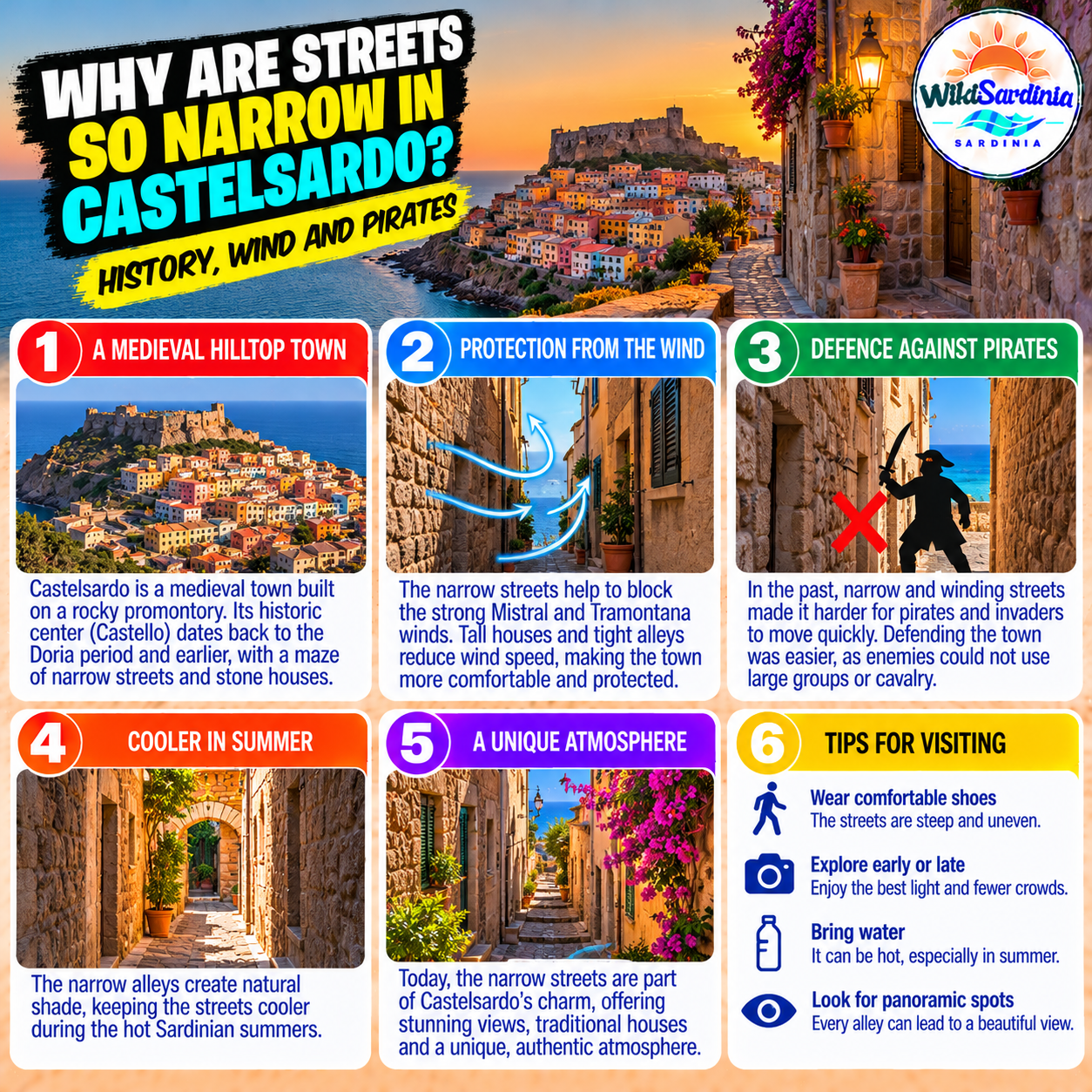
Walk through the old town of Castelsardo and you will quickly notice how narrow, steep and winding its lanes can be. The streets thread between stone buildings, climb towards the historic centre and open unexpectedly onto views of the sea. Their shape is not explained by one simple rule: it reflects the town’s medieval development, its rocky headland and the practical needs of a settlement built within limited space.
A town shaped by its rocky promontory
Castelsardo stands on a rocky promontory above the sea in northern Sardinia. The historic centre grew around the castle and defensive settlement, following the contours of the hill rather than a modern, regular street grid. On steep terrain, narrow lanes and closely grouped buildings make use of the available space and connect different levels of the town.
Medieval streets and defence
Castelsardo’s history is closely linked to its fortified position and the Doria period. In medieval towns, winding approaches, gates and compact building patterns could form part of a defensive landscape. Narrow lanes also made movement through the settlement less straightforward for outsiders. However, it would be too simplistic to say every street was deliberately designed to stop pirates: the layout developed over time and reflects several practical and historical factors.
What about the wind?
Northern Sardinia can experience strong winds, including the Mistral. Narrow streets and tall buildings can create shade and alter how air moves through a lane, so the layout may affect how exposed a street feels. But without specific historical evidence, wind protection should be treated as a possible benefit of the urban form—not as the proven original reason for Castelsardo’s narrow streets.
Shade during the Sardinian summer
Closely spaced buildings can shade parts of a street, making a walk more comfortable in hot weather. The effect changes with the time of day and the orientation of each lane. You may move from a bright, open viewpoint into a cool passage and then emerge into sunlight again within a few steps.
Why the lanes are still worth exploring
The narrow streets are part of what makes Castelsardo’s old town distinctive. They lead past traditional façades, small doorways, stairways, craft shops and viewpoints over the coast. The irregular route encourages visitors to slow down rather than move directly from one landmark to another.
Tips for walking around the old town
- Wear comfortable shoes: paving can be steep, uneven or slippery.
- Take your time: allow extra time for stairs and uphill sections.
- Bring water in warm weather: shade varies from street to street.
- Respect residents: some lanes pass directly beside homes, so keep noise low and avoid blocking entrances.
- Look for viewpoints: gaps between buildings can reveal beautiful coastal views.
A small street plan with a long history
Castelsardo’s narrow lanes are best understood as the result of a medieval town adapting to a steep, rocky site and developing through centuries of use. Its defensive past is part of the story, while shade and the way streets interact with wind are features visitors may notice today. Rather than a single explanation about pirates or the weather, the old town’s layout tells a broader story of geography, history and everyday life.