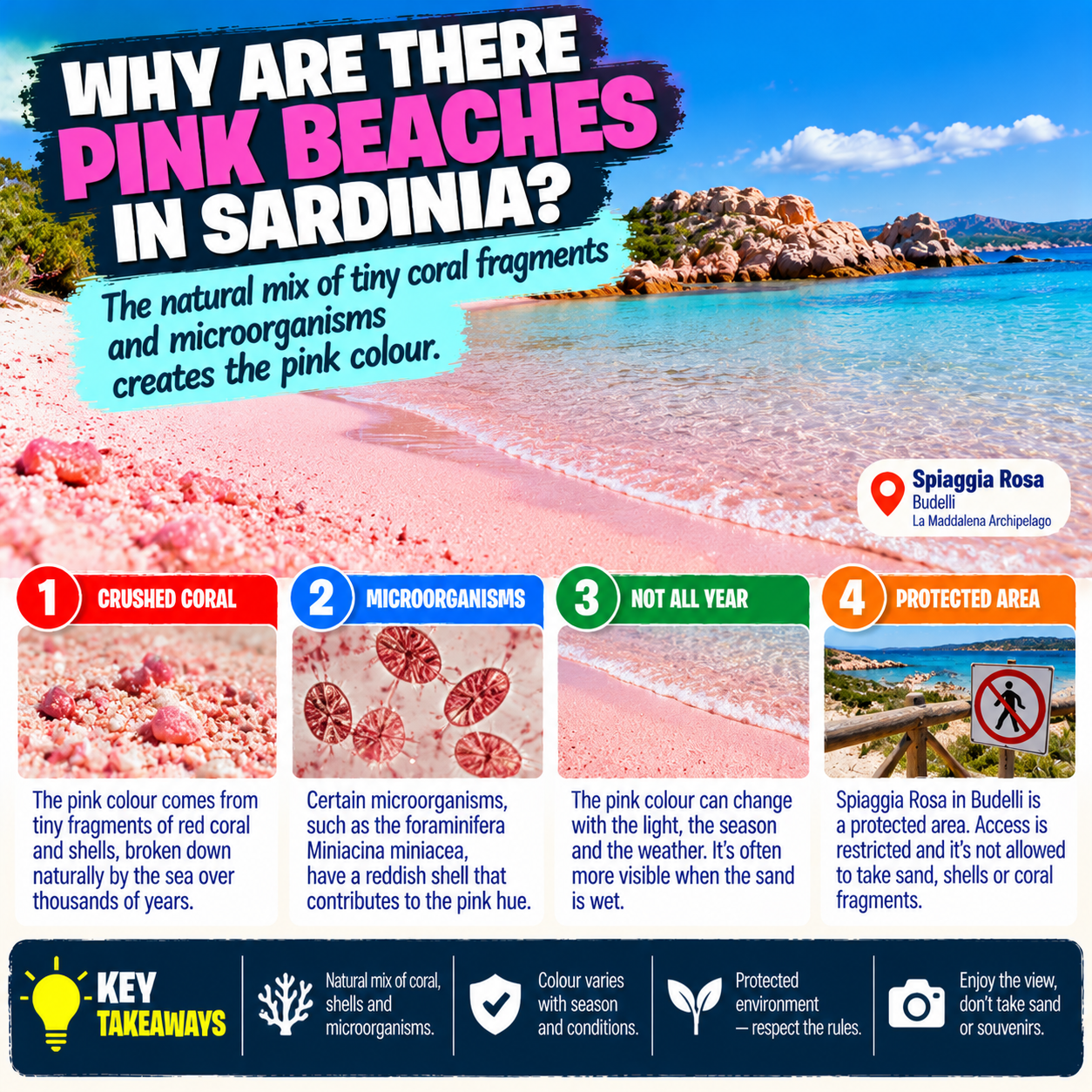
Sardinia’s famous pink beach, Spiaggia Rosa, lies on Budelli Island in the La Maddalena Archipelago, off the island’s northern coast. Its unusual colour is not simply the result of crushed coral: a key ingredient is the tiny pinkish shell of a marine foraminifer called Miniacina miniacea, mixed with other fragments of marine organisms and minerals.
What makes the sand pink?
Miniacina miniacea is a small marine organism with a calcareous shell. It lives associated with the rhizomes of Posidonia oceanica, a seagrass that forms important underwater meadows in the Mediterranean. When the tiny shells and other biological fragments are broken down and carried ashore by currents and waves, they contribute to the distinctive pink tone of the beach.
The sand also contains other biogenic fragments, including material from bryozoans and shells, alongside mineral grains. The colour is the result of this particular mix of material and the local coastal conditions—not a layer of naturally pink paint or a guarantee that every part of the beach will look equally pink.
Why does the colour vary?
The pink hue can look stronger or weaker depending on the light, moisture, viewing angle and the exact composition of the sand. The amount and distribution of tiny marine fragments also matter. Photographs taken in different weather or lighting can therefore show noticeably different shades.
The colour is part of a fragile natural balance. Disturbing the shoreline, removing sediment or damaging the nearby marine habitat can alter the conditions that help maintain it.
Can you walk on Spiaggia Rosa?
No. The beach is under integral protection within the Parco Nazionale dell’Arcipelago di La Maddalena. Landing on the sand, walking across it and swimming in the protected area are prohibited. Boats must respect the marked limits and local rules; do not anchor or stop where it is forbidden.
These restrictions help protect the delicate shoreline and prevent the removal of sand and biological fragments. Even taking a small souvenir would contribute to the loss of the very material that makes the beach special.
How can you see the pink beach?
Visitors can admire Spiaggia Rosa from permitted viewpoints or from the sea on an excursion that respects the park’s rules. Check current arrangements with the national park or a properly authorised local operator before travelling, as access conditions and tour routes can vary.
- Keep your distance: follow marked paths and viewpoint restrictions.
- Leave everything in place: do not collect sand, shells, stones or fragments.
- Respect the marine boundary: follow buoys, navigation rules and crew instructions.
- Choose responsible operators: confirm that the excursion respects the protected area.
A natural wonder worth protecting
Spiaggia Rosa is pink because of a rare-looking concentration of tiny marine shells and other natural fragments, especially those of Miniacina miniacea. Its colour is connected to the surrounding marine ecosystem, including Posidonia meadows, and to the delicate processes that bring these fragments ashore. The best way to enjoy this remarkable Sardinian landscape is to admire it from an authorised viewpoint and leave the beach untouched for the future.
Official sources: Parco Nazionale dell’Arcipelago di La Maddalena — Budelli; Italian cultural heritage portal — Spiaggia Rosa; Comune di La Maddalena — Spiaggia Rosa.