
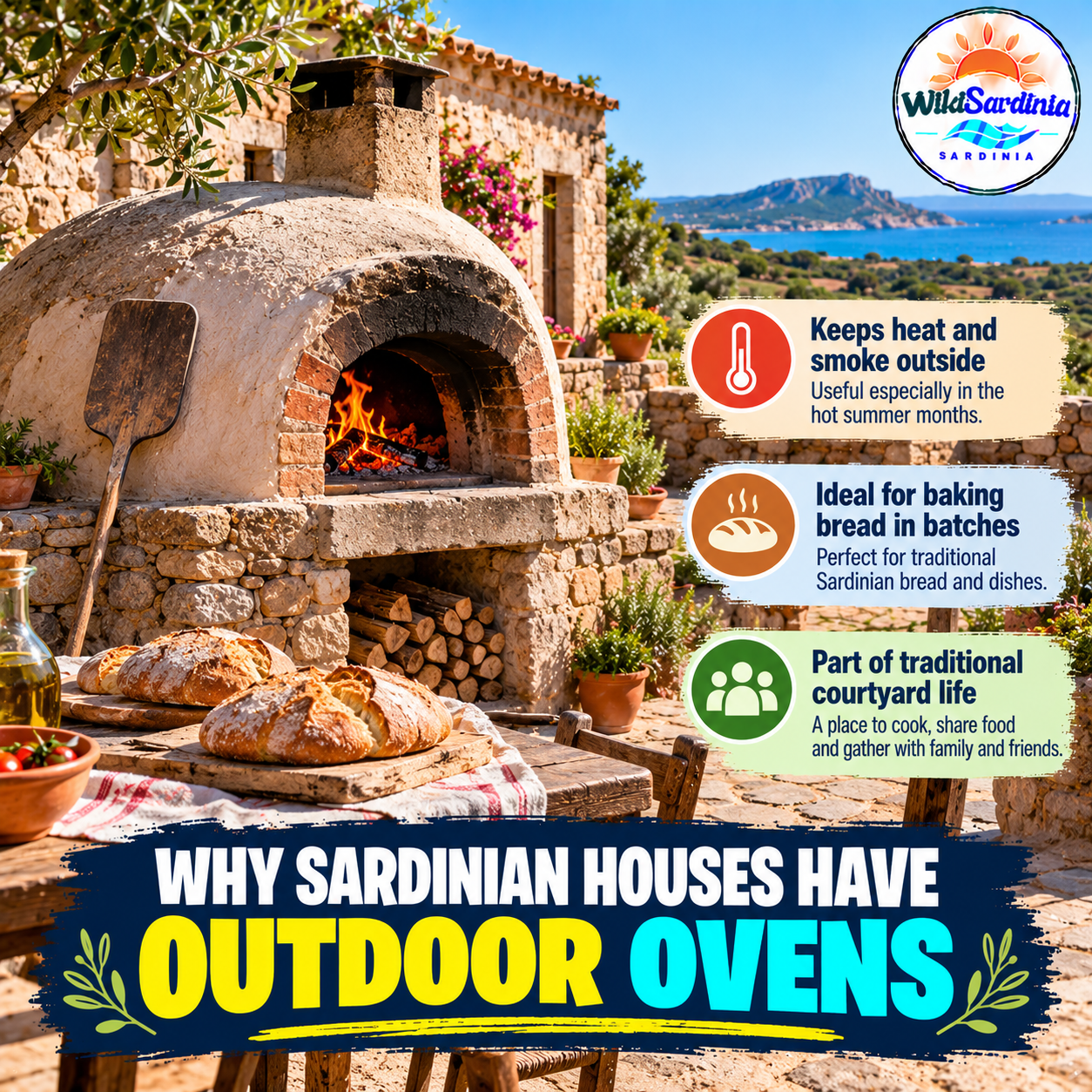
In many traditional Sardinian homes, especially in the Campidano and other lowland and hilly areas, the bread oven stood outside the main house, often in a courtyard or covered outdoor space. It was more than a cooking feature: bread-making was a regular household activity, and the oven was designed around the rhythm of rural life.
1. Keeping heat and smoke away from living rooms
A wood-fired oven produces intense heat and smoke while it is being fired. Placing it outside or in a separate covered space helped keep much of that heat and smoke away from the main living areas—particularly useful during warm weather. This is a practical advantage, although it should not be treated as the single proven reason for every Sardinian outdoor oven.
2. Baking bread in batches
Traditionally, families did not necessarily bake a small loaf every day. Bread could be prepared in larger batches, with the oven heated and used for several loaves or other foods in one session. A dedicated oven made it easier to manage the fire, prepare the baking area and handle the bread-making process.
Sardinia has a rich variety of breads, with techniques and shapes that differ by area. The oven and the baking routine were part of this local food culture, not simply a piece of kitchen equipment.
3. The courtyard was a working space
In rural homes, the courtyard often connected domestic life with agricultural work. Storage, tools, animals and food preparation could all have their own areas around the house. An outdoor oven fitted naturally into this productive space, where wood could be stored and bread prepared without taking over the main kitchen.
4. Why don't all Sardinian houses have an outdoor oven?
Traditional building styles varied across the island. According to SardegnaCultura, in the Campidano and many hilly and lowland areas, the domed oven was commonly placed outside, including in spaces known as sa lolla or sa dom’ ’e su vorru. In some parts of Ogliastra, the oven opened onto the kitchen, while in Barbagia it could be entirely inside the house.
So the outdoor oven is a recognisable feature of some Sardinian house traditions, but it was never a universal rule for every region or home.
5. Bread-making was also a social and cultural ritual
Preparing bread often involved several stages, from mixing and kneading to shaping and baking. In some communities, relatives and neighbours helped, turning the work into a shared activity. Historical accounts also document prayers and customs associated with firing the oven and baking bread, showing how important the process was to family and community life.
What to look for when visiting a traditional Sardinian home
- The oven shape: many traditional examples have a domed baking chamber on a masonry base.
- The setting: look for an oven in a courtyard, under a veranda or in a separate structure near the kitchen.
- The materials: stone, brick and other locally available materials were used according to place and period.
- The wider layout: the oven may be part of a larger working courtyard with storage and other farm-related spaces.
If you visit a historic home or a bread museum, follow the site rules and do not enter private courtyards without permission. Some ovens are preserved as heritage features and are no longer used.
A practical design shaped by local life
Traditional Sardinian outdoor ovens combined practical cooking needs with the way rural homes were organised. They made batch baking possible, helped separate the fire and smoke from living spaces, and often formed part of the household courtyard. But Sardinia’s architectural traditions are diverse: in some areas the oven was outside, while in others it was integrated into the house.
Further reading: SardegnaCultura — Cooking in traditional Sardinia; Sardegna Digital Library — Forno rustico.