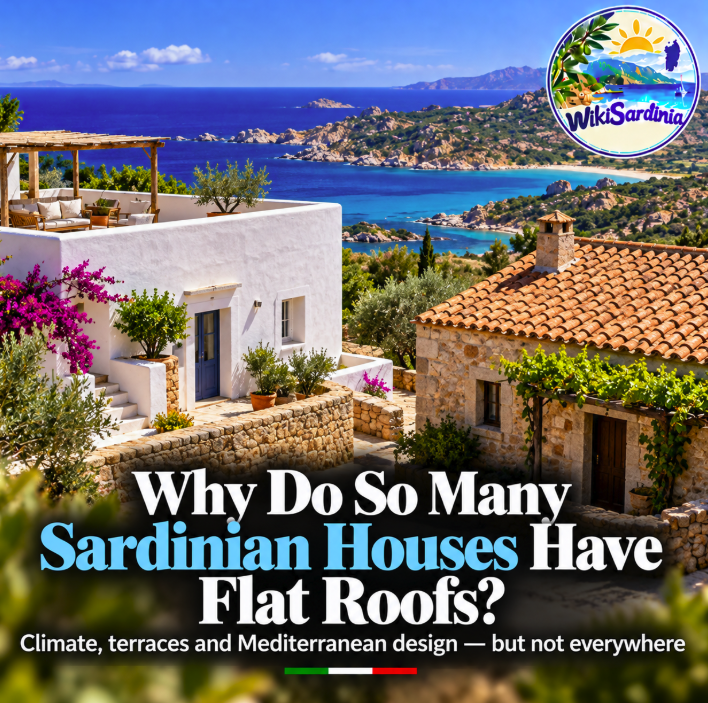
Drive through Sardinia and you may notice something that feels surprising if you come from northern Europe or the United States: many houses have flat or almost-flat roofs.
The obvious explanation is the Mediterranean climate, but the real story is more interesting. Flat roofs make practical terraces, suit many modern coastal designs and work well where snow loads are limited — yet they are not the universal traditional roof of Sardinia.
In fact, some of the island's most characteristic historic houses had pitched roofs covered with terracotta tiles.
First: Sardinian houses do not all have flat roofs
This is the most important correction to the question.
Sardinia has several distinct architectural traditions because Gallura, Barbagia, Campidano, Sulcis and the coastal settlements developed under different environmental and economic conditions.
Regional architectural documentation describes traditional Gallura stazzi, for example, with timber roof structures supporting terracotta tiles. Historic Campidanese houses also commonly used tiled roof structures.
So the flat roofs visitors notice today should not be interpreted as proof that Sardinian houses were historically all built that way.
Why are flat roofs so common today?
One reason is straightforward: a relatively flat roof can become useful outdoor space.
In a Mediterranean climate, a roof terrace can function almost like another room — somewhere for drying laundry, keeping plants, eating outside, enjoying the evening air or simply looking toward the sea.
On a small plot, turning the top of a building into usable space is particularly attractive.
“Flat” does not actually mean perfectly flat
A proper flat roof needs drainage.
Italian construction specifications for terrace roofs typically require a slight slope so rainwater moves toward collection points rather than remaining on the surface.
That means a roof can look completely horizontal from the street while its waterproof surface actually falls gently toward drains.
Without that slope and good waterproofing, the Mediterranean dream quickly becomes a ceiling leak.
But Sardinia gets rain
Yes — sometimes very heavy rain.
Sardinia is sunny, but it is not a desert. Autumn and winter storms can produce substantial rainfall, so flat roofs require effective waterproof membranes, drainage and maintenance.
The idea that Sardinians use flat roofs simply because “it never rains” is therefore wrong.
What about snow?
Along most of Sardinia's populated coastal and lowland areas, persistent heavy snow loads are not a normal design challenge in the way they are in Alpine or northern European regions.
That makes low-slope forms easier to use.
But Sardinia also has mountains, and snow does fall in the interior. Again, the island is too geographically varied for a single architectural explanation.
The white Mediterranean-house effect
Tourist developments and contemporary villas have reinforced the visual association between Sardinia and flat-roof architecture.
White walls, simple geometric volumes, terraces and pergolas create the Mediterranean aesthetic that visitors recognise instantly.
In coastal resorts, these forms can also keep buildings visually low against the landscape — an important consideration on an island where landscape protection strongly influences planning.
Sardinia's Regional Landscape Plan explicitly treats historic and identity-related landscape values as something that planning and development must preserve.
Traditional Sardinia was much more diverse
Travel inland and the architectural picture changes.
In Gallura, the historic rural stazzo was typically a simple elongated building. Regional documentation describes roofs supported by large juniper beams with terracotta tiles laid over a dense framework of reeds.
In the Campidano, traditional courtyard houses were organised around agricultural life, with earthen or stone walls, loggias, service areas and tiled roofs.
In the Sulcis, rural settlement produced forms such as medaus and furriadroxius. Elsewhere you encounter shepherds' cuiles, farmhouses and other locally specific building types.
The Sardinian regional government still identifies these structures as important examples of the island's historic rural architecture.
Why the terrace matters so much
A roof terrace is particularly valuable in a climate where outdoor living can continue for much of the year.
Even when it is not designed as a formal entertainment area, the terrace can hold water tanks, solar equipment, laundry or storage while leaving the ground-level courtyard free.
Modern houses often hide these practical functions behind a parapet, which makes the building appear even more cubic from the street.
Does a flat roof keep the house cooler?
Not automatically.
Roof shape alone does not determine summer comfort. Insulation, thermal mass, waterproofing, surface colour, ventilation, solar exposure and shading are all important.
A badly insulated flat roof under the Sardinian summer sun can become extremely hot. A well-designed roof can perform far better.
So “flat roof equals cooler house” is too simplistic.
Why old tiled roofs still make sense
Pitched terracotta roofs shed rain efficiently and create space between the external covering and the occupied rooms. Traditional builders also used materials that were locally available and construction techniques refined over generations.
That is why historic Sardinian villages often look very different from newer seaside developments.
The contrast itself is part of what makes Sardinian architecture interesting.
What visitors should look for
Next time you drive across the island, compare the roofs instead of assuming they are all the same.
Look at modern white villas near the coast, then compare them with rural houses in Gallura, courtyard architecture in the Campidano and stone buildings in inland villages.
You will start seeing Sardinia not as one architectural style, but as a collection of regional building traditions layered with twentieth- and twenty-first-century Mediterranean design.
WikiSardinia verdict
So, why do many Sardinian houses have flat roofs?
Because low-slope roofs fit modern Mediterranean architecture, can create valuable terrace space and are practical in many of the island's lowland and coastal environments.
But the better travel fact is this: the classic Sardinian house does not have one single roof shape.
Traditional stazzi and Campidanese houses often used pitched terracotta roofs, while the flat white silhouettes visitors associate with Sardinia are also strongly connected with newer coastal and Mediterranean architecture.
Look up while travelling around the island. The roofs tell you which Sardinia you are looking at.