Imagine arriving at a world-famous Sardinian beach, ready for turquoise water and white sand, only to discover that you need a reservation or an entry ticket. For visitors who associate beaches with free public access, this can be surprising. Why do some of Sardinia's best-known beaches require booking and fees? The main reason is to manage the impact of large numbers of visitors on exceptionally fragile coastal environments.
These rules do not apply to every beach in Sardinia. Many stretches of coastline can still be enjoyed without booking a daily admission slot. But a number of especially popular or environmentally sensitive places use visitor limits, timed access, permits or charges. Each system is different, and the details can change from one season to another.
Why are visitor numbers limited?
Beautiful beaches can be vulnerable precisely because they attract so many people. Repeated foot traffic can damage dunes and coastal vegetation, while crowding increases pressure on paths, waste collection, sanitation and sensitive habitats. On small coves, the physical space available may be particularly limited.
A daily visitor cap helps managers control how many people arrive at once. That can reduce overcrowding, make safety arrangements more manageable and improve the experience for visitors. A reservation system is therefore a tool for managing access, not necessarily a declaration that the beach has become private.
Are entry fees just another tourist tax?
Not necessarily. An entry charge and a general tourist tax are different things. At some sites, ticket revenue contributes to specific services such as monitoring, facilities, access management or environmental protection. What is included depends on the beach and the authority managing it.
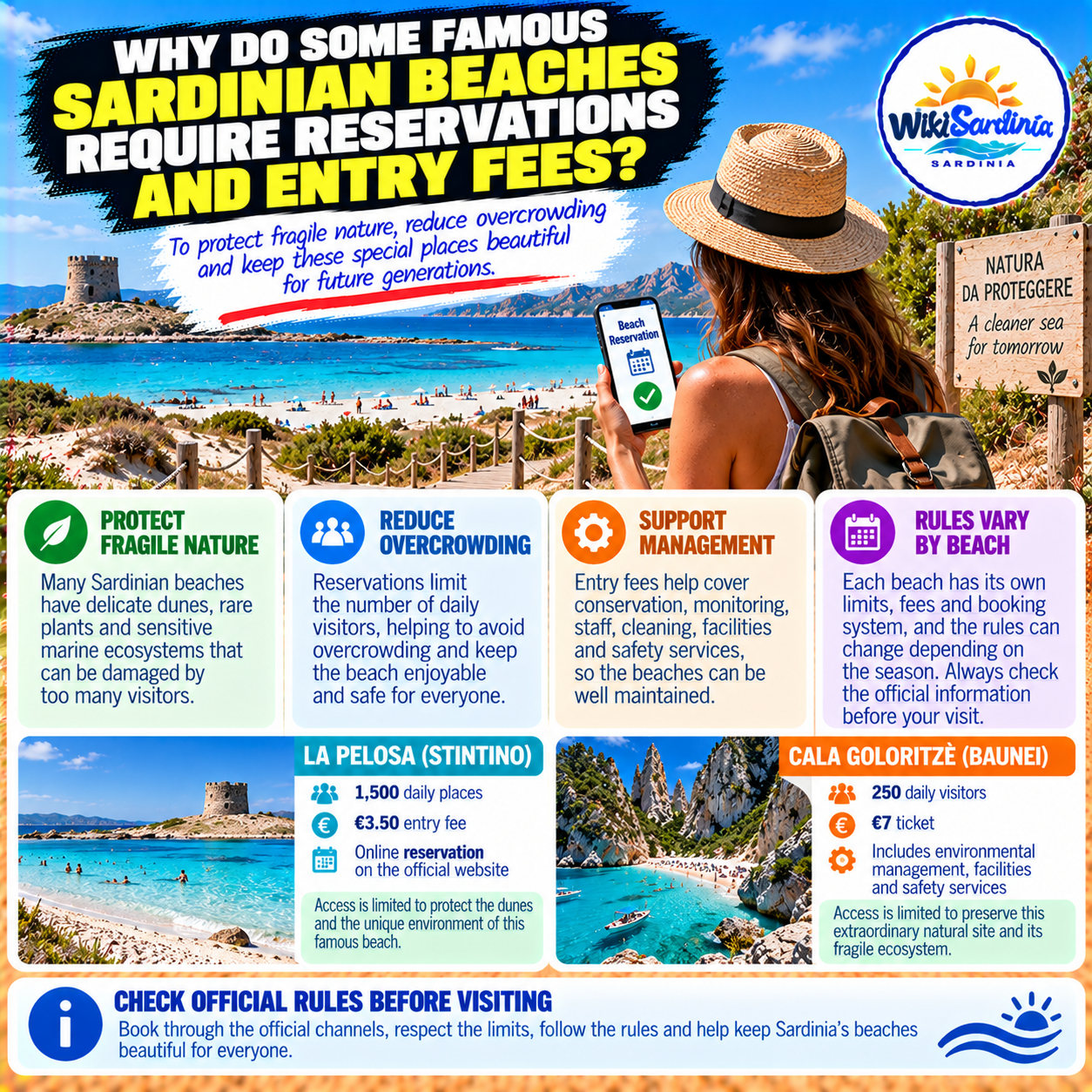
For example, official visitor information for Cala Goloritzè explains that its €7 ticket includes an environmental contribution, parking and toilets at Su Porteddu, surveillance and access to the path and beach. It would be inaccurate to assume that every Sardinian beach ticket covers the same services.
La Pelosa: why do you need to book this famous beach?
La Pelosa, near Stintino in northern Sardinia, is one of the clearest examples of controlled beach access. Its pale sand and shallow water make it exceptionally popular, and its coastal environment needs careful management.
According to the official La Pelosa booking website, the 2026 reservation system operated from 15 May to 15 October, with 1,500 daily places and a €3.50 per-person fee. The site describes two booking allocations: 500 places available further in advance and 1,000 released two days before the visit. Children under 12 did not need to book under the published 2026 rules.
Visitors received a QR code for access checks. The official website also warned about imitation booking sites, an important reason to avoid purchasing access from unverified third parties.
Important: These are published 2026 arrangements, not a promise that the same dates, prices or procedures will apply in future seasons. Always recheck the official website before travelling.
Cala Goloritzè: why is access even more restricted?
Cala Goloritzè, on the Baunei coast in eastern Sardinia, is a small and spectacular cove surrounded by limestone cliffs. Its limited size and sensitive setting help explain why access is tightly controlled.
Official destination information from STS Ogliastra states that access is capped at 250 visitors per day, with a €7 ticket and advance reservations. The published guidance describes a booking window of up to 72 hours before the visit and provides official booking channels.
There is another crucial detail for trip planning: you cannot simply arrive at Cala Goloritzè by boat and step onto the beach. The official guidance describes a buoyed exclusion area and land access via the hiking trail from the Golgo plateau. You can admire the cove from a boat where permitted, but that is not the same as being allowed to land.
Because the hike requires preparation, a booking is only one part of the visit. Check weather, daylight, footwear, water and the trail conditions before setting out.
Do all limited-access beaches use the same rules?
No. This is one of the most important things for travellers to understand. A visitor cap, a reservation, an admission fee and a parking permit are not interchangeable. One beach may limit the number of people on the sand; another may regulate cars entering a protected area; another may require an authorised guide or impose special boat-landing rules.
Some destinations have separate charges for parking or beach services. Others may have exemptions for certain visitors, children or residents. A booking may be required only during a specified season or at certain times of day. Do not assume that rules for La Pelosa apply to Cala Goloritzè, Cala Brandinchi, Tuerredda or any other beach.
Is the beach still public if there is an entrance fee?
Controlled access does not automatically mean a beach has been sold or converted into private property. In Italy, coastal access and the maritime public domain operate under legal rules that differ from the concept of private beachfront ownership familiar in some other countries.
Local authorities may regulate entry to protect an area, manage capacity or enforce environmental requirements. Those measures should be assessed under the specific rules governing the site. A paid beach club, a parking fee and an environmental access ticket are also different arrangements.
What happens if the beach is fully booked?
If an official reservation system shows no places for your date, do not assume you can gain access by turning up early, buying a parking ticket or asking a boat operator. Check whether the managing authority releases additional places later, whether an alternative access procedure exists, and whether the beach is subject to different rules outside the controlled period.
At La Pelosa, for example, the 2026 official booking system published a specific release schedule for different groups of places. That does not mean all Sardinian beaches use the same timing. If no valid option is available, choose another beach rather than bypassing access controls.
Do entry tickets help protect Sardinia's beaches?
Visitor limits can be useful, but they are not a complete solution. Environmental protection also depends on enforcement, maintenance, appropriate waste management, safe access paths and responsible behaviour. Fees alone do not guarantee that an ecosystem is protected; what matters is how the overall management system works.
Visitors can contribute by following designated paths, avoiding dunes, leaving sand and shells in place, taking litter away and respecting rules about smoking, pets and beach equipment where applicable.
How should you book a restricted beach?
First, identify the exact beach and the municipality or protected-area authority responsible for it. Next, find the official reservation website or the operator explicitly authorised by that authority. Read the current season's dates, admission conditions, cancellation rules and any exemptions before paying.
Keep the confirmation and QR code accessible, ideally with an offline copy in case mobile coverage is unreliable. Check whether your booking includes parking, transport or other services; often it does not. Be especially careful with websites that imitate official booking platforms.
Should you book weeks in advance?
There is no universal answer. Some systems allow reservations well ahead of time, while others release tickets only shortly before the date. In busy summer weeks, popular slots can fill quickly, but booking earlier is not always technically possible.
The practical strategy is to check the official booking window as soon as you know your travel dates, then set a reminder for the correct release time. For future seasons, verify that the system has actually opened before relying on information from an older travel article.
Are there beautiful Sardinian beaches without reservations?
Yes. Sardinia has a long coastline with many beaches that do not use the same controlled-access system. Conditions still vary: parking may be limited, nature-protection rules still apply and some places can be crowded in peak season.
Rather than planning an entire holiday around a single famous cove, consider exploring several areas. A less-publicised beach may be just as memorable and allow a more flexible day, provided you respect local regulations.
The verdict: why Sardinia asks visitors to reserve some beaches
Reservations and entry fees at certain Sardinian beaches are primarily tools for managing visitor pressure and protecting sensitive coastal places. They can also support practical services and help keep crowded sites safer and more enjoyable. But the rules are specific to each destination and can change every year.
For a stress-free trip, treat a famous beach booking like any other important travel reservation: check the official source, understand what you are paying for, and have a backup plan. Protecting the places you came to see is part of keeping them beautiful for future visitors.