Spend a summer in Sardinia and you can walk across dozens of beaches without seeing a single snake. That sometimes creates an even stronger claim: “There are no snakes in Sardinia.”
That is not true.
Sardinia does have snakes. What it famously does not have is a native living population of vipers, and most of the island's snakes have little reason to crawl across a hot, crowded stretch of open beach.
Are there snakes in Sardinia?
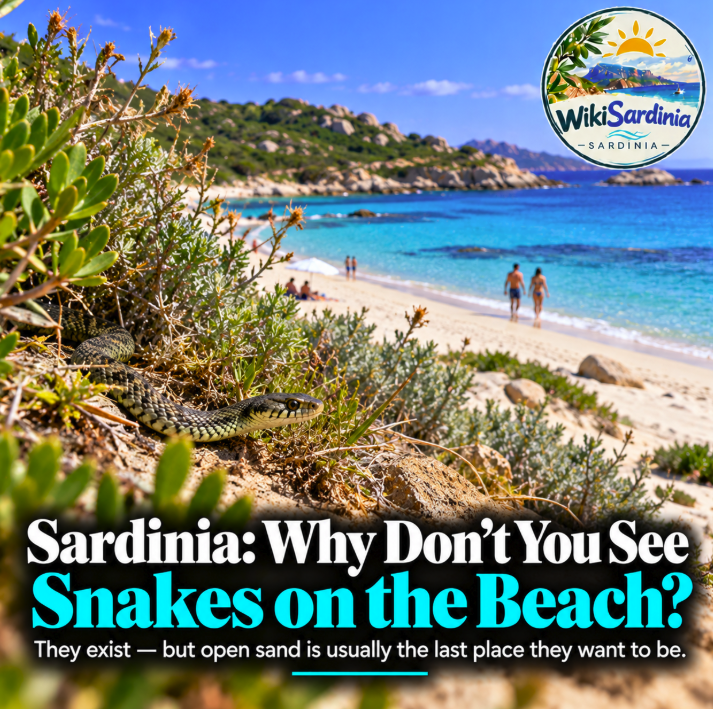
Yes. Scientific literature recognizes four snake species in Sardinia: the western whip snake (Hierophis viridiflavus), horseshoe whip snake (Hemorrhois hippocrepis), viperine snake (Natrix maura) and the Sardinian population of the barred grass snake (Natrix helvetica cetti).
The last of these is an endangered endemic subspecies with a restricted and fragmented distribution.
Then why don't you see snakes on the beach?
Because the middle of an exposed sandy beach is generally a poor place for a terrestrial snake to spend its time.
There is little cover from people and predators, few places to hide and, under the Sardinian summer sun, sand can become intensely hot.
Snakes are far more likely to use habitat that provides vegetation, stones, walls, scrub, freshwater margins or other shelter.
They can live close to the coast
“Rarely on the beach” does not mean “absent from coastal areas.”
Research on Sardinian horseshoe whip snakes records them in coastal habitats including Mediterranean scrub, sandy soils, rocky areas, ponds and coastal lagoons.
So a snake could certainly occur near a beach, particularly around dunes, vegetation, wetlands, stone walls or undeveloped scrub behind the shoreline.
The distinction is habitat: coastal vegetation can be useful snake habitat; a busy strip of bare sand usually is not.
What is the most common snake in Sardinia?
SardegnaForeste describes the western whip snake, locally also called biacco, as Sardinia's most common snake.
It occupies many different environments, including rocky, dry and sunny ground, grassland, gardens and riverbanks.
It is diurnal and typically escapes rapidly when it encounters a person.
Is the biacco venomous?
No. SardegnaForeste explicitly states that its bite is not venomous.
Like any wild animal, however, it should not be handled or cornered. A frightened snake may defend itself if it cannot escape.
Are there vipers in Sardinia?
No living Vipera species are part of Sardinia's current fauna.
A modern clinical review of Italian viper bites identifies Vipera species across mainland Italy, Sicily, Elba and Montecristo but specifically records them as absent from Sardinia.
This is one reason Sardinia's wildlife risk feels different from hiking in many parts of mainland Italy.
Why are there no vipers?
The story is more interesting than the simple claim that “Sardinia separated before vipers arrived.”
Fossil evidence shows that viperids did exist on Sardinia in the geological past. Fossil snake remains from sites including Monte Tuttavista document a viperid that is now extinct on the island.
Whatever combination of isolation, colonization history and environmental change produced the modern fauna, the practical fact today is simpler: Sardinia has snakes, but not the living viper populations familiar from mainland Italy.
Are Sardinian snakes dangerous to tourists?
For an ordinary visitor, snakes are not a significant beach hazard.
The official SardegnaTurismo safety guidance states that Sardinia has no animals considered venomous or particularly dangerous to humans.
That does not mean wildlife should be touched. It means a traveler should not arrive expecting Sardinian beaches to be populated by dangerous snakes.
What about the viperine snake?
The name causes understandable confusion.
The viperine snake, Natrix maura, is not a true viper. It is an aquatic or semi-aquatic snake associated with water and belongs to a different snake lineage.
Its resemblance and defensive behavior can make it look intimidating, but its name should not be interpreted as evidence that Sardinia has vipers.
Could you see a snake swimming?
Some Sardinian snakes associated with freshwater are capable swimmers, so seeing a snake in or near water is biologically possible.
That is very different from saying Sardinian sea beaches commonly have “sea snakes.” They do not.
If you see a snake crossing water or a path, give it space and let it continue.
Where are you more likely to see one?
Your chances increase away from the busiest open beach and toward natural habitat: Mediterranean scrub, rural tracks, rocky ground, riverbanks, wetlands, gardens and stone walls.
Even there, most encounters are brief because snakes generally avoid humans when they can.
What about dunes behind beaches?
Dunes and coastal vegetation are a different ecosystem from the sand where people place their towels.
They provide shade, prey and cover for many animals.
This is another good reason to stay on established access paths and respect fencing around protected dune systems rather than walking through vegetation.
Should you shake your shoes in Sardinia?
There is no need to develop a snake ritual every time you leave the beach.
If you are camping, hiking or staying in a very rural property, ordinary precautions around wildlife are reasonable: do not put your hands blindly into rock piles, dense vegetation or holes, and check equipment left outdoors.
For a normal hotel-and-beach holiday, snakes are unlikely to become part of your trip at all.
What should you do if you see a snake?
Stop, give it room and let it leave.
Do not try to catch, move or kill it. SardegnaForeste notes that the common western whip snake is protected, and wild reptiles play an important role in local ecosystems.
If you are unsure what species you have seen, photograph it only from a safe distance.
What should beachgoers actually worry about?
The official Sardinian tourism guidance puts the emphasis elsewhere: sea conditions.
Not every beach has lifeguards, and visitors are advised to assess conditions before entering the water and obey red flags.
On a Sardinian beach, strong surf, currents, sun exposure and dehydration are much more practical concerns than snakes.
WikiSardinia's answer
Sardinia does have snakes — you simply don't see them very often on open beaches because beaches are generally poor habitat for them.
They prefer places offering shelter, vegetation, rocks, freshwater or prey, and most will try to escape rather than approach people.
The reassuring part of the Sardinian story is real: there are no living vipers on the island.
So enjoy the beach. Just remember that the scrub, dunes and wetlands behind it are living ecosystems too — and if a snake happens to appear, give it space and let it disappear the way it usually does.