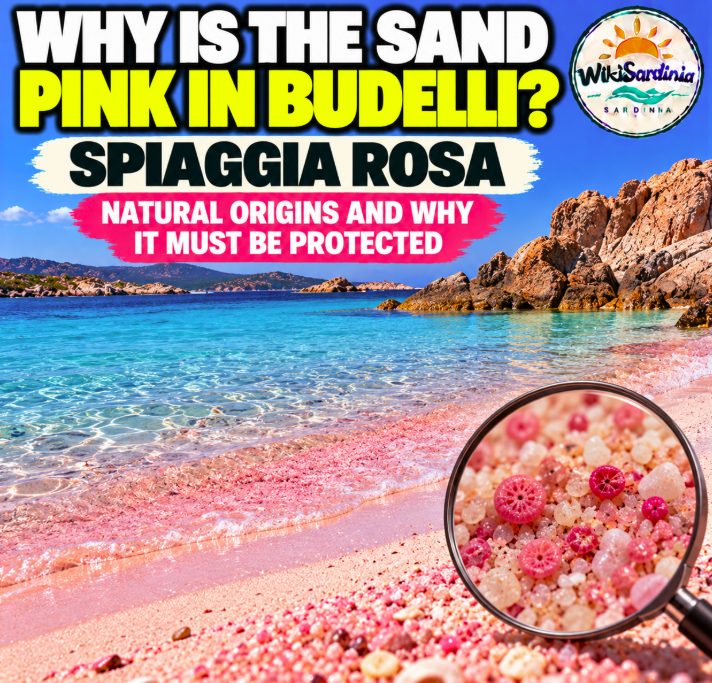
Why is the sand pink at Budelli's famous Spiaggia Rosa? The unusual color comes largely from tiny fragments of marine organisms with reddish or pinkish calcium-carbonate structures, mixed with pale mineral grains and other shell material. Over time, waves and natural erosion break these biological remains into small particles that become part of the beach sediment.
One organism often mentioned in explanations of Budelli's pink sand is Miniacina miniacea, a reddish-pink, shell-building foraminifer that lives in Mediterranean marine environments. Other biological components, including fragments of shells and calcareous organisms, can contribute to the color. It is not accurate to say that every grain comes from one organism, or that the beach is colored by an artificial dye.
Important for visitors: Spiaggia Rosa is a protected and highly sensitive beach in the La Maddalena Archipelago. Do not walk onto the protected sand, swim into restricted areas or remove even a small amount of sediment. Observe the beach only from currently permitted viewpoints and follow the National Park's latest instructions.
Where is the Pink Beach in Sardinia?
Spiaggia Rosa, or Pink Beach, is on Budelli Island in the La Maddalena Archipelago off northeastern Sardinia. The archipelago is known for granite islands, turquoise water and exceptional coastal ecosystems.
Budelli's beach became internationally famous for its pink appearance. It is not a resort beach with ordinary public access. Its conservation status and access restrictions are central to any responsible visit.
What actually makes Budelli's sand pink?
Sand is not always made only of crushed rock. On many beaches, it also contains biogenic sediment: small pieces produced by living organisms, including shells, skeletal fragments and other calcium-carbonate structures.
At Budelli, reddish and pinkish biological particles become mixed with lighter grains. The resulting sand may look blush pink, salmon-colored or pale rose depending on its composition, moisture and lighting.
The pink effect is therefore a natural result of marine biology, sediment transport and time. It does not mean the water itself is pink or that a pigment has been poured onto the shore.
What is Miniacina miniacea?
Miniacina miniacea is a marine foraminifer, a type of single-celled organism that produces a distinctive hard structure. It can form reddish or pinkish calcareous material associated with Mediterranean seabed habitats.
When biological material is broken down and transported, fragments can become part of beach sediments. This species is frequently cited in explanations of the pink particles found at Budelli.
Although a foraminifer is microscopic or small in biological terms, it is not a bacterium and should not be described simply as “pink algae.” Its calcareous structures, rather than a living pink film covering the sand, are part of the story.
Is the pink color caused by microorganisms or shells?
Both descriptions can be relevant, but they refer to different parts of the process. Some of the colored sediment comes from the remains of small marine organisms, including foraminifera. Other grains can be fragments of larger calcareous structures and shells.
Marine organisms produce the material; erosion and wave action turn it into sediment; coastal currents and local beach conditions help determine where it accumulates.
It is more precise to speak of biological fragments mixed into the sand than to claim the entire beach is covered with living pink microorganisms.
Why is the sand pink in some places but not others?
Beaches are shaped by their surrounding geology, marine ecosystems, wave energy and sediment supply. Even neighboring coves can contain very different proportions of quartz, granite-derived grains, shell fragments and biological material.
Budelli's particular mixture of sediment and local coastal conditions produced its recognizable color. That does not mean every Sardinian beach should be pink or that a similar organism will always create a visibly pink shoreline.
Is Budelli's sand really bright pink?
Not always. Online photographs can exaggerate the color through saturation, editing or unusually warm light. In reality, the beach may look subtly pink, especially when compared with nearby pale sand.
The apparent shade changes with sunlight, wetness, viewing distance and the mixture of grains. A photograph showing uniformly neon-pink sand should be treated cautiously.
Why did Spiaggia Rosa need protection?
Pink sand is a delicate natural resource that forms through slow environmental processes. Historically, visitor pressure and the removal of sand as souvenirs contributed to concerns about protecting the beach.
Foot traffic can disturb the sediment and fragile coastal habitat, while removing even small quantities of sand reduces a finite natural feature. Conservation restrictions help protect both the visible beach and the wider ecosystem.
The purpose of protection is not to keep a beautiful place secret. It is to prevent damage so that its natural characteristics can persist.
Can you walk on Spiaggia Rosa?
Do not assume you can. Spiaggia Rosa is subject to strict protections and access restrictions. Visitors should not land on or walk across the protected beach unless explicitly authorized under current rules.
Boat excursions may offer views from permitted areas, but operators must respect navigation, anchoring and protected-area regulations. A commercial tour advertisement does not override National Park restrictions.
Before booking, check the La Maddalena Archipelago National Park for the latest rules. Restrictions can evolve and may specify where vessels and visitors are allowed.
Can you swim at the Pink Beach?
Do not treat Spiaggia Rosa as an ordinary swimming destination. Swimming and approaching the protected shoreline are restricted; the exact current boundaries and permitted observation zones should be verified with the park.
There are many other beaches around Sardinia where visitors can swim lawfully and enjoy clear water. Respecting Budelli's restrictions helps preserve its special environment.
Can you see Spiaggia Rosa from a boat?
Depending on the current rules and sea conditions, authorized excursions may allow visitors to observe the beach from a permitted distance. This can be a rewarding way to appreciate the landscape without stepping on its fragile sand.
Choose an operator who explains the protected-area rules and does not promise illegal landing, swimming or sand collection. Ask exactly what the itinerary includes before paying.
Can you take pink sand home as a souvenir?
No. Do not remove sand, pebbles, shells or other natural material from protected beaches. Sardinia also has regional rules against taking sand and similar coastal materials, with significant potential fines.
Even one small jar is not a harmless souvenir. The right way to take the color home is through photographs, memories or locally made art that does not contain illegally collected beach material.
How does the pink sediment reach the shore?
Marine organisms live in the surrounding sea. When their hard structures break apart naturally, currents and waves can move the fragments. Over time, sediment accumulates in places where coastal shape and water movement allow it to settle.
This is an ongoing natural process, but not one that can quickly replace sand removed by visitors. Beach sediment systems are complex and can be affected by storms, changing currents and human disturbance.
Does pink sand mean the sea is polluted?
No. The natural pink coloration is not, by itself, evidence of pollution. It is associated with biological and geological components of the sediment.
That said, the color of a beach alone cannot establish water quality. Travelers should follow any current environmental or swimming advisories for the location they intend to visit.
Is Budelli the only pink beach in the world?
No. Pinkish beaches exist in other parts of the world, but their sediment sources and shades differ. Some owe their color to foraminifera, shell fragments or other naturally colored minerals and biological remains.
Budelli is distinctive because of its setting in the La Maddalena Archipelago, its particular ecological context and the strong conservation measures associated with the site.
Why the color matters to Sardinia
Spiaggia Rosa has become a symbol of the island's extraordinary coastal diversity. Sardinia is known for white quartz grains at Is Arutas, pale sand in many northern coves and the pink biological sediment of Budelli.
These differences tell a story about geology and marine life. They also remind visitors that a beach is not merely a backdrop for photographs: it is a dynamic habitat that can be damaged by seemingly small actions.
How to visit responsibly
- Check current rules published by La Maddalena Archipelago National Park.
- Choose an authorized excursion and ask where viewing is permitted.
- Do not step onto the protected sand or cross marked boundaries.
- Do not swim, anchor or approach the shore where restrictions apply.
- Never remove sand, shells, stones or other natural material.
- Use photographs rather than physical souvenirs to remember the beach.
- Respect wildlife, marine habitats and the crew's safety instructions.
Frequently asked questions
Why is Budelli's sand pink?
Its color comes from a mixture of pale sediment and reddish or pinkish fragments of marine organisms, including calcareous material associated with foraminifera such as Miniacina miniacea.
Is the pink color caused by microorganisms?
Small marine organisms contribute to the sediment, but the color is largely associated with their hard remains and fragments, not a living pink coating on the sand.
What is Miniacina miniacea?
It is a foraminifer, a single-celled marine organism that forms reddish or pinkish calcareous structures.
Is Budelli's Pink Beach naturally pink?
Yes. The coloration is natural, although photographs may exaggerate how vivid it looks.
Can tourists walk on Spiaggia Rosa?
Access is strictly restricted. Do not walk on the beach unless current rules expressly authorize it.
Can you swim at Spiaggia Rosa?
Swimming and approaching the protected shoreline are restricted. Verify the latest park rules.
Can you see the beach from a boat?
Authorized excursions may offer views from permitted areas, subject to current navigation and conservation restrictions.
Can you collect a little pink sand?
No. Removing beach sediment is prohibited and damages a fragile natural resource.
Is the sand always bright pink?
No. The shade varies with sediment composition, moisture, light and photographic editing.
Is the pink sand made from coral?
It should not be described simply as crushed red coral. The sediment includes different biological components, notably material associated with foraminifera and other calcareous organisms.
The bottom line
Budelli's Spiaggia Rosa is pink because nature has mixed tiny reddish marine-organism fragments into the sand over time. The foraminifer Miniacina miniacea is a key part of the explanation, alongside other biological sediment. The beach's beauty is also why it needs protection: admire it from permitted viewpoints, leave every grain where it belongs and help keep one of Sardinia's most remarkable natural places intact.
Useful resources
Parco Nazionale dell'Arcipelago di La Maddalena — Official protected-area information; SardegnaTurismo — Official Sardinia tourism information. Check the park's current access, swimming and navigation restrictions before visiting.