You buy a jar of local honey in Sardinia, taste a spoonful and stop for a second: why is this honey bitter?
It probably is not spoiled, burnt or badly made. You may have found one of Sardinia's most distinctive foods: miele di corbezzolo, the intensely bitter honey produced from the flowers of the strawberry tree, Arbutus unedo.
The Autonomous Region of Sardinia officially lists Miele di Corbezzolo di Sardegna among the island's traditional food products and describes its flavour as decidedly bitter, intense and persistent.
What is corbezzolo?
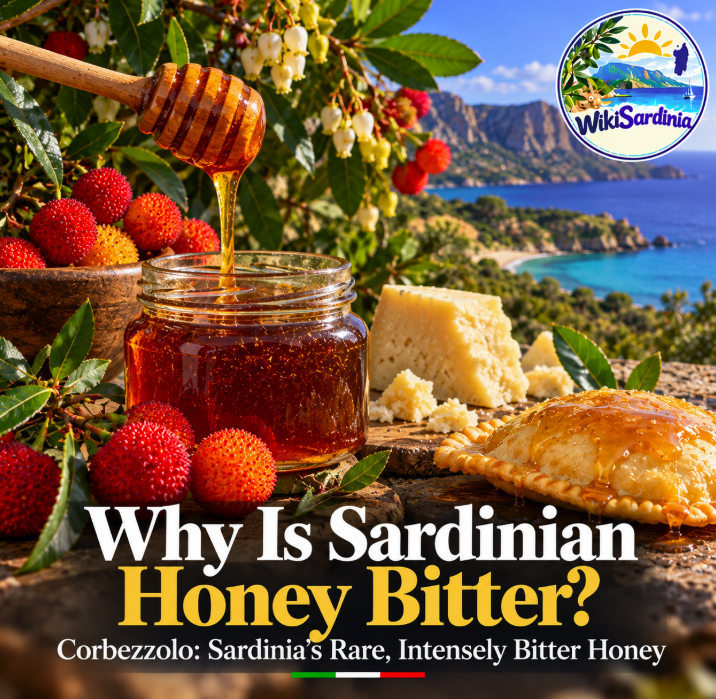
Corbezzolo is the Italian name for the strawberry tree, an evergreen shrub that grows naturally throughout the Mediterranean maquis and is widespread across Sardinia.
It produces small white or pinkish bell-shaped flowers and round fruits that turn orange-red as they ripen. One of the unusual things about the plant is that flowers and mature fruit can appear at the same time.
The bees are interested in the flowers. They collect their nectar and transform it into the honey Sardinians know for its unmistakable bitter finish.
Why does the honey taste bitter?
The bitterness is a natural characteristic of honey made predominantly from corbezzolo nectar.
Sardinia's regional agricultural documentation describes the flavour as initially only slightly sweet and then decidedly bitter and astringent, with a long-lasting bitter finish.
The aroma can be equally surprising. Official sensory descriptions compare it with bitter herbs, roasted coffee and other dark, vegetal or toasted notes.
So if your Sardinian honey tastes almost medicinal, herbal or coffee-like rather than simply sugary, that can be exactly what it is supposed to taste like.
It is one of Sardinia's most unusual honeys
Most visitors expect honey to become progressively sweeter on the palate. Corbezzolo does almost the opposite.
There is sweetness, because it is still honey, but the bitter component quickly becomes dominant and remains after swallowing.
That contrast makes it divisive. Some people fall in love with it immediately; others take a few tastings to understand why Sardinians value it so highly.
Why is corbezzolo honey rare?
The strawberry tree flowers during the difficult part of the beekeeping year.
Regional documentation places flowering roughly between late autumn and winter. Cold temperatures, rain, wind and shorter daylight hours can prevent bees from flying enough to collect large quantities of nectar.
That makes production much less predictable than honey made from abundant spring or summer blossoms.
A good corbezzolo harvest therefore depends not only on the presence of the plant but on a narrow window of suitable weather while it is flowering.
Why Sardinia is famous for it
Corbezzolo grows widely across the island, particularly in Mediterranean scrub and inland or mountainous areas.
Sardinia's combination of extensive wild vegetation and a strong beekeeping tradition has made bitter strawberry-tree honey one of the island's characteristic products.
It is so closely associated with Sardinia that regional food documentation also records traditional names including melalidone and olione.
What colour should it be?
Do not expect every jar to look exactly the same.
When liquid, corbezzolo honey can range through amber shades and may show unusual greenish reflections. Once crystallised it becomes lighter, often beige or hazelnut-toned.
It also tends to crystallise readily. That is normal and does not mean the honey has gone bad.
How Sardinians eat bitter honey
This is where corbezzolo starts making culinary sense.
Instead of treating it only as something to sweeten tea or breakfast, try it as a contrasting ingredient.
Aged pecorino is an excellent partner: salty, fatty cheese meets the honey's sweetness, bitterness and aromatic intensity.
It is also traditionally associated with seadas or sebadas, Sardinia's fried pastry filled with cheese. A drizzle of honey over the hot pastry creates the sweet-salty-bitter contrast that makes the dish memorable.
Even if you normally prefer mild honey, tasting corbezzolo with cheese is worth trying before deciding whether you like it.
Is bitter Sardinian honey supposed to taste this strong?
Yes — genuine corbezzolo honey can be surprisingly intense.
Its bitterness is not merely a faint aftertaste. Sardinian agricultural descriptions specifically identify a strong, persistent bitter component as one of the honey's defining sensory characteristics.
Of course, flavour varies from harvest to harvest and between producers because weather, location and accompanying nectar sources can influence the final honey.
When to buy it
Autumn and winter are particularly appropriate times to look for fresh-season corbezzolo honey, but good producers and speciality food shops sell it throughout the year while stocks last.
Because production can be limited, expect it to cost more than ordinary multifloral honey.
When buying, look for a producer who clearly identifies the botanical origin as corbezzolo / Arbutus unedo and preferably provides the production area.
WikiSardinia verdict
If you searched “Sardinia best local honey bitter taste why”, the answer is probably corbezzolo.
The bitterness is not a defect. It is the defining feature of one of Sardinia's most characteristic honeys, created from strawberry-tree flowers during a difficult autumn and winter flowering period.
Try a small spoonful first. Then try it again with pecorino or a hot seada.
You may discover that the strange bitter jar you almost rejected is actually one of the most authentically Sardinian things you brought home.