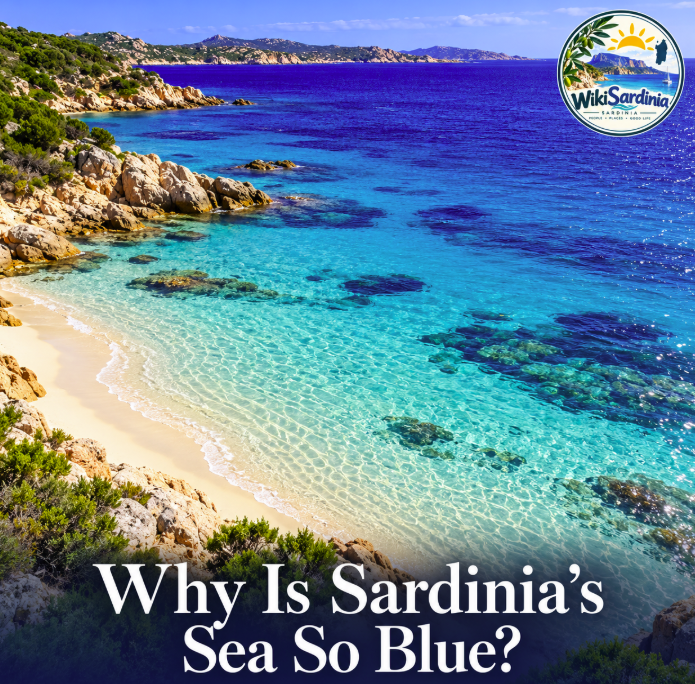
Sardinia’s sea looks blue because water absorbs some colours of sunlight more readily than others. Its famous turquoise shallows add another ingredient: light reaching a pale seabed and returning through clear water. Depth, the bottom beneath the surface and the conditions on the day combine to create the bands of colour that make a Sardinian beach so striking.
That is why the same bay can look almost transparent at your feet, bright blue a little farther out and much darker towards the horizon. There is no single “Sardinian blue,” and the effect does not require a tropical location. The island’s coastal scenery gives you memorable places to watch ordinary physics at work.
The blue begins inside the water
Sunlight contains a range of visible colours. As NOAA explains, water absorbs light in the red part of the spectrum, leaving more of the blue light available for us to see. Scattering helps return some of that light towards an observer. The colour you see therefore involves light travelling through water, rather than simply sitting on its surface.
The sky can still contribute a reflection. Woods Hole Oceanographic Institution points out that the surface may reflect a blue sky, grey weather or the colours of sunrise and sunset. But blue remains below the surface, where a sky reflection cannot explain it. Both processes can affect the view from the beach.
Why shallow bays turn turquoise
In clear, shallow water, sunlight can reach the bottom. A light-coloured sandy seabed sends some of it back up, making the water look brighter. NASA’s explanation of coastal colour connects these lighter shades with shallow water, bottom reflection and differences in light absorption. Where water becomes deeper, the bottom contributes less to the view and darker blues can take over.
Sardinia has familiar examples of this combination. The regional tourism authority describes La Pelosa, near Stintino, as having very fine white sand and shallow water extending for tens of metres. Its descriptions range from pale blue and turquoise to deeper blue. At Cala Brandinchi, in San Teodoro, the same authority highlights white sand, a very shallow seabed and darker patches around rocks.
These are useful examples, rather than proof that every beach on the island shares the same bottom. Applying the general science to those documented features helps explain the luminous shallows. A rocky cove can offer a different palette from a sandy bay, even when both waters are clear.
Clear water is not colourless scenery
Transparency lets you see more of what lies beneath the surface. It should not be confused with a promise that the whole sea will look uniformly pale blue. A dark patch may reflect a change in the bottom rather than a sudden change in water quality. Equally, colour alone cannot establish the depth or condition of a swimming spot.
The water itself also changes. Woods Hole explains that waves can stir sand and silt from the seabed, while material arriving from land can alter its appearance. Phytoplankton can produce greener or other hues. A beach photographed in settled weather may therefore look different after rough conditions. That does not mean the earlier photograph must have been edited, or that every change is a sign of pollution.
Watch the colours during your visit
Try looking at the same stretch from the water’s edge and from an existing elevated viewpoint. Notice where the visible bottom gives way to a darker band, and whether rocks interrupt the pale sand. You do not need a famous beach or a drone to make those observations; a short walk along the shore can reveal several different views.
For photographs, include some shoreline or seabed detail rather than filling the frame with an isolated blue patch. It gives the colour context and makes the scene more informative. Compare the view with your eyes before increasing saturation: Sardinia’s natural variation is often more interesting than a uniformly electric turquoise image.
And if the bay looks less dazzling than a travel photograph, look for what has changed: the light, the surface or the water beneath it. Understanding those differences turns “why is it so blue?” into something you can explore on the beach, one shifting shade at a time.