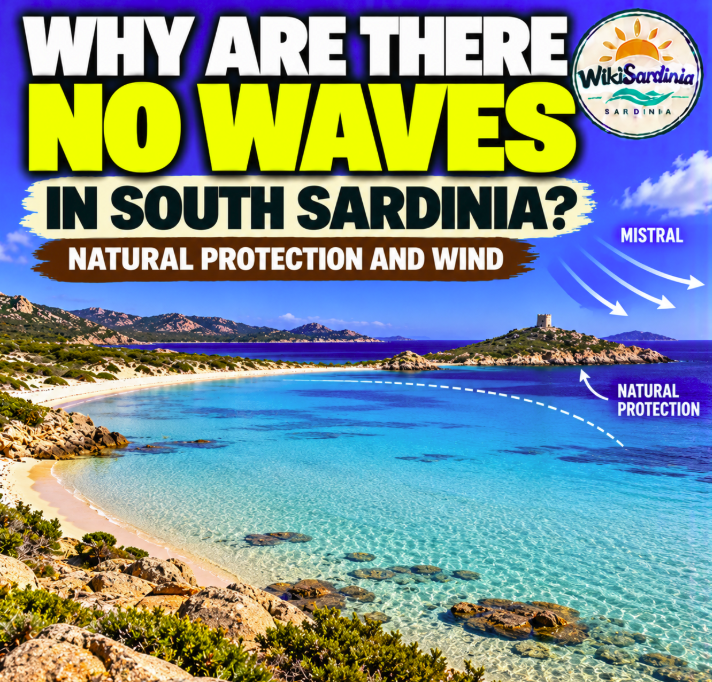
Why does the sea sometimes look completely flat in southern Sardinia? Visitors to beaches around Chia, Pula, Villasimius and Cagliari often find remarkably smooth turquoise water, particularly on calm summer mornings. The explanation is not that southern Sardinia has no waves. It is a combination of wind direction, coastal orientation, shelter from headlands, water depth and the distance over which wind blows across the sea—a distance known as fetch.
Southern Sardinia can also experience powerful surf, dangerous shorebreak and storm waves. Understanding the difference helps travelers choose a beach that is comfortable for swimming without assuming any stretch of coast is always protected.
Does southern Sardinia really have no waves?
No. The idea that the south coast is always flat is a myth. Many photographs are taken on calm days, in sheltered bays, or during the early morning before local breezes strengthen. Those images are real, but they represent particular conditions rather than a permanent characteristic of the region.
On other days, southern beaches can have breaking waves, strong currents and hazardous water. In fact, some south- and southwest-facing stretches are directly exposed to storms arriving from the appropriate direction.
The key factor: which way the wind is blowing
Wind transfers energy to the sea surface. How large the resulting waves become depends partly on wind strength, how long it blows and how far it travels across open water.
When the wind blows from land toward the sea—an offshore wind—it may leave the water close to the beach looking relatively smooth, even when conditions farther offshore are rougher. When it blows from sea toward land—an onshore wind—it can push waves toward the beach and make swimming less pleasant.
The same wind can therefore create very different conditions at beaches facing different directions.
Why the Mistral can leave some southern beaches calmer
The Maestrale, or Mistral, commonly blows from the northwest and is one of Sardinia's best-known winds. It can make exposed parts of the northwest and west coasts rough and windy.
At some beaches on the southern side of the island, a northwesterly wind arrives partly over land or from behind coastal terrain. That can reduce locally generated waves near shore. This is why people sometimes notice that the sea is choppy in one part of Sardinia while a south-facing cove looks almost like a swimming pool.
But the Mistral does not guarantee calm water across all of southern Sardinia. Local geography, the exact wind angle, wave swell and offshore conditions still matter. Offshore winds can also push swimmers or inflatables away from shore, so a flat-looking surface is not automatically safe.
What happens when the wind comes from the south?
Winds with a southerly component, including the Scirocco from the southeast and the Libeccio from the southwest, can expose parts of the southern coastline to rougher conditions. The effects depend on each beach's orientation and the storm's position.
A beach that feels protected during a northwesterly wind may become windy and wavy when the direction reverses. There is no single “good wind” for every southern beach.
How headlands and islands protect some bays
Sardinia's southern coast is full of curves, capes, rocky promontories and coves. These features can block some incoming wave energy or alter the way waves enter a bay.
For example, a beach tucked behind a headland may be sheltered from waves approaching at one angle, while a neighboring beach faces them directly. Small offshore islands and underwater topography can also influence local conditions, although the degree of protection varies.
This explains why two beaches just a short drive apart can look completely different on the same afternoon.
Does shallow turquoise water mean fewer waves?
Not necessarily. The beautiful pale-turquoise color of many Sardinian beaches is largely related to clear water, light-colored sand or seabed materials, and sunlight. Shallow water can look especially bright, but it does not prevent waves from forming.
As waves approach a shallow beach, they interact with the seabed, slow down, steepen and may break. Gentle seabed slopes can create broad, shallow swimming areas on calm days, but they can also produce surf when incoming waves are strong enough.
Why the sea can look flatter in the morning
On some settled days, early morning brings lighter local winds than the afternoon. As land heats up, a sea breeze may develop and create more surface chop later in the day.
This is a useful tendency, not a rule. Regional winds and weather systems can override the daily breeze cycle, and a swell can arrive even when the local air feels still.
Is Chia always calm?
No. The Chia area, including beaches such as Su Giudeu and Cala Cipolla, is famous for clear water and dramatic scenery, but conditions depend on the wind and swell. Su Giudeu is relatively open and can experience substantial waves. Cala Cipolla's smaller cove may offer shelter from some directions, but not all.
Choose based on the actual marine forecast and what you see at the beach, not a promise that “Chia has no waves.”
Is Villasimius calmer than the west coast?
It can be under certain wind patterns. The Villasimius area has beaches facing different directions, which gives visitors options. Porto Giunco and nearby coves may have different wave conditions on the same day because their exposure differs.
However, easterly or southeasterly weather can produce rough seas on beaches that look sheltered during a northwest wind. Check conditions individually.
What about Poetto in Cagliari?
Poetto is a long urban beach facing the Gulf of Cagliari. It often looks gentle in photographs, especially on settled days, but the gulf is not a sealed lagoon. Wind, swell and changing weather can generate waves.
Its long shoreline and convenient access make it easy to observe how conditions change during the day. If the sea is rough, stay out rather than assuming a city beach is automatically safe.
Is Tuerredda protected from waves?
Tuerredda is a visually sheltered bay with a beautiful sandy beach and a small offshore island. Its shape can help reduce exposure to waves from some directions, contributing to the calm-water photographs that make it famous.
But no cove is protected from every wind and swell direction. Strong weather can make Tuerredda unsuitable for swimming, and beach access rules may apply independently of sea conditions.
Why the west coast often has bigger waves
Many western beaches face a large expanse of open Mediterranean water, allowing waves generated by distant winds to travel toward the shore. Depending on the weather system, that exposure can produce stronger surf than a sheltered southern cove.
Still, the west coast can be glassy on calm days, and the south can be rough. Coastline direction and current conditions matter more than a blanket north-versus-south rule.
What is the difference between wind chop and swell?
Wind chop consists of relatively short, irregular waves produced by nearby winds. Swell consists of waves that have traveled away from the area where they were generated.
This distinction matters because a beach can look calm in terms of local wind while still receiving swell from a distant storm. Checking only the wind speed is not enough; look at forecast wave height, period and direction as well.
How to find a calmer beach in southern Sardinia
- Check the wind direction, not only the temperature or sunshine.
- Check wave height, period and swell direction in a marine forecast.
- Compare the orientation of nearby beaches on a map.
- Look for natural shelter from headlands, but do not assume it blocks all waves.
- Observe the beach on arrival, including breaking waves, currents and warning flags.
- Ask lifeguards or local authorities when available and follow posted safety advice.
Do not use this checklist as a guarantee of safe swimming. Local hazards can include rip currents, sudden drop-offs, rocks and offshore winds even when the water surface looks smooth.
Can you swim safely when the water looks flat?
Flat water is not proof of safety. Strong offshore winds can carry floating toys and inflatables away from the beach. Currents may be difficult to see, and underwater hazards remain present even in transparent water.
Never swim alone in unfamiliar conditions. Supervise children closely, avoid inflatables in offshore winds and do not enter the sea when warning signs or local advice indicate danger. Outside the main summer season, lifeguard coverage may be absent.
Does October have calmer seas than August?
There is no reliable universal rule. October may bring beautiful, quiet days, but autumn weather systems can also produce strong winds and swell. August often has more settled beach weather, although breezy days are common then too.
If you are visiting in October, check the forecast daily and remain flexible about which beach you choose. A sheltered bay on one day may be exposed the next.
Frequently asked questions
Why are there no waves on some beaches in southern Sardinia?
Usually because the wind and incoming swell are weak or approach from directions blocked by land, headlands or the beach's orientation.
Is the sea always calm in southern Sardinia?
No. Strong southerly, southeasterly or southwesterly weather can produce significant waves, depending on the beach.
Does the Mistral make southern Sardinia calm?
Sometimes it leaves certain south-facing beaches more sheltered than exposed western beaches, but not always.
Which is calmer, Chia or Villasimius?
Neither is always calmer. Their beaches face different directions, so the best choice changes with wind and swell.
Does Tuerredda have waves?
Yes, it can. Its sheltered appearance does not mean it is immune to storms.
Why is the sea turquoise if there are no waves?
Turquoise color comes primarily from clear water, the seabed and sunlight—not from the absence of waves.
Is the sea calmer early in the morning?
Often on settled days, but regional winds and swell can override this pattern.
Can a beach be dangerous with no visible waves?
Yes. Offshore winds, currents and underwater hazards can be present even in flat-looking water.
Is October a good month for calm-water swimming?
It can be on settled days, but autumn storms and reduced lifeguard coverage require caution.
How do I choose a beach with fewer waves?
Compare current wind direction, swell, wave height, coastal orientation and local safety advice rather than relying on a permanent ranking.
The bottom line
Southern Sardinia does have waves. Its famously calm-looking beaches are the result of favorable weather, protected bays and the way wind and swell interact with the coastline. The same beach can resemble a natural swimming pool one morning and be rough the next day. Learn to read the wind and the sea, and you will have a better chance of finding beautiful, comfortable conditions—without mistaking clear turquoise water for guaranteed safety.
Useful official resources
Italian Air Force Meteorological Service for weather and marine forecasts; Sardegna Ambiente for regional environmental information; SardegnaTurismo for destination information. Always consult current local marine conditions before swimming.