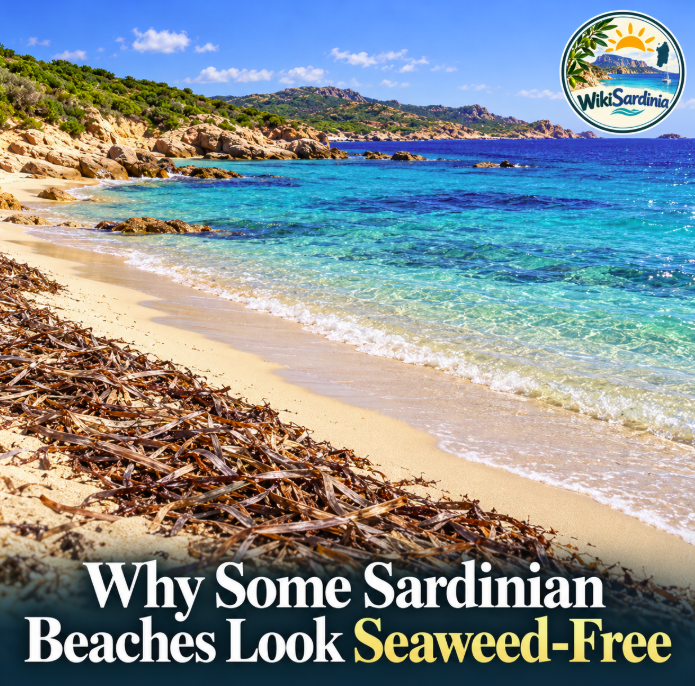
Sardinia’s beaches are not universally seaweed-free. Some photographs show an almost spotless strip of pale sand, while a different beach—or the same shore after rough weather—can have substantial deposits of brown leaves. Much of the material visitors call “seaweed” is Posidonia oceanica, a Mediterranean marine plant rather than an alga.
The useful question is why a particular beach looks clear at a particular moment. Natural movement of stranded leaves and local beach management can both affect what you see. A photograph alone cannot establish which explanation applies, and a clean-looking shoreline does not mean there is no marine vegetation offshore.
The brown leaves belong to a living coastal system
ISPRA explains that Posidonia forms underwater meadows and naturally sheds leaves. Storms can carry them onto beaches, where they accumulate into deposits known as banquettes. The underwater habitat supports marine life, while the stranded material helps protect the coast.
That distinction changes how a visitor might read the scene. Brown leaves on the sand are not, by themselves, evidence that a beach has been neglected. Nor should every piece of vegetation be identified as Posidonia without closer examination: other marine material can also wash ashore.
Think of the visible strandline as one part of the beach, rather than a complete report on the surrounding sea. An empty patch of sand tells you what is present in that patch when the image was taken. It cannot tell you how the beach looked last week, what lies outside the frame or what is growing underwater.
Why one beach photograph looks different from another
Natural deposition is one explanation. The Sardinian Region’s account of Posidonia conservation describes currents bringing dead leaves ashore, where they mix with sand. It notes that these deposits reduce damage associated with storms and erosion. Their presence can conflict with visitors’ expectations of an attractive bathing beach, even though they have an ecological role.
Management is another possible explanation. ISPRA documents practices including leaving deposits in place, moving them and removing them under applicable rules. It also warns that removal can take trapped sand away with the leaves. Its discussion of widespread removal refers to a 2007–2010 survey; it should not be read as a current inventory of every Sardinian beach.
For a specific location, ask the municipality or beach manager about its current approach rather than assuming that the absence of leaves proves recent cleaning. Similarly, a pile at one end of the beach should not automatically be described as dumped waste or an untouched natural deposit without local information.
Social videos add another limitation: framing. A short clip can show the stretch nearest the camera while omitting the rest of the shoreline. We have not verified the claim that this question is currently viral on TikTok, but it remains a useful example of how a beautiful image can prompt a misleading island-wide conclusion.
A natural beach is more than clear sand
On July 30, 2026, the Region announced operational directions for preparing its first regional Posidonia management plan. The announcement emphasised scientific criteria, monitoring and approaches suited to different coastlines. It was a step towards preparing the plan, not confirmation that a completed plan had already been applied everywhere.
For visitors, that means a beach with retained deposits can reflect a deliberate conservation approach. The appropriate question is how the shoreline is managed, rather than whether it matches an image of uniformly bare sand. Tourism and coastal protection have to be considered together.
Leave natural deposits where they are and follow local signs. If you encounter actual litter, distinguish it from the stranded vegetation when reporting it. Avoid clearing a patch yourself simply to improve a photograph; management decisions belong with those responsible for the beach.
When choosing somewhere to spend the day, use recent local information and consider access, facilities and conditions as well as appearance. No guide can promise a permanently leaf-free shoreline. Sardinia’s pale sand and blue water are real, but so are the marine plants and natural deposits that form part of its coast.