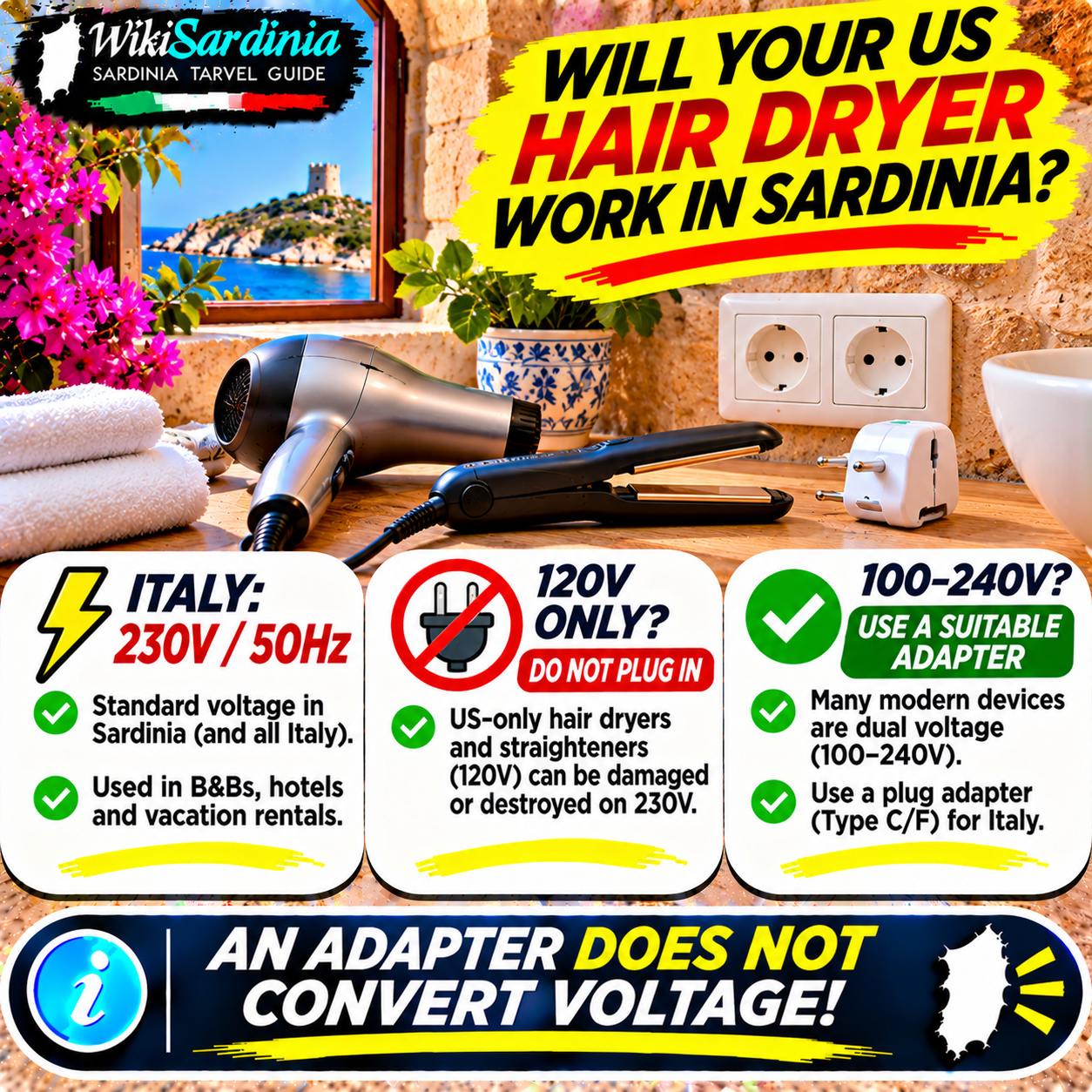
Yes—a US hair dryer or straightener designed only for 120 volts can overheat, fail or become dangerous if plugged into a normal socket in a Sardinian B&B. Sardinia uses the same electrical system as mainland Italy: nominally 230 volts at 50 hertz, often casually called “220V.” This applies to ordinary outlets in hotels, bed-and-breakfasts, agriturismi and holiday apartments. The crucial detail is the voltage rating printed on your own appliance, not the type of accommodation.
Is electricity 220V or 230V in Sardinia?
The modern nominal supply is 230V AC, 50Hz. You may still see 220V in older travel guides and everyday descriptions, but visitors should plan for a 230V supply. North American household outlets generally provide around 120V at 60Hz. A device built solely for 120V should never be assumed compatible with an Italian outlet.
Will a US hair straightener work?
Check the rating label before packing. If your straightener says INPUT 100–240V, 50/60Hz, it is designed to accept Italy's supply and generally needs only a suitable physical plug adapter. If it says 120V only or 110–120V, do not plug it directly into a 230V outlet. Some dual-voltage devices have a manual 120/240V selector: set it correctly according to the manufacturer's instructions before connecting it to power. Also check whether the manufacturer's instructions impose additional restrictions.
What about an American hair dryer?
Many US hair dryers are single-voltage, and dryers draw substantial power. A 120V-only dryer plugged into 230V can overheat or be permanently damaged. Do not try it “just for a second.” A high-power voltage transformer can sometimes be used if expressly suitable for the appliance, but it must meet the power and operating requirements; small travel converters are not a safe universal solution. For most visitors, using the accommodation's dryer or bringing a proper dual-voltage travel dryer is simpler.
Does a plug adapter convert voltage?
No. An adapter changes the physical connection so a US plug can fit an Italian socket; it does not turn 230V into 120V. This is the single most important distinction. Italy uses socket types C, F and L, although not every socket accepts every plug. Choose an adapter appropriate for the outlet and device, including its current rating and grounding needs. Never defeat a grounding connection to make a plug fit.
What if my device says 100–240V?
If the complete label indicates 100–240V, 50/60Hz, Italy's supply falls within the stated operating range. Use a properly rated compatible plug adapter and follow the manufacturer's instructions. Many phone and laptop chargers have universal-voltage inputs, but you should check the individual charger rather than assuming. A USB port built into a room is a separate low-voltage charging connection, not a suitable power source for a hair dryer.
Can I use a voltage converter for my 120V-only dryer?
Only a converter or transformer explicitly compatible with your particular appliance's wattage, motor/heating technology and frequency requirements should be considered. Check the hair dryer's rated power in watts and the converter's continuous output rating. A converter with a low wattage rating can overheat or fail when connected to a high-power dryer. Some electronic or motor-driven hair tools may not operate correctly even with certain converters. A locally supplied 230V dryer is usually the safer and more convenient option.
Do Sardinian B&Bs supply hair dryers?
Many do, but do not assume every room or rental apartment has one. Look for asciugacapelli or phon in the accommodation's amenities list and ask the host before arrival. You can write: “C'è un asciugacapelli in camera?” (“Is there a hair dryer in the room?”). If you also need a straightener, ask specifically; a supplied hair dryer does not imply that a straightener is available.
Are bathroom shaver sockets suitable?
No. A bathroom socket labeled for shavers may be designed only for low-power devices and is not a general solution for a high-wattage hair dryer or straightener. Follow the socket's markings and hotel instructions. Keep electrical appliances away from water and never use them with wet hands or near a filled sink or bathtub.
What should you pack from the USA?
Before departure, inspect the labels on your dryer, straightener and chargers. Bring a compatible Italian plug adapter rated for the intended load, a dual-voltage styling device if needed and any manufacturer's instructions for manual voltage switching. If your dryer is 120V-only, leave it at home and confirm the hotel provides one. Do not use a US-only power strip to bypass voltage restrictions.
What if I accidentally plugged a 120V dryer into 230V?
If it sparks, smells of burning or behaves abnormally, stop using it immediately and disconnect power only if it is safe to do so. Do not touch a damaged or overheating appliance with wet hands. Notify your accommodation if the socket, breaker or room wiring may have been affected. Do not reconnect a possibly damaged appliance to test whether it still works.
Frequently asked questions
Is Sardinia different from the rest of Italy for electricity?
No. Ordinary mains electricity uses the same nominal 230V/50Hz standard.
Will a US-to-Europe adapter protect my hair straightener?
No. A basic adapter does not change voltage. Your straightener must be compatible with 230V or be used with a suitable approved voltage-conversion solution.
Can I use a 100–240V hair dryer?
Generally yes, with a properly rated compatible plug adapter, provided the frequency and manufacturer's requirements are also met.
What plugs are used in Sardinia?
Types C, F and L are used in Italy. Socket compatibility varies, so choose an adapter that fits the actual outlet and preserves required grounding.
Are US phone chargers safe?
Many are rated 100–240V, 50/60Hz, but verify the label on each charger before use.
The takeaway
In Sardinia, expect 230V—not US 120V. A 120V-only hair dryer or straightener can be damaged or dangerous if plugged directly into a normal B&B socket. A dual-voltage model rated for 100–240V and 50/60Hz generally works with a suitable adapter. Remember: an adapter changes the plug, not the voltage.
Sources: Electrical Safety First — Italy; Italia.it — Practical travel information; Conair — Appliance voltage and converters.