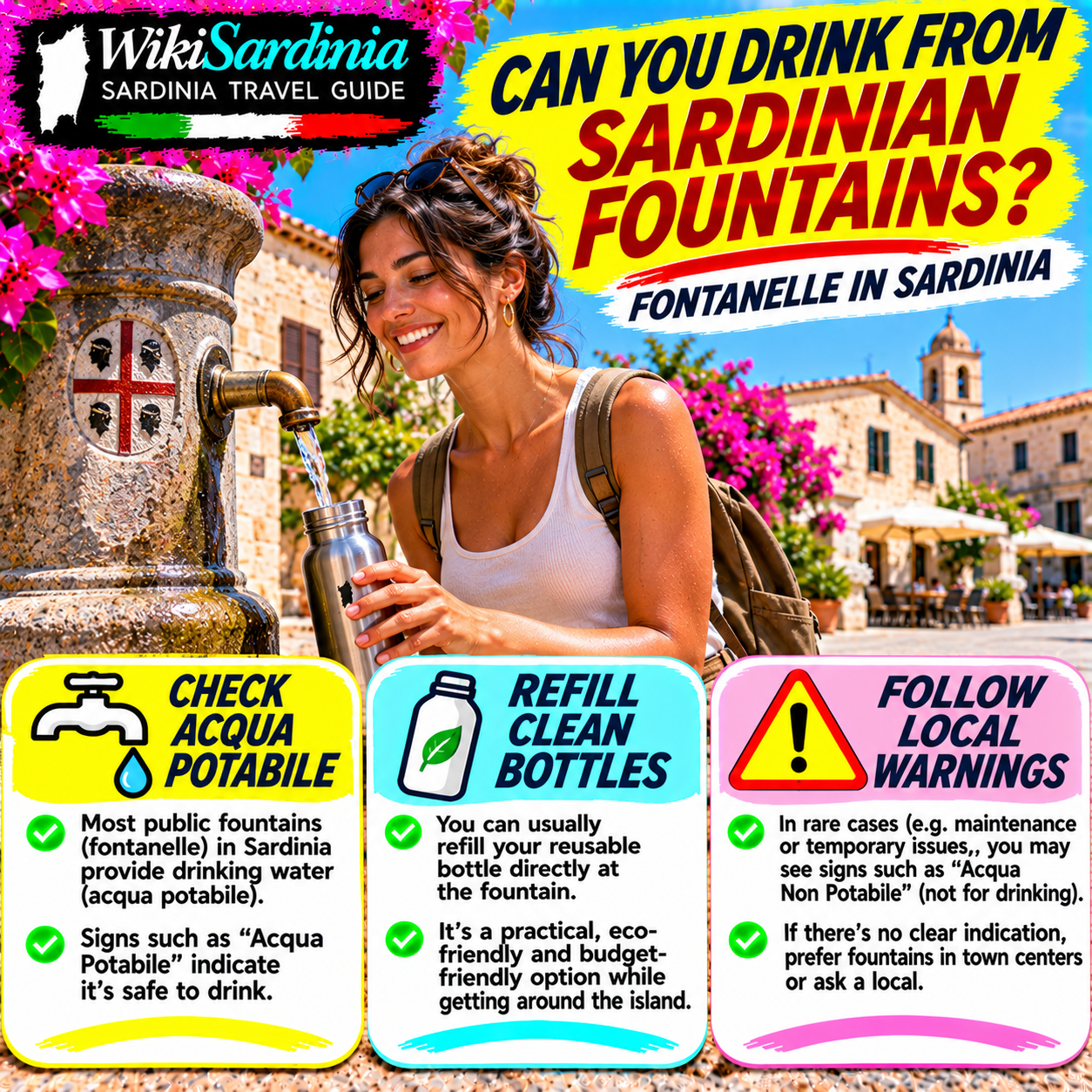
Yes, many public drinking fountains (fontanelle) in Sardinian towns provide potable water and can be used to refill reusable bottles for free. But not every spout, spring or ornamental fountain is a drinking-water source. Always check local signs and any current municipal or water-provider warning before drinking, especially after service interruptions.
What is a fontanella?
A fontanella pubblica is a public water outlet commonly found in town squares, parks and streets. It may have a tap, push-button or continuously flowing spout. Some are connected to the municipal drinking-water network, meaning they normally dispense the same regulated water supplied to local homes. Others may be fed by springs or different systems, so appearance alone cannot establish potability.
Is the water safe to drink?
The Italian National Institute of Health (Istituto Superiore di Sanità, ISS) explains that public drinking water is regulated and subject to quality monitoring, and is generally safe when it meets the legal requirements. Sardinian fountains connected to the potable network normally share this protection. However, a specific outlet may be temporarily affected by contamination, infrastructure work, local restrictions or poor hygiene at the spout. Do not assume every fountain on the island is safe simply because water flows from it.
What do the signs mean?
Acqua potabile means drinking water. Acqua non potabile means not suitable for drinking. Divieto di bere means drinking prohibited. Acqua non destinata al consumo umano means not intended for human consumption. A current official municipal warning overrides an old sign, a tourist map or an online review. If no sign is visible and you cannot verify the source, ask the municipality or choose a clearly designated potable outlet.
How do you use a public fountain?
Look for a clearly identified potable fountain. If it has a tap, turn it gently; if it has a button, press to start the flow. Use a clean reusable bottle, keep the bottle rim away from the spout, avoid touching the outlet with your hands or mouth and let the water run briefly if the fountain has been unused. Do not wash shoes, pets or dirty equipment directly against a drinking spout. Leave the fountain clean for the next visitor.
What if the water looks cloudy or smells strange?
Do not drink it. ISS recommends avoiding water with abnormal color, smell or taste and seeking information from the local health authority or water supplier. A slight chlorine taste can occur in treated water and does not by itself prove it is unsafe, but unexpected changes should be checked. Do not rely on boiling to solve every problem: boiling does not remove chemical contamination, and official 'non-potable' warnings may concern different hazards.
What about temporary water warnings in Sardinia?
Local authorities can restrict drinking-water use when tests reveal a problem. The municipality may issue an ordinanza di non potabilità or another limitation, and the water operator may publish updates. Such restrictions may apply to a neighborhood or particular locality rather than an entire town. Check the municipality's official notices and the relevant provider, including Abbanoa where it operates, before refilling if you have heard of an alert. An older restriction may have been lifted; always check its current status.
Are rural springs safe?
Not automatically. A natural spring (sorgente) or roadside pipe may look clean and taste refreshing but still contain microorganisms or contaminants. Unless there is reliable current confirmation that the source is potable and monitored, do not treat it like a town drinking fountain. This is especially important when hiking in remote parts of Sardinia, where livestock, wildlife and rainfall can affect water sources.
What is a casa dell'acqua?
A casa dell'acqua is a dedicated public water-dispensing station, sometimes offering chilled or sparkling water. Some operate free of charge, while others use small fees, cards or other access systems. They are different from traditional street fountains, although both may use regulated public water. Follow the machine's hygiene and bottle-placement instructions, and verify its status and pricing locally.
Can tourists refill bottles for free?
At an ordinary publicly accessible potable fountain, refilling a personal bottle is generally free. Some kiosks or water-dispensing stations charge for water or carbonation. Never assume a decorative fountain or private tap is open for drinking. If the outlet is on private property or has restricted access, ask permission.
How do you keep your bottle hygienic?
Wash and disinfect reusable bottles regularly according to the manufacturer's instructions, particularly caps, straws and seals. ISS warns that poor bottle hygiene can cause secondary contamination even when the water itself meets drinking standards. Avoid touching the fountain outlet with the bottle opening, and do not leave filled bottles for long periods in direct summer heat.
Can children drink from fontanelle?
Children can generally drink from a verified potable fountain, provided the water is currently safe and the bottle or cup is clean. Supervise young children so they do not put their mouths directly on the spout. For infant formula, follow specific infant-feeding and safe-water preparation guidance rather than assuming that every public refill point is appropriate for preparing formula.
How do you find fountains in Sardinia?
Look for signs reading fontanella or acqua potabile, ask at tourist information offices and check mapping services that list public drinking fountains. Crowdsourced maps can help locate a fountain but cannot certify today's water quality. For any suspected issue, the official municipality, water operator or local health authority is the authoritative source.
What about beaches and hiking trails?
Do not rely on finding a drinking fountain at every beach, trailhead or remote cove. Carry enough water for the heat, distance and group size, and plan refills at confirmed points before leaving a town. A fountain marked on a map may be dry, out of service or unsuitable for drinking. Summer heat makes contingency water particularly important.
Useful Italian phrases
“Quest'acqua è potabile?” — Is this water safe to drink? “Posso riempire la borraccia?” — May I refill my water bottle? “C'è una fontanella pubblica qui vicino?” — Is there a public fountain nearby? “Ci sono ordinanze sull'acqua?” — Are there any water restrictions? “La fontana funziona?” — Is the fountain working?
Frequently asked questions
Is fountain water in Sardinia safe?
Water from an identified public drinking fountain connected to a compliant municipal network is normally safe, unless a current warning or local issue says otherwise.
Does 'acqua potabile' mean drinkable?
Yes, but check for more recent restrictions and abnormal water conditions.
What does 'acqua non potabile' mean?
It means the water must not be used for drinking.
Can I refill my bottle for free?
Usually at a public drinking fountain. Specialized dispensers may have fees or access conditions.
Is a mountain spring always cleaner?
No. Clear spring water is not necessarily microbiologically safe.
Can I drink from an ornamental fountain?
Do not assume so. Use designated drinking-water outlets.
Do I need a water filter?
Not normally for verified municipal potable water. A portable filter does not guarantee removal of all chemical contaminants or make an officially restricted supply safe.
Where can I check water restrictions?
Look at the municipality's official notices, the water operator's service alerts and local health-authority communications.
The takeaway
Refilling a reusable bottle at Sardinia's public drinking fountains is often safe, practical and environmentally friendly. Verify that the fountain dispenses potable water, respect current municipal warnings, keep your bottle clean and never assume an unmarked spring or decorative fountain is drinkable. Carry extra water for remote beaches and hikes.
Official and practical sources: Istituto Superiore di Sanità — Safety of tap water; ISS — Safe use and bottle hygiene; ISS — Drinking-water legislation and monitoring; Abbanoa — Water-service information and alerts.