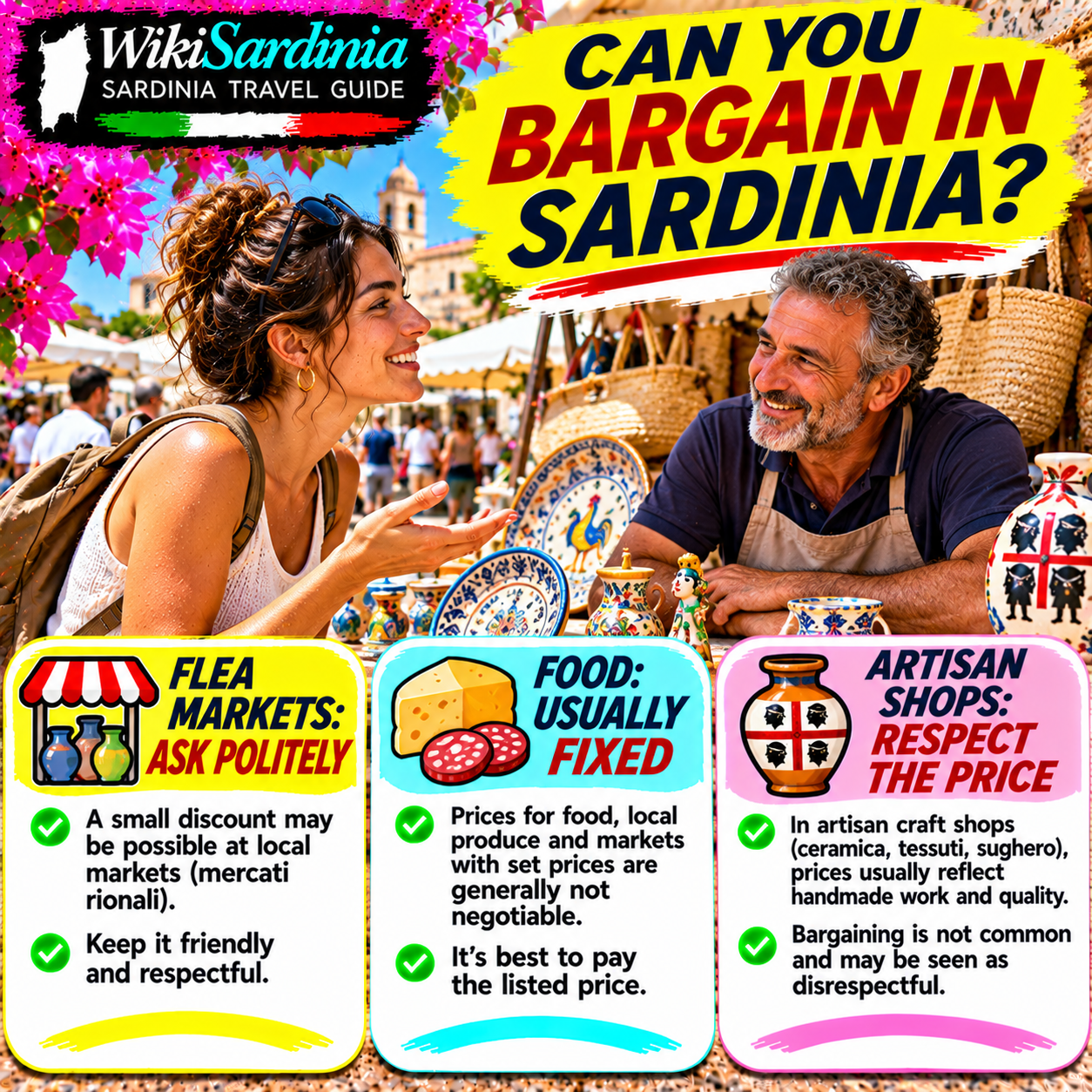
Yes, you can sometimes bargain at street markets in Sardinia, but haggling is not an everyday expectation across the island. A friendly request for a modest discount may be welcome at flea markets, antiques fairs or some informal souvenir stalls. At food markets, established shops and workshops selling genuine handmade Sardinian crafts, prices are usually fixed and should be respected. The best approach is to understand what kind of seller you are dealing with before asking for a better price.
Is bargaining normal in Sardinia?
Unlike markets where prolonged haggling is a central part of shopping culture, Sardinian retail generally works with displayed prices. Travel guides to Italy distinguish between non-food street stalls and flea markets, where negotiation can be possible, and food stalls or regular shops, where it is unusual. Sardinia's seasonal evening markets sometimes have informal sellers open to a small price adjustment, but this depends on the stall and the product, not on a universal local custom.
Where can you politely ask for a discount?
Flea markets and secondhand stalls: This is often the most natural setting for discussing price, particularly when condition, age or authenticity affects an item's value. Antiques fairs: Sellers may consider a reasonable offer, especially for several items. Informal souvenir and non-food market stalls: A small discount may be possible, particularly if you buy more than one item. Seasonal evening markets: Some vendors negotiate; others, especially artisans who make their own work, have firm prices. Asking once politely is fine, but the answer may simply be no.
Where should you avoid haggling?
Food markets: Fruit, vegetables, cheese, bread, honey and other local foods are generally sold at the stated price. A familiar customer may occasionally receive a small extra or rounding gesture, but tourists should not expect to bargain over each kilogram. Supermarkets, pharmacies and established retail shops: Prices are normally fixed. Artisan workshops and galleries: A price often reflects material costs, skilled labor and hours of work; aggressive bargaining can feel dismissive. Restaurants and cafés: Menu prices are not opening offers for negotiation.
What about handmade Sardinian ceramics?
Traditional pottery can involve hand shaping, glazing, painting and firing. If you are buying directly from the maker, first ask about the process and the origin of the piece. Do not assume a handcrafted plate should cost the same as a mass-produced souvenir. If you are purchasing several items, you may politely ask whether the artist offers a combined price, but accept a refusal without pressing.
Can you negotiate for baskets, textiles and cork crafts?
The same principle applies to woven baskets, traditional textiles and cork objects. A genuine handmade item may take considerable time to produce, and the artist may set a firm price. At a reseller's souvenir stall, there might be more flexibility than at a working artisan's studio. Ask whether the object was made locally, what materials were used and who produced it before comparing prices. A cheaper price does not necessarily mean better value or authenticity.
What about Sardinian filigree jewelry and coral?
Jewelry, gold, silver and coral pieces are generally sold through established retailers with stated prices. You can ask about craftsmanship, material, hallmarking and documentation, but do not expect market-style haggling. For coral, verify provenance and any applicable trade restrictions, especially before taking items outside the European Union. If buying an expensive piece, you can ask whether there is a promotion or price for multiple purchases, but avoid assuming that the initial price is deliberately inflated.
Does buying multiple items help?
Sometimes. A reasonable question such as “If I buy three, could you offer a combined price?” is more natural than demanding a large reduction on one handmade object. For example, if three souvenirs are individually priced at €15, the seller may or may not offer a small total discount. There is no standard percentage and no entitlement to a reduction. Never invent defects or pressure the seller into accepting a price below their costs.
How much should you offer?
There is no reliable Sardinian rule such as always offering half the asking price. In many settings that would be inappropriate. Compare genuinely similar items, consider craftsmanship and make a modest, respectful request only where bargaining seems welcome. If a vendor says the price is fixed, thank them and decide whether the item is worth buying.
Is it rude to ask for a discount?
A single friendly question is not automatically rude. The problem is treating every shop like a bargaining arena, criticizing handmade work or repeatedly pushing after the seller declines. A smile and a simple “È possibile un piccolo sconto?” can be acceptable in a suitable market context. Respecting the answer is more important than winning the negotiation.
What does the displayed price mean?
In normal Italian retail, a displayed price is the advertised selling price rather than a starting bid. Market rules can also regulate price display and changes. For example, Alghero's municipal market regulation addresses posted prices and prohibits charging more than the indicated price without justification. A seller's voluntary reduction is different from treating all labels as negotiable.
Can you get a discount for paying cash?
Do not assume cash automatically entitles you to a lower price. Italian businesses have electronic-payment obligations subject to applicable rules, and a legitimate sale should still be properly documented. A vendor may voluntarily offer a lawful discount, but you should not agree to avoid a receipt or tax documentation in exchange for a lower price. Ask for the appropriate receipt when purchasing.
Are tourist prices higher than local prices?
Prices can vary between locations, quality levels and sellers, especially in busy coastal destinations. That does not prove a vendor is charging tourists a separate rate. Compare like-for-like products, check labels and ask about provenance. If a price seems excessive, you can decline and shop elsewhere without confrontation.
Useful Italian phrases
“Quanto costa?” — How much does it cost? “Il prezzo è fisso?” — Is the price fixed? “È trattabile?” — Is it negotiable? “È possibile un piccolo sconto?” — Is a small discount possible? “Se ne compro due, mi fa un prezzo migliore?” — If I buy two, can you offer a better price? “È fatto a mano in Sardegna?” — Is it handmade in Sardinia? “Grazie, ci penso.” — Thank you, I'll think about it.
Frequently asked questions
Can tourists haggle in Sardinian markets?
Sometimes, especially at flea markets, antiques fairs and informal non-food stalls. It is not a universal custom.
Can I bargain over fruit and vegetables?
Generally no. Food-market prices are normally fixed.
Can I negotiate in a ceramics workshop?
You may ask politely about a combined price for multiple pieces, but respect the maker's stated prices and craftsmanship.
Should I offer half the asking price?
No. There is no general 50-percent bargaining convention in Sardinia, and such an offer may be insulting.
Are evening markets different?
Some informal non-food stalls may allow small discounts, but artisans and food sellers may use fixed prices.
Is it better to pay cash?
Cash may be convenient at some stalls, but it does not guarantee a discount or remove receipt requirements.
Can I ask for a discount on jewelry?
You can ask about promotions or multiple-item pricing, but established jewelry stores normally have fixed prices.
What if the seller refuses?
Thank them, then either pay the stated price or walk away politely.
The takeaway
In Sardinia, polite bargaining can be part of browsing flea markets and some informal stalls, but it is not standard practice at food markets or artisan shops. Ask once, keep offers reasonable and remember that authentic craftsmanship has a real cost. A respectful conversation with a local maker is often worth more than saving a few euros.
Sources: Rough Guides — Shopping in Italy; Sardinia Inside — Markets and supermarkets; Rick Steves — How to Haggle; Comune di Alghero — Municipal market regulations.