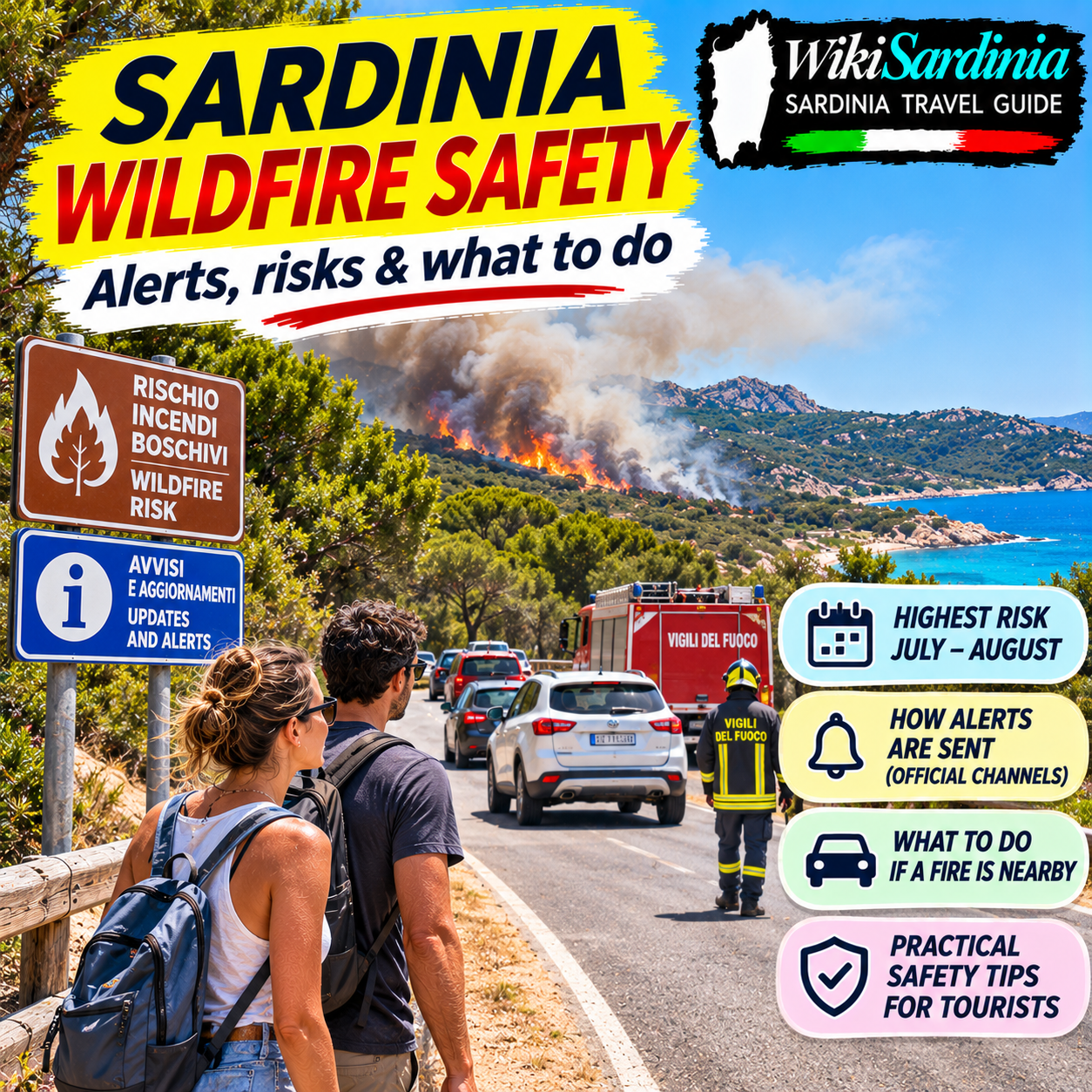
Yes. Wildfires are a genuine summer safety risk in Sardinia, particularly during hot, dry and windy weather in July and August. This does not mean the island is generally unsafe to visit. It means travelers should check official daily fire-danger forecasts, respect temporary closures and know how to contact emergency services. In 2026, Sardinia's official high-fire-danger period ran from June 1 to October 31, subject to weather-related adjustments.
When is wildfire season in Sardinia?
The regional 2026 fire-prevention rules established June 1 through October 31 as the high-danger period. July and August are especially relevant to tourists because dry vegetation, high temperatures, wind and busy coastal roads can combine to increase exposure. An official danger forecast describes the potential for fires to start and spread; it does not mean a wildfire is currently burning in your area.
How are wildfire warnings issued?
Sardinia's regional Civil Protection system produces daily wildfire-danger bulletins covering designated warning zones. These are published through official regional channels and may be relayed by municipalities, local police, accommodation providers and news outlets. During an actual emergency, authorities may communicate road closures, evacuations and protective instructions using local official channels and direct on-site directions. Travelers should actively check these sources rather than expecting a personal text message every time the risk rises.
Will I receive an IT-alert message on my phone?
Do not rely on IT-alert as a guaranteed wildfire-warning service. Italy's national cell-broadcast system is designed for specific severe emergency scenarios. The Civil Protection Department's published operational risk categories do not establish a general automatic notification for every Sardinian forest fire. A phone may receive emergency communications where an applicable system is activated, but the absence of a message does not prove that a nearby area is safe. Keep checking local official notices and follow emergency responders.
Where can I check the daily danger level?
Start with the Regione Autonoma della Sardegna and its Civil Protection wildfire bulletins, including the designated territorial warning zones. The Sardegna Ambiente portal provides fire-prevention resources. For a specific beach, mountain trail or town, also check the municipality's website or official communications. Forecast maps are not live maps of every active fire, so distinguish a high-danger bulletin from an actual incident report.
What do the warning levels mean?
The regional fire-danger bulletin uses four levels of forecast danger. Higher levels indicate that conditions may allow more dangerous fire behavior and may trigger additional restrictions or operational precautions. The precise implications for a visitor depend on local measures, such as temporary closures of natural areas, limits on access or parking restrictions. Read the actual bulletin and any municipality-specific ordinance instead of treating the color alone as a universal beach-closure instruction.
Can beaches and nature trails close?
Yes. Authorities may restrict access to forests, nature reserves, trails, parking areas or coastal routes when danger is elevated or an active fire threatens access. Not every beach closes on a high-risk day. Sardinia's updated 2026 rules specifically strengthen fire-safety provisions for tourist parking areas and coastal access, including escape routes and vegetation management. If your intended destination has one narrow access road, check whether it is open before driving there.
What if you see smoke or flames?
Move away from the danger, avoid vegetation and smoke, and immediately report the location. In Sardinia, the regional government identifies 1515 for the Forestry Corps and 112 as the unified emergency number. Give the nearest road, beach or trail name, a map pin if available, visible landmarks, and whether people are at risk. Do not approach the fire to take photos or launch a drone. Follow instructions from firefighters, police and Civil Protection personnel.
What should you do if a wildfire approaches your beach?
Stay calm, alert the emergency services and follow official evacuation instructions. Do not assume the sea is automatically the safest escape route: smoke, cliffs, wind and access conditions matter. Move away from smoke and flames using an officially safe route, avoiding dense vegetation and blocked roads. If exits are cut off, tell emergency services your exact position and follow their guidance. Never attempt to drive through flames or thick smoke.
What if you are driving?
Check for closures before traveling to remote beaches or rural villas. If smoke reduces visibility or a road is blocked, do not drive toward the fire or bypass police barriers. Stop only in a safe place without obstructing emergency vehicles, follow traffic directions and choose an authorized alternative route. Keep enough fuel or battery reserve for a detour, and do not park on dry vegetation or block emergency access.
What if you are hiking or camping?
Check the day's bulletin and local trail restrictions before leaving, tell someone your route and carry water, a charged phone and offline maps. Avoid lighting fires or using any ignition source contrary to regional rules. If you see smoke, turn back early rather than continuing toward a ridge or canyon. Remote valleys and narrow trails can be difficult to evacuate. For organized excursions, follow the guide's risk assessment and instructions.
Are villas and agriturismi at risk?
Some rural accommodations are near woodland or scrub, so ask the host about emergency exits, assembly points and the nearest safe road. The 2026 regional rules reinforce protective measures around tourist facilities and parking, but the existence of those requirements does not guarantee every property is equally protected. Save the property's address and GPS location and learn how to open gates during an emergency.
What about children, older travelers and people with reduced mobility?
Plan evacuation needs in advance. Ask your accommodation whether accessible escape arrangements exist and how staff will communicate instructions. Keep essential medicines, identification, water and mobility equipment ready. If you cannot evacuate without assistance, contact emergency services early and explain the specific need rather than waiting for the situation to worsen.
Can I use a barbecue, campfire or fireworks?
Regional fire-prevention prescriptions and local ordinances can restrict ignition sources, burning, outdoor fires and hazardous activities during the high-danger season. Do not assume a private villa garden, beach or campsite permits a barbecue or fireworks. Ask the property manager and consult the current rules before lighting anything. Never discard cigarette ends into vegetation or from a vehicle.
Do wildfires affect flights, ferries or road trips?
An active fire may cause road closures and local transport disruption, while smoke or operational safety requirements can affect nearby services. There is no automatic island-wide transport shutdown when a wildfire occurs. Check your airline, ferry company, road authority and municipality for the exact route and date. Allow extra time and avoid attempting to reach a closed area.
What should tourists do before leaving their hotel?
- Check the official daily fire-danger bulletin for your destination.
- Check local closures and instructions from the municipality or protected-area manager.
- Save the address and GPS pin of your accommodation and destination.
- Carry water, a charged phone and offline navigation.
- Know that 112 is the emergency number and 1515 is the Forestry Corps fire-reporting line.
- Follow official directions immediately if conditions change.
Useful Italian phrases
“C'è un incendio vicino?” — Is there a fire nearby? “La strada è chiusa?” — Is the road closed? “Dove possiamo andare in sicurezza?” — Where can we go safely? “Serve evacuare?” — Do we need to evacuate? “Siamo sulla spiaggia di…” — We are at … beach. “Abbiamo bisogno di assistenza.” — We need assistance.
Frequently asked questions
Are July and August dangerous for tourists?
Wildfires are a real seasonal hazard, but risk varies by location and weather. Check the daily forecast and local instructions.
Does Sardinia publish daily wildfire warnings?
Yes. Regional Civil Protection issues fire-danger bulletins for territorial warning zones.
Will my American phone automatically receive a wildfire alert?
Do not assume so. IT-alert is not a guaranteed notification system for every wildfire.
What number should I call if I see a fire?
Call 112 for emergencies or 1515 to report a wildfire to Sardinia's Forestry Corps.
Are beaches closed on high-risk days?
Not automatically. Closures depend on the specific local conditions and official decisions.
Can I drive through smoke to reach my hotel?
No. Avoid smoke, flames and roadblocks, and follow emergency personnel's instructions.
Should I cancel my holiday because of wildfire season?
Not automatically. Monitor the actual conditions and follow any specific travel or evacuation advisories.
Can fires happen outside August?
Yes. The official 2026 high-danger period extended from June through October, and fires are possible outside it.
The takeaway
Wildfires are a serious but manageable travel risk when visitors prepare and follow local instructions. The most reliable routine is to check Sardinia's daily official fire-danger bulletin, respect closures and know how to contact emergency services. Do not depend solely on a smartphone push notification to tell you when danger is near.
Official sources: Regione Sardegna — 2026 fire-prevention rules; Regione Sardegna — 2026 wildfire campaign; Regional Civil Protection — Wildfire bulletins and monitoring; Italian Civil Protection — IT-alert; Italian Civil Protection — Wildfire response.