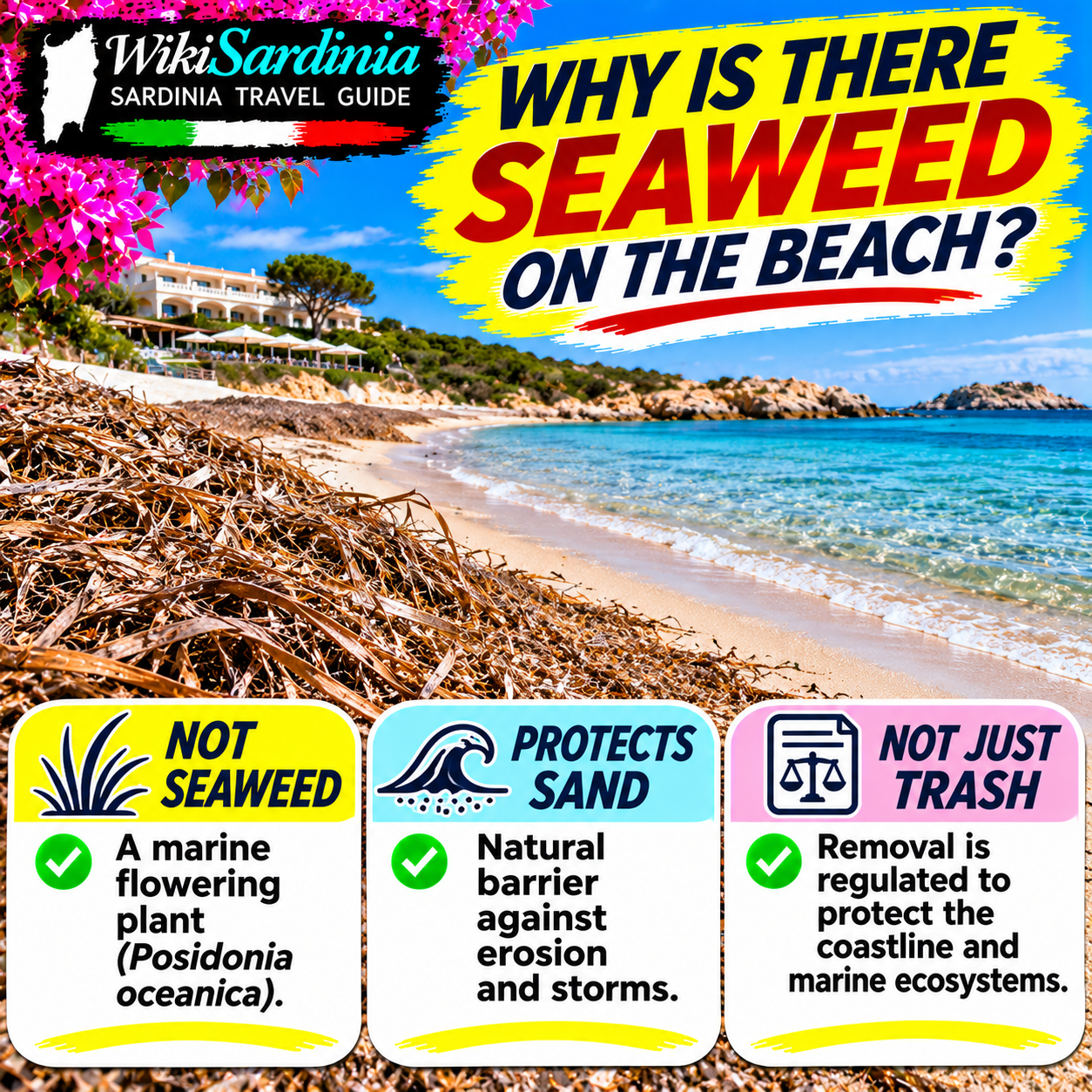
The brown piles that sometimes cover Sardinian beaches are usually dead leaves of Posidonia oceanica, a Mediterranean seagrass—not ordinary seaweed and not automatically garbage. Waves and currents carry the leaves ashore, where they form natural deposits called banquettes. Hotels and beach clubs cannot simply bulldoze them away whenever they want: removing them can take valuable sand with them, increase coastal erosion and breach environmental management rules.
What exactly is Posidonia oceanica?
Posidonia is a flowering marine plant with roots, leaves and underwater meadows. It grows in clear Mediterranean coastal waters and provides shelter, feeding grounds and nursery habitat for marine life. Its underwater meadows are protected as a priority habitat under the European Habitats Directive. The plant naturally sheds leaves, which waves may carry onto beaches. Finding dead leaves on shore does not mean that living seagrass is dying or that the beach is polluted.
Why does it pile up in thick brown banks?
Waves, currents and seasonal storms transport detached leaves and other plant remains to the shoreline. Over time they can build thick, compacted deposits known as banquettes, sometimes reaching substantial heights. Their size changes with weather, beach shape and wave exposure. The deposits trap sand and become part of the beach's natural sediment system rather than simply sitting on top of it as disposable waste.
Why don't hotels and beach clubs clean it away?
Because removing it indiscriminately can damage the beach. Sand becomes trapped between the leaves; mechanical removal often carries that sand away too, accelerating erosion. The deposits also absorb wave energy and help protect the shoreline, especially during storms. The beach may be public maritime land, and even a hotel operating a licensed beach concession must follow municipal, regional and protected-area rules. A hotel cannot assume it has permission to permanently remove a natural deposit just because guests dislike it.
Is removing Posidonia illegal in Sardinia?
It is regulated, not universally prohibited. Sardinia's Regional Law No. 1 of February 21, 2020 recognizes beached Posidonia as natural coastal protection and identifies leaving it in place as the preferred solution. Where deposits prevent normal summer beach use, municipalities and, under the relevant procedures, concession holders may arrange temporary relocation to suitable areas, with later replacement. Protected marine areas can impose stricter limits. The applicable permissions, notifications and methods depend on the beach and operation; visitors should not assume that every deposit may be removed or that no removal is ever possible.
What changed in 2026?
On July 30, 2026, Sardinia's regional government announced operational directions for preparing its first regional Posidonia management plan. In a notice published November 2, 2026, the Region announced €700,000 in 2026 funding for municipalities to manage beached Posidonia, with priority for temporary movement followed by replacement on the same beach. This is funding and policy guidance, not a promise that every tourist beach will be cleared. After the January 2026 Cyclone Harry storms, special emergency guidance also prioritized leaving deposits in place where possible to protect the coast.
Is Posidonia a sign of dirty water?
No. Living Posidonia meadows are generally associated with ecologically valuable coastal waters and are sensitive to environmental degradation. However, a pile of leaves is not a water-quality test. Swimming-water safety depends on official monitoring, contamination events and local restrictions. Check designated bathing-water results if you have concerns; do not judge microbiological safety solely by the color or amount of seaweed-like material.
Why does it sometimes smell?
Large wet deposits can undergo natural decomposition, producing unpleasant odors, especially in warm conditions. This does not automatically mean sewage pollution. But plastic, food waste or other litter mixed into the deposit should be managed separately, and unusual pollution concerns can be reported to the municipality or beach operator. A strong odor alone cannot establish whether bathing water is safe.
Can you still swim where Posidonia is piled up?
Often yes, provided bathing is permitted, local water-quality information is satisfactory and sea conditions are safe. Deposits on the beach are not in themselves a universal swimming ban. Enter the water carefully because thick wet layers may be slippery or hide uneven ground and litter. Follow lifeguard flags and any local closure notices.
Does Posidonia protect Sardinia's famous white sand?
Yes. ISPRA explains that banquettes trap sediments and protect beaches from wave-driven erosion. Removing them can also remove sand, forcing costly beach replenishment later. The deposits may look unattractive to some visitors, but they help preserve the very coastline travelers come to see. They also provide habitat and nutrients for organisms in the coastal ecosystem.
Can hotels move it to make room for sunbeds?
Only within applicable rules and procedures. Temporary seasonal relocation can be permitted when deposits prevent regular use of a beach, but operators must respect the beach's ecological balance, dunes and vegetation, and any special protected-area requirements. The correct process is coordinated with the relevant authorities rather than decided unilaterally by a hotel. Some beaches are deliberately managed as ecological beaches, leaving the deposits largely undisturbed.
What should visitors do if a beach is covered?
Ask your hotel or beach club whether there is an accessible section, whether approved seasonal management is planned, and whether a nearby alternative beach has different current conditions. Do not drag away large amounts yourself or remove sand and natural material as souvenirs. If the deposit contains plastic, glass or suspected hazardous waste, alert the operator or municipality rather than attempting unsafe cleanup. Check recent beach photos, weather and local notices before traveling to a remote cove.
Can you predict which beaches will have it?
Not reliably months in advance. Accumulations depend on underwater meadows, winds, currents, storms and shoreline shape. A beach can look different from one week to the next. Ask accommodation staff for current conditions rather than relying on an old promotional photograph. The presence of Posidonia is not limited to budget beaches; it can occur beside luxury resorts too.
What is an ecological beach?
ISPRA promotes the concept of a spiaggia ecologica, where natural beach deposits are recognized as part of the coastal environment and visitors are informed of their benefits. The aim is not to abandon litter collection or public safety, but to distinguish human-generated rubbish from naturally deposited marine vegetation. A well-managed ecological beach may retain Posidonia while still removing plastics and other waste.
Frequently asked questions
Is Posidonia oceanica seaweed?
No. It is a marine flowering plant, or seagrass, rather than an alga.
Why is it brown?
Detached and aging leaves naturally turn brown as they dry and decompose on the shore.
Does it mean the beach is polluted?
No. Natural Posidonia deposits are not proof of pollution, though separate litter or contamination can occur.
Can a hotel remove it for guests?
Only under applicable coastal-management rules and procedures; it is not an unrestricted hotel cleaning decision.
Is Posidonia removal completely banned?
No. Sardinian law prefers keeping deposits in place but allows regulated management and temporary relocation in specified circumstances.
Can I swim near a Posidonia bank?
Often yes, if swimming is otherwise permitted and water and sea conditions are safe.
Why does it smell bad sometimes?
Natural decomposition of wet organic material can produce odors, particularly in warm weather.
Will every beach be cleaned before summer?
No. Management varies by location, conditions, regulations and ecological priorities.
What did Sardinia announce in November 2026?
Regional funding of €700,000 for 2026 municipal Posidonia management, prioritizing temporary relocation and return to the beach.
The takeaway
Those brown piles are often part of what keeps Sardinia's beaches alive. Posidonia banquettes help retain sand, shelter coastal life and protect the shore from erosion. Hotels cannot simply treat them as ordinary trash. If deposits interfere with beach use, management may be possible—but it must balance tourism with the long-term survival of the coastline.
Official sources: ISPRA — Beached Posidonia management; ISPRA — Ecological beach; Sardinia Region — November 2026 funding; Sardinia Region — Regional management plan directions; Sardinia Civil Protection — Post-storm Posidonia guidance.