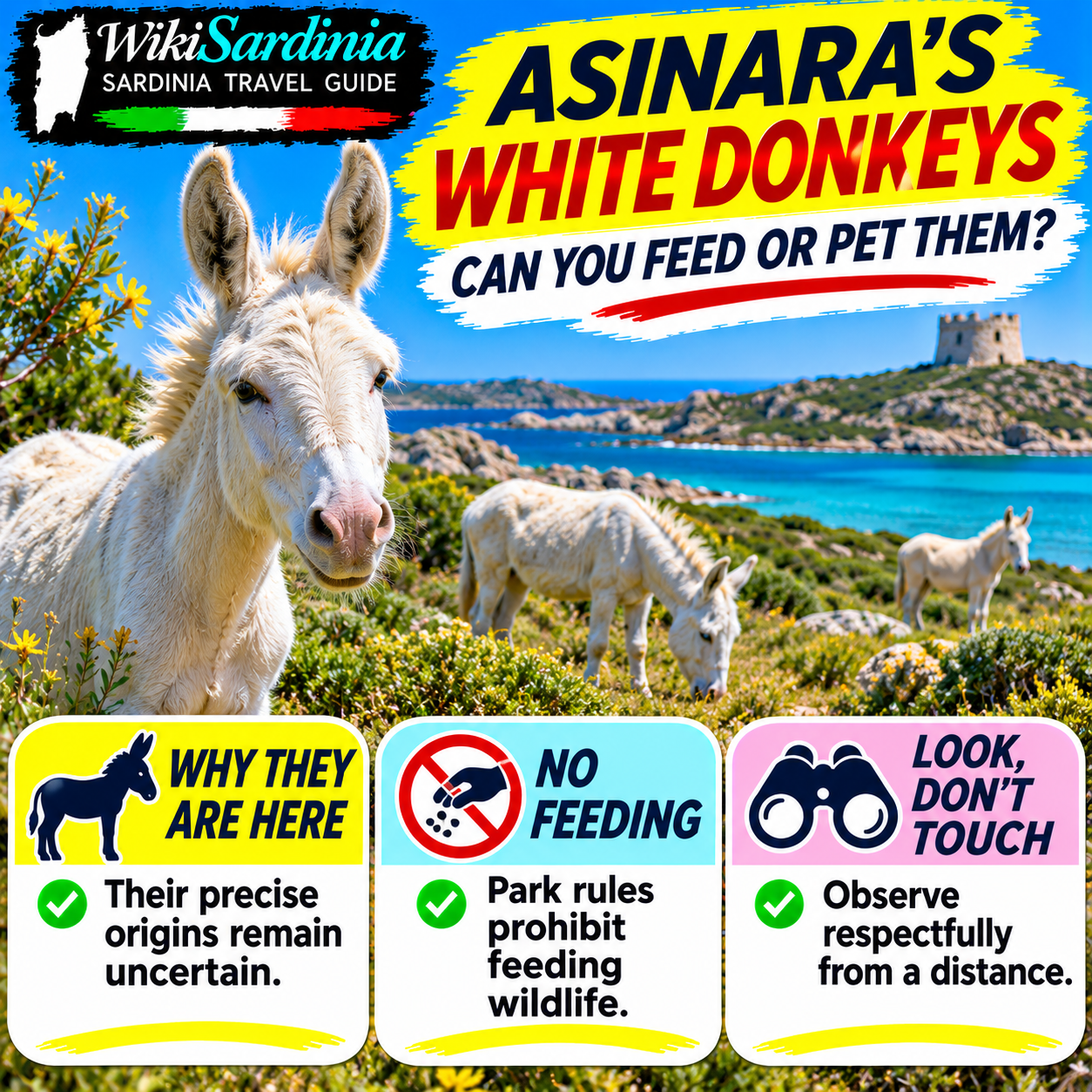
Asinara Island is famous for its free-roaming white donkeys, but visitors must not feed or disturb them. Petting is also best avoided: even a donkey that approaches people should be observed without touching it. These animals are one of the most recognizable symbols of Asinara National Park, off Sardinia's northwestern coast. They share the island with gray Sardinian donkeys and other animals that have lived in free-ranging or semi-wild conditions.
Why are there donkeys on Asinara Island?
Donkeys have long been part of the island's rural and human history. Asinara supported farming, livestock and later a penal colony, and animals remained in its landscape. The distinctive white population became a conservation symbol after the island's transformation into a national park. However, the exact origin of the white donkeys is not conclusively established.
Where did the white donkeys come from?
The Park Authority discusses several explanations. One suggests white donkeys were imported from Egypt by a historical landowner; another is a shipwreck story. The explanation the park considers most plausible is that white-coated animals arose among the island's gray donkeys through a hereditary pigmentation trait. These are hypotheses, not equally verified historical facts. The Sardinian Region's breed documentation likewise acknowledges uncertainty about their origins.
Why are Asinara's donkeys white?
The characteristic white coat is linked to an inherited pigmentation condition often described as incomplete albinism. The animals are small, typically around one meter at the withers as adults, and their pale coat and exposed skin can make them more susceptible to sun-related irritation. The Park Authority documents veterinary monitoring and conservation efforts. Not all donkeys on Asinara are white: gray Sardinian donkeys also occur.
Are they truly wild?
It is more accurate to call them free-roaming or feral donkeys descended from domestic animals rather than a separate wild donkey species. Some have become accustomed to visitors, but habituation is not an invitation to feed or touch them. They remain animals with their own needs and unpredictable reactions.
Is it legal to feed the donkeys?
No. Asinara National Park's official visitor rules explicitly prohibit disturbing or feeding wild animals within the protected area. That includes offering bread, fruit, carrots, snacks or other food to free-roaming donkeys. Feeding can alter behavior, draw animals toward roads and people, and create health or welfare problems. Do not leave food on the ground for them either.
Can I pet a white donkey?
Do not attempt to pet, hug, restrain or lure one closer. The Park explicitly bans disturbing wildlife, although the published visitor guidance does not list a separate, universally worded fine specifically for every instance of touching a donkey. Touching an animal may constitute disturbance depending on the circumstances. For visitors, the clear responsible rule is look, photograph and leave the animal alone. A calm-looking donkey can still bite, kick or move suddenly.
Can I take a selfie with one?
Yes, from a respectful distance, without baiting the animal or blocking its movement. Use your camera zoom. Never stand between a mother and her foal, crowd an animal with a group or attempt to make it pose by offering food. If a donkey approaches, remain calm, give it space and do not reach out.
Where can visitors see the donkeys?
Donkeys roam in different parts of Asinara, so no specific sighting is guaranteed. Authorized excursions, guided visits and approved park routes may provide opportunities to see them in their habitat. The park has landing points at Fornelli and Cala Reale, reached by services from Stintino and Porto Torres respectively. Check current transport and access arrangements with the park or authorized operators before travel.
How should I behave if donkeys are on a road or path?
Slow down or stop at a safe distance and wait for them to move. Do not honk, chase or attempt to push animals away. Follow your guide's instructions and park transport rules. If walking or cycling, avoid sudden movements and give the animals a clear escape route. Do not leave backpacks or open food unattended near them.
Are there penalties for feeding or disturbing wildlife?
Violating national park rules can lead to enforcement under applicable protected-area legislation, but a verified fixed fine specifically for feeding an Asinara donkey has not been established here. Do not trust a viral claim that every visitor automatically pays a particular euro amount. The important confirmed fact is that feeding and disturbing wildlife are prohibited; follow park rangers' instructions.
Can I bring my dog to Asinara?
Check the latest rules carefully. Some older English pages of the park website state a general ban on pets, but the updated Italian FAQ cites a June 24, 2026 resolution allowing dogs, cats and other pets in designated Zone D areas subject to conditions. This is not unrestricted pet access across the national park. Verify the permitted area and conditions before booking and keep pets away from the donkeys.
How does the park protect the white donkeys?
The Park Authority monitors the population and works with scientific and veterinary partners to conserve its genetic heritage and animal health. The official management documents discuss the risks of limited genetic diversity, reproductive challenges and skin problems. Conservation is not improved by tourists feeding the animals; respectful distance helps protect their welfare and natural behavior.
What should families teach children?
Explain that these are not petting-zoo animals. Children can enjoy watching their ears, movements and behavior from a safe distance, but should not run toward them, touch their faces or offer snacks. Keep food packed away and follow your guide's directions. This is also an opportunity to explain why national parks protect animals from human interference.
Frequently asked questions
Why are there white donkeys on Asinara?
Their exact origin is uncertain. The park considers an inherited white-coat trait emerging among gray donkeys a plausible explanation.
Are the white donkeys albino?
Their pigmentation is often described as incomplete albinism, rather than simply assuming every white animal has the same genetic condition.
Are all Asinara donkeys white?
No. Gray Sardinian donkeys also live on the island.
Can tourists feed them carrots or bread?
No. Feeding wildlife is explicitly prohibited by the park.
Can tourists pet them?
Visitors should not touch or disturb them. Observe from a distance even when an animal seems friendly.
Can I photograph the donkeys?
Yes, without approaching too closely, baiting or interfering with them.
Are donkey sightings guaranteed?
No. They roam freely, and sightings depend on the route and the animals' movements.
Can I visit with a dog?
Only within the areas and conditions permitted under the park's updated 2026 rules; verify before departure.
What if a donkey approaches me?
Stay calm, avoid feeding or touching it, and allow it to move away without obstruction.
The takeaway
Asinara's white donkeys are a rare and memorable part of Sardinia's natural heritage. Their origin is still debated, but the visitor rules are not: do not feed or disturb them. Bring a camera, keep a respectful distance and let these remarkable animals roam freely.
Official sources: Asinara National Park — Flora and fauna; Asinara National Park — Updated visitor FAQ; Asinara National Park — How to visit and rules; Park / ISPRA — Donkey population management; Sardinian Region — Asinara donkey breed documentation.