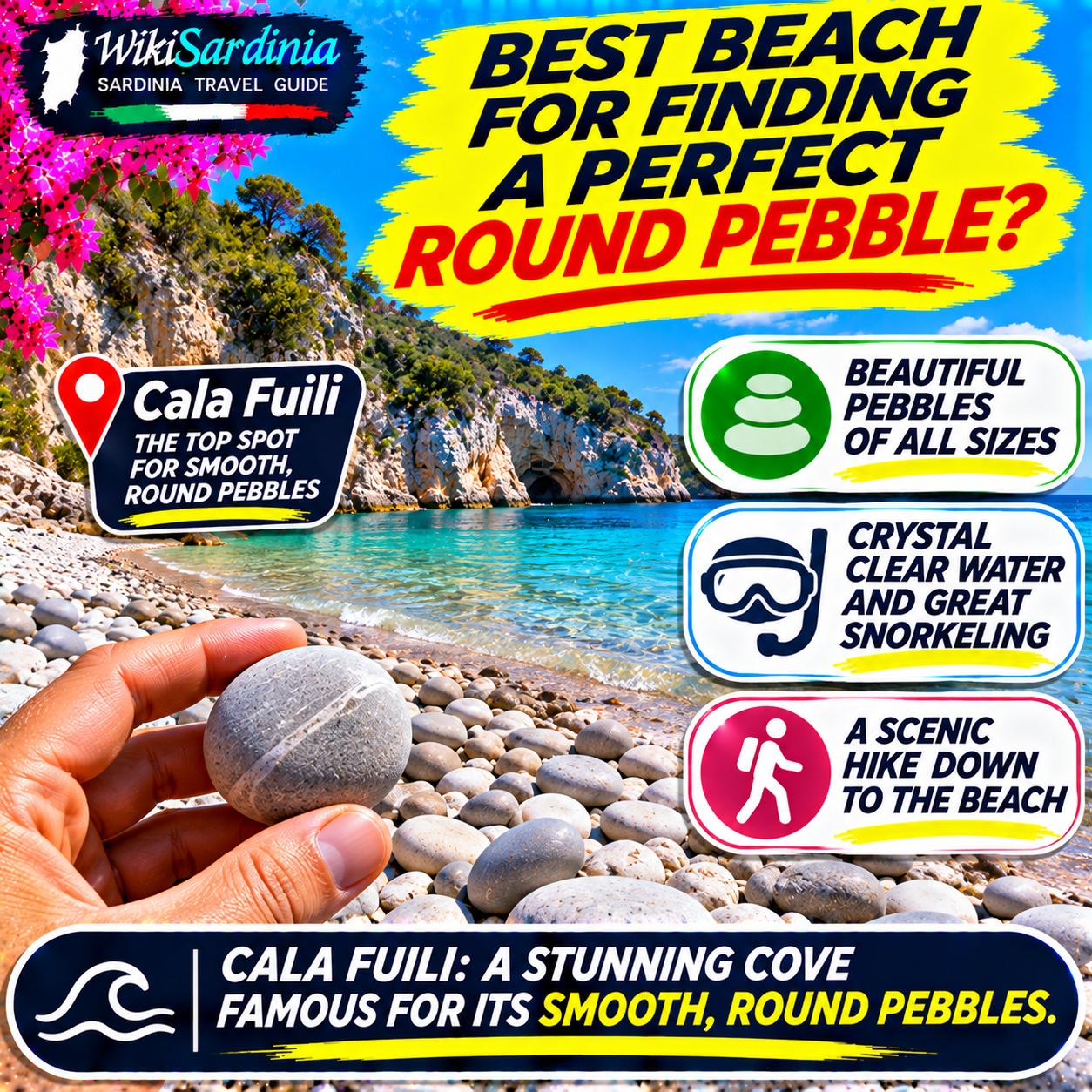
Cala Fuili, near Cala Gonone on Sardinia's eastern coast, is a lovely place to look for smooth, rounded beach pebbles. The small cove sits between limestone cliffs and has a mix of stones and coarse beach material that can look beautifully polished by the sea. But there is an important distinction between finding a perfect round pebble and taking it home: in Sardinia, removing stones, pebbles, sand and other natural beach materials is prohibited. Enjoy the search, take a photograph, and leave your favorite stone where you found it.
Is Cala Fuili the best beach in Sardinia for round pebbles?
It is a compelling choice if you enjoy observing smooth stones in a dramatic coastal setting, although there is no official ranking naming Cala Fuili the island's number-one round-pebble beach. Its shoreline can contain rounded stones of different sizes, and the precise mix changes with waves, storms and seasonal movement of beach material. You might find an almost spherical pebble, but no beach can guarantee a perfectly round one on a particular visit. Think of Cala Fuili as a beautiful place for pebble spotting, not a source of souvenirs to collect.
Where is Cala Fuili?
Cala Fuili lies just south of Cala Gonone, a seaside town in the municipality of Dorgali on Sardinia's eastern coast. The cove is framed by limestone rock and Mediterranean vegetation, with clear water at the foot of steep coastal slopes. It is much smaller and more enclosed than a long sandy beach, which is part of its appeal. The surrounding area belongs to the wider Gulf of Orosei landscape, famous for cliffs, coves and walking routes.
Why are the pebbles so smooth and round?
Rounded pebbles are shaped over time by abrasion and repeated movement. Waves and currents move stones against other stones, sand and the seabed. Sharp edges gradually chip and wear away, leaving smoother surfaces. The original rock type, its hardness, cracks and the length of time it spends being moved all influence the final shape. Some pebbles become oval, flat or egg-shaped rather than perfectly spherical. A remarkably round stone is a natural result of geology and physical processes, not evidence that someone polished it by hand.
What colors and shapes might you see?
Depending on the stones present at the time, you may notice pale limestone-colored pebbles, gray stones and others with veins or subtle patterns. Look for differences in texture, smoothness, symmetry and the way sunlight reveals markings when the surface is wet. Avoid identifying a pebble as a particular mineral or fossil solely from its color. If you are interested in geology, photograph both sides beside an ordinary object for scale and consult a qualified local guide or geological reference afterward.
Can you take a pebble from Cala Fuili as a souvenir?
No. Leave it on the beach. Sardinia's Regional Law No. 16 of 28 July 2017, Article 40, prohibits removing, possessing and trading sand, pebbles, stones and shells from the coastline without the required authorization. Violations can lead to administrative penalties. This applies even if you only want one small, beautiful pebble for your desk at home. Do not assume that a stone is exempt because it is tiny, already loose or far above the waterline. The responsible alternative is to photograph it and put it back exactly where you found it. Consult the Autonomous Region of Sardinia for the current law and enforcement guidance.
Is it legal to pick up a pebble just to photograph it?
Observing stones where they lie is the safest approach. If you briefly lift a loose stone to examine its shape, put it back immediately without moving it away from the shore, disturbing animals or damaging the habitat. Because the regional law includes rules on removal and possession, visitors should avoid treating beach stones as personal property or carrying them around. For photographs, it is better to leave the pebble on the ground and change your camera angle instead.
How do you reach Cala Fuili?
Travel toward Cala Gonone and follow the coastal road south toward Cala Fuili. Access is typically from the end of the road, followed by a steep stepped descent toward the beach. Conditions, access arrangements and parking rules can change, so check locally before setting out. The path is not a level promenade and may be unsuitable for visitors with significant mobility limitations, strollers or anyone who cannot comfortably climb steps on the return. Wear shoes with grip rather than relying on flip-flops.
Is the walk difficult?
The descent is relatively short compared with a full mountain hike, but it involves steps and uneven terrain, and the return is uphill. In summer, heat can make the climb more tiring. Take drinking water, protect yourself from the sun and allow time to climb back without rushing. The route can be slippery after rain or when covered with loose material. If you have limited mobility, choose a more accessible beach rather than assuming a short distance means easy access.
Is Cala Fuili suitable for children?
Families can enjoy the scenery, but parents should consider the steps, rocky ground, water conditions and limited space. Pebbles can be uncomfortable underfoot and small stones can be a choking hazard for very young children. Keep toddlers closely supervised and discourage throwing stones toward people or the water. Water shoes may help with the uneven shoreline, but they do not make rough sea conditions safe. There may not be the facilities or easy access found at a large serviced family beach.
Can you swim and snorkel there?
On calm, clear days, Cala Fuili's water can be inviting for swimming and snorkeling. The rocky setting may offer interesting underwater scenery, but visibility, currents and wave conditions change. There is no guarantee of lifeguard supervision. Check the sea before entering, avoid swimming near rocks in rough conditions, and never snorkel alone. The pebble-searching idea is best treated as a shoreline activity rather than a reason to dive for stones.
When is the best time to look at the pebbles?
Calm weather and good daylight make it easier to see colors, textures and shapes. Early morning may offer a quieter experience during the busiest travel months, although visitor numbers and shade depend on the season and weather. After strong waves, the arrangement of pebbles may change, but do not visit during dangerous surf simply because you hope the sea has uncovered new stones. Wait for safe conditions and keep clear of unstable cliff edges.
How can you photograph a perfectly round pebble?
Look for a stone with a smooth outline, then photograph it in place from directly above to show its shape. A low side angle can emphasize its polished surface and natural curves. Soft morning or late-afternoon light often reduces harsh reflections, while a wet surface may reveal veining and color. Use your phone's close-up mode if available, but avoid disturbing the surrounding beach or arranging large piles of stones for a picture. The photograph is the souvenir.
Are perfectly spherical stones rare?
Very round stones are less common than ordinary rounded or oval pebbles because natural abrasion does not produce identical shapes. A stone's initial form and the forces acting on it influence whether it becomes nearly spherical. The term perfect is subjective here: beach pebbles are not precision-manufactured objects. Enjoy comparing naturally different shapes rather than expecting to find a flawless geometric sphere.
Are there other pebble beaches in Sardinia?
Yes. Sardinia has a great variety of shorelines, from fine sand to coarse gravel, pebbles and rocky coves. Along parts of the eastern coast, smaller inlets may contain rounded stones, while other beaches have very different sediments. Beach composition can change within a short distance, and not every cove is easily or safely accessible. If pebble textures are your main interest, ask a local guide about accessible rocky beaches rather than making an unsupported list of guaranteed 'perfect-pebble' locations.
Can you take quartz grains from Is Arutas instead?
No. The famous quartz-rich beaches of the Sinis Peninsula, including Is Arutas, are also protected from souvenir collecting. Their distinctive grains are part of the natural beach system, not free keepsakes. Taking a handful of sand or a few quartz pebbles is not a legal alternative to taking a stone from Cala Fuili. Photograph the colors and leave every grain in place.
Why does leaving pebbles matter?
A single stone may seem insignificant, but the cumulative effect of many visitors removing beach material can alter a shoreline. Pebbles help make up the beach's natural structure and can provide habitat for small organisms. Removing them also deprives future visitors of the chance to experience the same landscape. Sardinia's protections are designed to preserve coastal environments, not simply to prevent people from taking large bags of sand.
What should you bring for a Cala Fuili visit?
Pack grippy walking shoes for the access steps, water, sun protection, a small towel and a camera or phone. Water shoes can be useful for rocky shallows. Bring your own supplies because you should not rely on a shop or beach club being open at this small cove. Take all rubbish away with you. If you are planning to continue onto a hiking trail, check the route separately: a short beach visit and a longer coastal hike require different preparation.
Useful Italian phrases
“Dove si trova Cala Fuili?” — Where is Cala Fuili? “Che bel ciottolo rotondo!” — What a beautiful round pebble! “Posso fotografare questo sasso?” — May I photograph this stone? “È vietato portare via i sassi dalla spiaggia?” — Is it forbidden to take stones from the beach? “La discesa alla spiaggia è ripida?” — Is the descent to the beach steep? “Lasciamo i ciottoli dove sono.” — Let's leave the pebbles where they are.
Official information and sources
For destination background and travel planning, consult the official Sardegna Turismo portal and the Municipality of Dorgali for local information. For the regional rules protecting coastal materials, see Regione Autonoma della Sardegna, especially Regional Law 16/2017, Article 40. Access, parking, facilities and sea conditions should be checked for the actual day of your visit.
The WikiSardinia takeaway
Cala Fuili is a wonderful place to admire smooth, rounded pebbles against a backdrop of limestone cliffs and turquoise water. There is no guarantee of finding a mathematically perfect sphere, but spotting unusual shapes can make a beach visit memorable. The golden rule is simple: find it, photograph it, leave it. The most beautiful Sardinian pebble belongs on the beach, not in your suitcase.