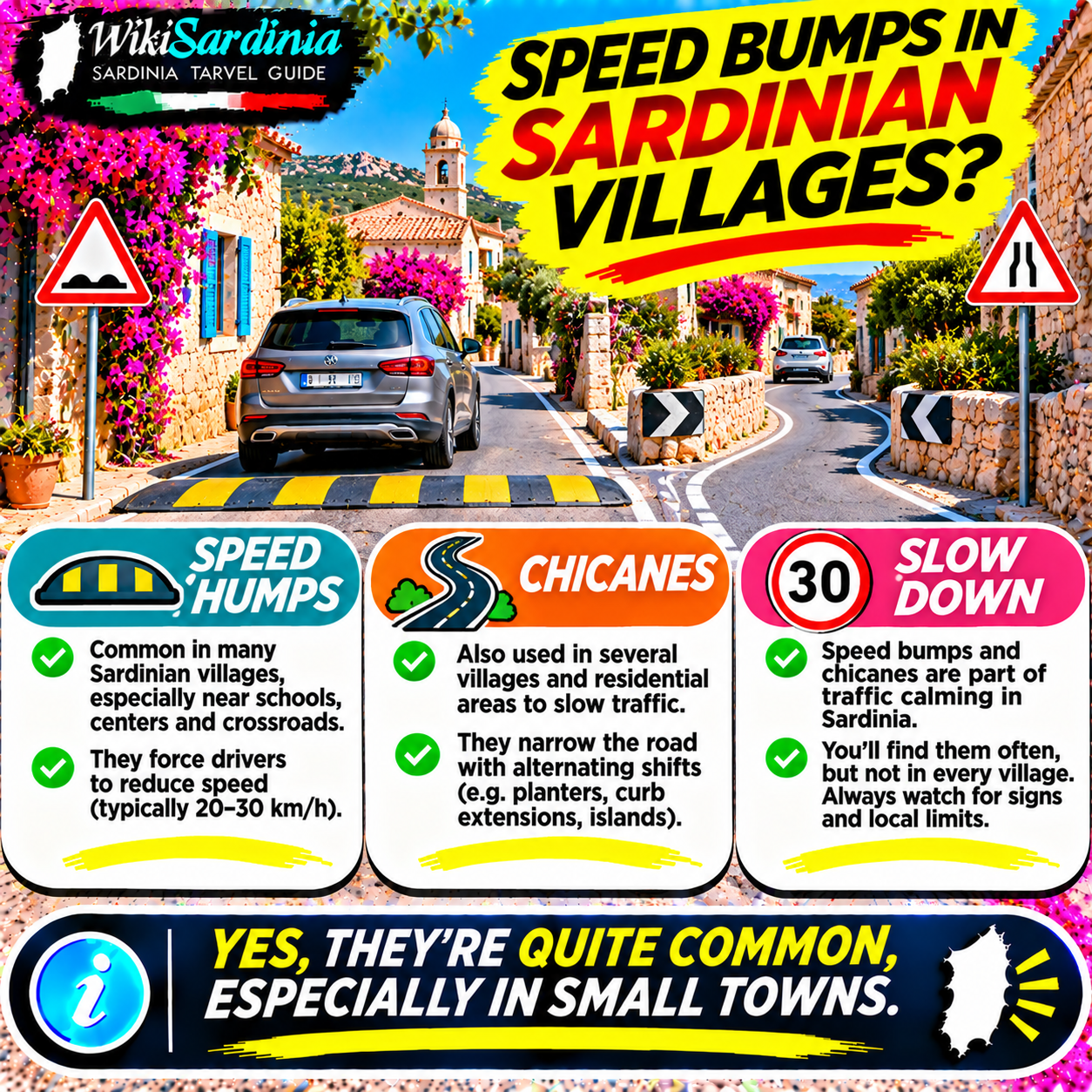
Yes, you may encounter speed bumps, raised pedestrian crossings and road-narrowing features in Sardinian towns and villages. These measures help slow vehicles near homes, schools, pedestrian crossings and other sensitive locations. However, there is no verified island-wide count showing that every small village has them or that chicanes are equally common everywhere. When driving a rental car through Sardinia, expect local differences and pay close attention to road signs and the street ahead.
What kinds of traffic-calming measures are used?
Italian road terminology includes dossi artificiali (speed humps), attraversamenti pedonali rialzati (raised pedestrian crossings), strettoie (road narrowings) and chicane (a deliberate sideways shift in the road alignment). A chicane may be created by curb extensions, staggered parking or traffic islands. These features do not all work in the same way: a hump makes a vehicle pass over a raised surface, while a chicane or narrowing encourages drivers to reduce speed and steer carefully.
Are they actually used in Sardinia?
Yes. Official local-government records provide concrete examples. In May 2026, the Comune di Carbonia issued an ordinance establishing raised pedestrian crossings to improve road safety. The Comune di Oristano documented raised crossings in the town and in the smaller settlement of Silì. Quartu Sant'Elena has also reported work on raised crossings. These cases demonstrate real use on the island, but they do not establish how frequently a driver will encounter them in every rural village.
What about chicanes in particular?
The Regione Sardegna's Regional Cycling Mobility Plan explicitly describes chicanes and road narrowings as traffic-calming design tools. It explains that chicanes create an S-shaped deviation using alternating curb extensions, central islands or offset parking, while narrowings reduce the space available at potentially dangerous points. A planning document's inclusion of these designs is not proof that every village has installed them. Expect them where local road authorities have adopted them, rather than assuming a fixed pattern.
Are natural narrow streets the same as chicanes?
No. Many older Sardinian village centers have naturally narrow, winding streets because of historic buildings and street layouts. Those streets may require very slow driving or yielding to oncoming vehicles, but they are not necessarily engineered traffic-calming chicanes. Likewise, parked cars may create a temporary bottleneck without being part of an official road design. Always distinguish an intentional feature from ordinary street geometry.
What speed should you drive over a hump?
Follow the posted speed limit, warning signs and actual road conditions, and slow enough to cross a raised feature smoothly and safely. There is no universal Sardinian rule that every hump must be taken at 20 or 30 km/h. Italy's national road regulations govern the use and design of artificial speed reducers; the specific installation and signage matter. Brake progressively before the feature, rather than making a sudden maneuver on top of it, and allow extra room if the road is wet.
What do the road signs mean?
A triangular warning sign showing a raised bump warns of an uneven or raised section; a triangular sign with converging sides warns that the carriageway narrows. Speed-limit signs show the applicable maximum where posted. Additional panels may identify a specific hazard or length of road. A 30 km/h sign means the signed limit, not a general island-wide limit for all villages. Some historic centers also have ZTL restricted-traffic areas: a low speed limit does not itself give you permission to enter a restricted zone.
Will they damage a rental car?
Normal road-legal traffic-calming features should be approached at a suitable speed, but driving too fast over a hump can scrape a low vehicle, cause discomfort or damage tires and suspension. If you have a low-clearance car, loaded trunk or bike rack, take particular care. Do not swerve onto the pavement to avoid a hump or overtake dangerously around a chicane. Check your rental agreement and document any pre-existing underbody damage at pickup.
How should cyclists handle them?
Reduce speed before a raised crossing and watch for slippery markings, drainage gaps or rough edges. Through a narrowing, avoid riding so close to the curb that a driver might try to squeeze past without safe clearance. Make your intentions predictable, obey priority signs and be especially cautious where parked cars reduce visibility. A traffic-calming feature intended to protect pedestrians does not eliminate the need to look for approaching vehicles.
What if two cars meet at a narrow section?
Look for signs assigning priority to one direction, or for road markings and physical islands showing the intended passage. If no special priority is posted, follow the ordinary rules and yield as necessary to avoid conflict. Do not assume that being the first to enter a chicane always grants priority. On very narrow historic streets, a patient, low-speed approach is safer than trying to force a passage.
Are bumps more common near schools?
School zones and pedestrian crossings are common reasons for installing speed-reduction measures, but exact placement is decided locally. Official Sardinian municipal announcements frequently cite pedestrian safety and accident prevention as motivations. Do not assume that a street without a hump is safe to drive quickly: children, pedestrians and cyclists may still appear unexpectedly.
Frequently asked questions
Does every small Sardinian village have speed bumps?
No such island-wide pattern is verified. They are used in some municipalities, but installations vary.
Are chicanes legal in Sardinia?
Chicanes are recognized traffic-calming designs in regional planning guidance. Specific installations must comply with applicable road-design and traffic rules.
Are raised pedestrian crossings the same as speed bumps?
Not exactly. Both can slow vehicles, but a raised crossing is designed to serve pedestrians and has a different road function and geometry.
Is 30 km/h the default limit in Sardinian villages?
No. Follow the speed limit actually in force and any signed lower limit. Do not infer a universal 30 km/h rule from the presence of humps.
Can I drive around a speed bump?
Do not use sidewalks, cycle lanes or opposing lanes to bypass it. Slow down and cross safely.
What is the Italian word for speed bump?
Dosso artificiale (plural dossi artificiali); a raised pedestrian crossing is an attraversamento pedonale rialzato.
The takeaway
Speed bumps and raised crossings are a real part of driving in Sardinia, and chicanes and narrowings are recognized ways to slow traffic. But no verified data supports a blanket claim that every small village uses them. When you enter a town, ease off the accelerator, watch for raised surfaces and narrow passages, and follow the posted signs. That is better for pedestrians, cyclists and your rental car.
Official sources: Regione Sardegna — Regional Cycling Mobility Plan, traffic-calming design; Comune di Carbonia — Ordinance 62/2026; Comune di Oristano — Raised crossings in Oristano and Silì; Normattiva — DPR 495/1992, Article 179.