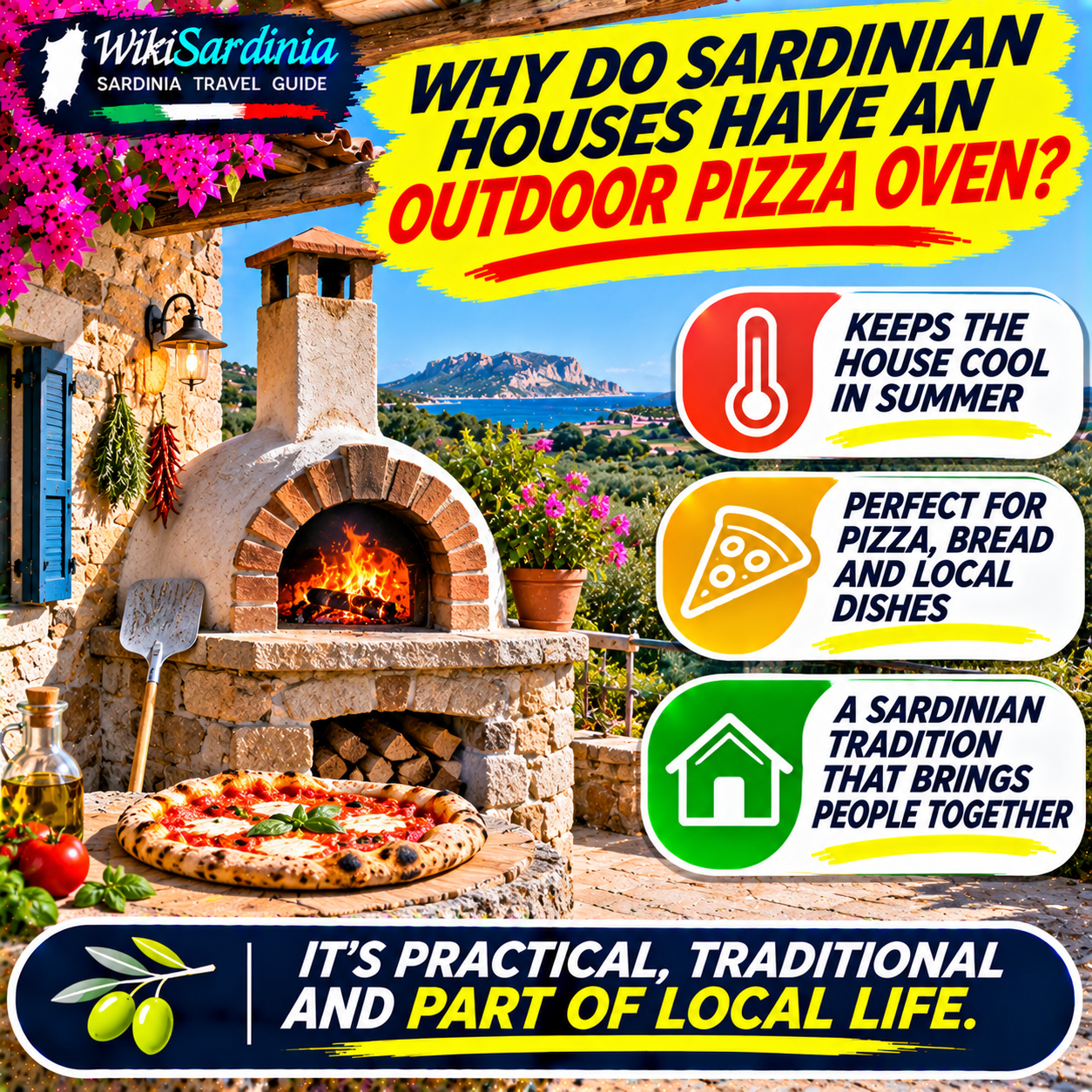
Walk through a Sardinian countryside villa or a family garden and you may notice a small domed masonry oven standing on the patio. It looks like a pizza oven, but the story is bigger than pizza. Outdoor wood-fired ovens are useful for cooking without heating the house, and they connect modern Sardinian gatherings with an older tradition of baking bread and preparing food over fire. Not every Sardinian home has one, and there is no single reason every family built its oven outdoors. Climate, cooking traditions, available space and the way a household uses its garden all play a part.
Why put the oven outside instead of inside the kitchen?
A wood-fired masonry oven stores a great deal of heat in its walls and floor. Lighting one indoors during a hot Sardinian summer would add heat to the living space unless the building was specifically designed to manage it. An oven on a terrace, in a courtyard or in an outbuilding allows people to cook substantial meals while keeping much of that heat and smoke away from the main rooms. The practical benefit is especially appealing when family and friends eat outdoors during warm evenings. This is a sensible architectural explanation, not evidence that every historic oven was built primarily for summer cooling.
Were these ovens originally made for pizza?
Not necessarily. Sardinia has a long and varied bread-making tradition, and wood-fired ovens were used to bake breads and other foods well before contemporary garden pizza ovens became fashionable. A historic forno a legna may have been a household oven, a shared oven or part of a dedicated baking area. The modern image of a pizza sliding into a domed oven is familiar, but calling every old Sardinian oven a 'pizza oven' can obscure its earlier uses. In a rural household, bread was often the more important everyday product.
What did Sardinians bake in wood-fired ovens?
Traditional breads vary across the island. They include forms such as pane carasau, civraxiu and coccoi, although each has its own preparation and baking techniques and not every oven is suitable for every style. Families may also use a wood-fired oven for focaccia, savoury pies, vegetables and roasts. Contemporary outdoor ovens are often used for pizza because they can reach the intense heat that helps produce a well-browned crust quickly. Some Sardinian dishes, such as porceddu, are traditionally associated with roasting methods that are not identical to baking in a domed oven; do not assume all traditional Sardinian cooking happens in a pizza oven.
How does a traditional wood-fired oven work?
A typical masonry oven has a heat-retaining floor and a curved or domed chamber. Wood burns inside or in an adjacent firebox, depending on the design, and heats the surrounding masonry. Once hot, the oven radiates heat toward the food while the floor transfers heat from below. The cook manages embers, flame, airflow and temperature according to the dish. Pizza may be baked with an active fire to one side, while some breads and slow-cooked dishes use heat retained after the fire has been reduced or cleared. Oven design and cooking methods differ, so a particular oven's safe operating instructions always come first.
Why are ovens often built from stone or brick?
Brick, refractory materials and masonry are well suited to storing and releasing heat. Their thermal mass allows an oven to remain hot after the fire has died down, which can be useful when preparing several batches of food. A traditional exterior may be finished with local stone or plaster, although the material you see outside is not necessarily the heat-resistant material lining the cooking chamber. Proper construction, insulation and a suitable flue or chimney are important for performance and safety.
Is the outdoor oven a Sardinian tradition or a modern luxury?
Both histories can be visible in the same courtyard. Wood-fired bread ovens belong to older rural and domestic food traditions, while newly built garden pizza ovens are also popular additions to villas, holiday homes and outdoor kitchens. Some families preserve or restore an existing oven; others install a modern one for entertaining. Seeing a dome beside a holiday villa does not prove that it is centuries old. Its age and original function depend on the property.
Did Sardinian villages have communal ovens?
Shared bread-making facilities have existed in different Mediterranean communities, including Sardinian contexts, but practices varied by village and period. Some households had their own ovens, while others used facilities shared among families or organized baking around communal arrangements. The key point is that baking was often a social activity involving preparation, timing and cooperation, rather than simply putting a frozen pizza into a hot oven. Avoid treating one village's historical practice as universal across the entire island.
Why is the oven placed in a courtyard or under a covered patio?
A courtyard gives the cook room to handle firewood, dough and long oven tools, and it allows guests to gather nearby without crowding the indoor kitchen. A partial roof may protect the work area from rain or sun, but it must be designed with safe clearances and adequate ventilation. The exact location also depends on property layout, local building rules and wind exposure. An oven should never be installed under flammable materials or used in a poorly ventilated enclosure.
Does Sardinia's summer heat make outdoor cooking especially useful?
Yes, particularly on warm days when a wood-fired oven could otherwise raise the temperature inside the home. However, Sardinia has different microclimates: mountain villages can be cool, and wood-fired cooking is not restricted to summer. The oven is useful year-round for special meals and gatherings. The claim that 'Sardinians invented outdoor ovens to avoid heating their houses' would be too simplistic; the better explanation is that keeping heat outdoors is one practical advantage of a wider cooking tradition.
What about the Maestrale wind?
The northwesterly Maestrale can make outdoor cooking more difficult, especially in exposed courtyards. Gusts may blow smoke toward seating areas or affect embers, ash and flames. A well-sited oven has suitable wind protection and a properly designed exhaust path, but strong winds can still make firing unsafe. Never use an outdoor wood-burning oven during applicable fire restrictions or when wind conditions create a wildfire hazard. The presence of a permanent oven does not automatically make it legal to light it on any day.
Can tourists use the outdoor pizza oven at a rented villa?
Ask the host first. An oven shown in rental photographs is not necessarily available for guest use. The owner may require supervision, prohibit wood fires during certain periods, or restrict use because of fire-safety rules. Ask whether the oven is operational, whether firewood and tools are supplied, and whether the host provides instructions. If permission is granted, keep children away from the hot masonry, use appropriate tools and follow local fire-prevention guidance. Never improvise a fire in a damaged or unmaintained oven.
Are there fire restrictions on outdoor ovens in Sardinia?
Sardinia has seasonal wildfire-prevention measures, and the details may vary by year, location and type of fire or appliance. Rules for open fires, agricultural burning and outdoor cooking are not always identical. Consult the current regional fire-prevention ordinance and ask the property owner or municipality how it applies to the specific oven. Do not assume that a barbecue, a portable fire pit and an enclosed masonry oven are regulated in exactly the same way. The official Regione Autonoma della Sardegna website is the starting point for current regional notices.
Is pizza the most traditional thing to cook in a Sardinian oven?
Pizza is widely enjoyed in Sardinia today, but it is not the best single symbol of the island's historic baking culture. Local breads tell a more distinctive story. Pane carasau, for example, is associated with a specialised baking process that produces thin, crisp sheets, while civraxiu is a different type of loaf. When visiting a village bakery or food event, look for demonstrations of traditional bread-making rather than assuming all wood-fired ovens are used mainly for pizza.
Why does outdoor cooking bring people together?
A wood-fired oven takes time to heat, so cooking often becomes part of the occasion. Someone prepares dough, someone tends the fire, and friends or relatives gather as dishes are cooked in batches. That makes the oven a natural focal point for a long meal. This social role is especially visible in modern gardens and holiday properties, but it also echoes older patterns of preparing bread and food together. The oven is as much a place to spend time as it is a cooking appliance.
Can you see traditional ovens while visiting Sardinia?
Look for them at rural agriturismi, restored country houses, village food festivals and traditional bread-making demonstrations. Some museums and cultural events focus on regional food heritage, but access to working ovens and demonstrations varies by season and venue. A private home's oven is not a public attraction: ask before entering a courtyard or photographing residents. If you want a hands-on experience, search for a clearly advertised bread-making workshop and confirm what visitors are allowed to do.
Is a Sardinian outdoor oven different from a Neapolitan pizza oven?
There is no single standardized 'Sardinian outdoor oven' design. A traditional bread oven, a modern wood-fired pizza oven and a purpose-built commercial pizza oven may all have domed masonry chambers but differ in size, insulation, heat management and intended use. Neapolitan pizza is associated with a specific culinary tradition and baking technique; Sardinian domestic ovens should not be assumed to follow those specifications. The similarities come from broader wood-fired oven technology, while the foods and household traditions may differ.
What should you ask before booking an agriturismo with an outdoor oven?
Check whether the oven is decorative or operational, whether guests may use it, whether a staff member operates it, and whether the experience is included in the accommodation price. Ask about firewood, cooking tools, food preparation and any seasonal restrictions. If your goal is to learn about traditional Sardinian bread rather than bake pizza, request a laboratorio di panificazione tradizionale (traditional bread-making workshop) rather than assuming an oven on the property means classes are available.
Useful Italian phrases
“È un forno a legna?” — Is it a wood-fired oven? “Il forno si usa ancora?” — Is the oven still used? “Possiamo usarlo per fare la pizza?” — May we use it to make pizza? “È un forno tradizionale per il pane?” — Is it a traditional bread oven? “Ci sono restrizioni per accendere il fuoco?” — Are there restrictions on lighting a fire? “Organizzate laboratori di panificazione?” — Do you organize bread-making workshops?
Where to learn more
For regional food and travel background, consult the official tourism portal Sardegna Turismo and its coverage of Sardinian bread traditions. For current fire-prevention regulations, consult Regione Autonoma della Sardegna and the local municipality. These official portals are starting points; no specific fire ordinance, universal oven design or historical origin date is asserted here without location-specific verification.
The WikiSardinia takeaway
Outdoor pizza ovens in Sardinian houses are about much more than pizza. They let people cook with substantial wood-fired heat without warming the main living rooms, especially during summer, while carrying forward older bread-baking traditions and creating a place for family meals. If you see one beside a country house, think of it as a practical outdoor kitchen and a connection to Sardinia's food culture—not proof that every Sardinian family cooks pizza outdoors every day.