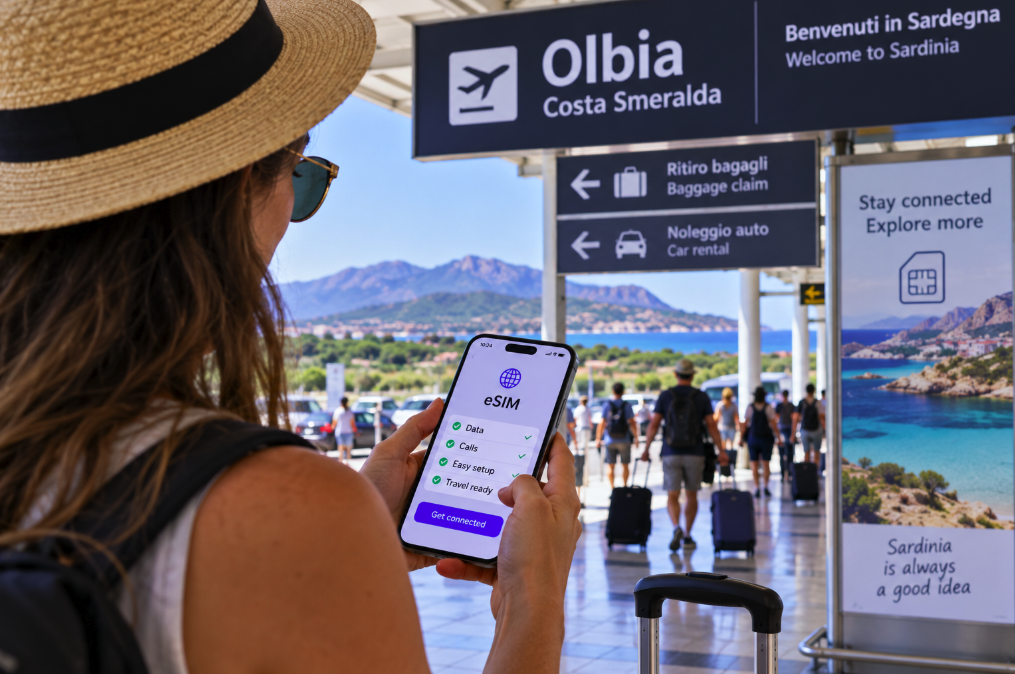
For most U.S. travelers arriving in Sardinia with an unlocked recent smartphone, an eSIM is the simplest way to get mobile data without swapping a physical card. But it is not automatically the best choice for everyone. A travel eSIM is convenient for maps and messaging, an Italian prepaid SIM can provide a local number and generous data, while keeping your U.S. carrier’s roaming plan may be easiest if the price is already included in your contract.
The important point is that Sardinia does not require a special island SIM. It uses Italy’s normal mobile networks. Your choice therefore depends on your phone, trip length, data needs and whether you need an Italian telephone number.
First check whether your U.S. phone is unlocked
Before comparing data packages, make sure your phone can use another carrier. Apple states that an iPhone must be carrier-unlocked to use an eSIM from a different operator while traveling. On an iPhone, you can check under Settings, General and About; an unlocked device shows no SIM restrictions under the carrier-lock field.
This is especially important for U.S. iPhone owners. U.S.-market iPhone 14, 15 and 16 models are eSIM-only, and current U.S. versions of the iPhone 17 family are also listed by Apple among eSIM-only devices. Those travelers cannot simply buy a physical Italian nano-SIM at the airport and insert it.
Apple supports travel eSIM use on iPhone XS, XS Max, XR and later compatible models. Many recent Android phones also support eSIM, but travelers should check their exact model and carrier lock before departure.
Option 1: buy a travel eSIM before flying
A travel eSIM is usually the smoothest option for a short Sardinia holiday. You buy a digital plan online, install it before departure and select it as the data line when you arrive in Italy. International eSIM providers sell plans covering Italy and, in many cases, multiple European countries.
The advantage is immediate connectivity. You can open maps, message your hotel or find the rental-car desk without searching for a phone store after a long flight. Data-only plans are also perfectly adequate for many travelers because WhatsApp, FaceTime and other internet-based services work over mobile data.
Apple notes that supported iPhones can keep multiple eSIMs stored and that compatible models can use two active eSIMs simultaneously. This means a traveler can often keep the U.S. line active for calls or messages while using the travel eSIM for data.
Be careful with the settings. If your American line remains active, roaming charges can still apply to that line. Select the travel eSIM for cellular data and review data-roaming settings before landing rather than discovering an expensive mistake after the trip.
There is no single “best” travel eSIM for every Sardinia visitor. Prices, network partners, data allowances, hotspot rules and validity periods change frequently. Compare the current plan for Italy rather than relying on a ranking written months earlier.
Option 2: get an Italian prepaid eSIM or SIM
A local Italian plan can be attractive for longer stays or travelers who want a local phone number. Apple’s current carrier list says Iliad, TIM, Vodafone and Wind Tre support eSIM activation on prepaid plans for international travelers in Italy.
One particularly transparent tourist offer is TIM Tourist. As of September 2026, TIM advertises 200 GB of 5G data, unlimited calls to Italian numbers and 100 minutes of international calls for €14.99, valid for 30 days. The SIM card itself costs another €10, bringing the published base cost to €24.99 when a physical SIM is required. TIM also advertises an extra 100 GB for €5.
TIM says the plan is for new customers, is non-renewable and can be used in Italy and in EU roaming under its stated conditions. Travelers should check the current offer before purchase because mobile tariffs can change.
A local plan is especially useful if you expect to call restaurants, accommodation owners, guides or other Italian numbers frequently. It can also provide much more data than a small international travel eSIM.
Italian operators may require identification when activating a prepaid line. Apple specifically notes that local carriers in some countries can require a passport or other ID when selling an eSIM to international visitors.
Option 3: keep your U.S. carrier roaming
For a short trip, the least complicated option may be to do nothing except activate your existing carrier’s international service. Apple recommends checking before departure whether international roaming is already included in your plan or whether your operator offers a travel pass.
This can be more expensive than a local SIM or travel eSIM, but convenience has value. You keep your normal number, do not need a second plan and avoid changing data-line settings. For a two- or three-day Sardinia stop within a longer European trip, that simplicity may outweigh a small price difference.
Compare the total cost for the whole holiday rather than a daily headline price. A per-day roaming fee can become expensive on a two-week itinerary.
Which option works best in Sardinia?
For a typical American visitor spending one or two weeks in Sardinia, an unlocked eSIM-compatible phone plus a prepaid travel eSIM is usually the easiest setup. Install it while you still have reliable Wi-Fi at home, but follow the provider’s instructions about when the plan actually begins its validity period.
For a longer stay, heavy data use or a need for an Italian number, compare local prepaid offers from Italian operators. For travelers whose U.S. plan already includes affordable Italy roaming, keeping the existing line may be the most frictionless solution.
Network coverage should also influence expectations. Sardinia has good mobile service in its cities, towns and major resort areas, but it is a large, mountainous island with rural coastlines, hiking areas and remote roads. No carrier should be assumed to provide perfect signal in every cove, mountain trail or inland valley.
Download offline maps before driving into remote areas. Mobile data is useful, but it should not be your only navigation plan when exploring the Supramonte, rural Gallura or isolated stretches of coastline.
What to do when you land at Cagliari, Olbia or Alghero
If your travel eSIM is already installed, switch the mobile-data line to that eSIM after arrival and follow the provider’s roaming instructions. Keep the U.S. line’s data roaming off unless your domestic plan explicitly covers Italy.
If you want a local prepaid plan instead, use an official carrier store or authorized sales point and bring your passport. Do not assume every airport kiosk stocks every operator or can activate every type of eSIM. Buying in a city can offer more choice if immediate connectivity is not essential.
Travelers using U.S. eSIM-only iPhones should settle this question before joining a queue for physical SIM cards: their phone may have no SIM tray at all.
Keep your U.S. number for verification messages
One advantage of dual-SIM and dual-eSIM phones is the ability to keep a home line available while using another line for data. This can help when banks, airlines or booking services send verification messages to your U.S. number.
However, keeping a line switched on is not the same as keeping it free. Check how your American carrier charges incoming calls, outgoing calls, SMS and roaming activity. When possible, use Wi-Fi calling and app-based messaging according to your carrier’s rules.
Apple also warns that cellular data can generate roaming charges when the wrong line is selected. Take a minute to label your lines clearly — for example, “USA” and “Italy” — before traveling.
The simplest recommendation
If your U.S. phone is unlocked and supports eSIM, buy and install an Italy-compatible travel eSIM before departure, then use it as your data line in Sardinia. If you want an Italian number or a large 30-day allowance, compare current prepaid offers from TIM, Vodafone, Iliad and Wind Tre. If your existing U.S. plan already provides reasonably priced Italy roaming, compare that total cost before buying anything extra.
Whichever route you choose, set it up before you need it. Having data available as soon as you land makes the first hour in Sardinia much easier: navigation, accommodation messages, car rental details and transport information are all immediately accessible. The best SIM is ultimately the one that keeps those basic travel tools working without surprise roaming charges.