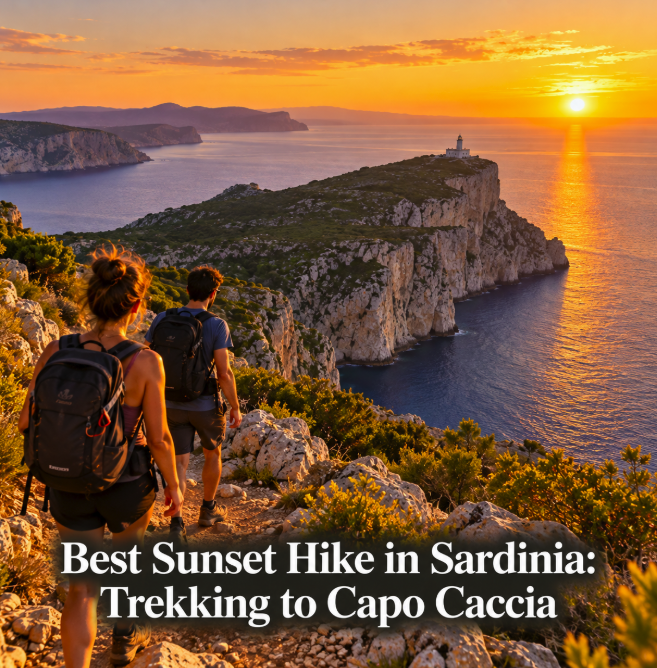
Capo Caccia is one of the most dramatic places near Alghero to watch the sun disappear over the western sea, but the best sunset experience does not have to mean standing beside the road at the famous viewpoint. The surrounding Porto Conte Regional Nature Park contains a network of trails through limestone headlands, Mediterranean scrub and coastal forest, allowing hikers to combine an afternoon walk with the evening light that has made Capo Caccia one of northwest Sardinia’s classic sunset locations.
The key is choosing the right kind of outing. Capo Caccia itself is a high limestone promontory reached by the SP55 road, while nearby Punta Giglio, Monte Timidone and other sections of Porto Conte provide more conventional hiking. For most visitors, a sensible sunset plan combines a protected-area trail during the afternoon with a viewpoint that can be left safely before full darkness.
Why Capo Caccia works so well at sunset
Capo Caccia rises more than 180 metres above the sea on the western side of the Porto Conte landscape. The park authority specifically identifies the Capo Caccia promontory as a place for spectacular sunsets and highlights the belvedere overlooking Isola Foradada as one of the area’s essential panoramic stops.
The Foradada viewpoint is reached from the SP55 road toward Capo Caccia. From there, the view opens toward the offshore island and the western horizon, while the wider panorama includes Porto Conte Bay, Monte Doglia and Monte Timidone. Because the coast faces the open western sea, the evening light can be exceptional when cloud and visibility cooperate.
No sunset is guaranteed, of course. Cloud banks on the horizon can hide the final minutes, while strong mistral winds can make exposed viewpoints uncomfortable. Check the weather and wind before setting out rather than planning only around the published sunset time.
A hiking option: Punta Giglio
For travelers who want an actual trek rather than a short walk from a parking area, Punta Giglio is one of the most useful options in the same protected landscape. The peninsula forms the opposite side of Porto Conte Bay from Capo Caccia and contains a network of trails of different lengths and difficulty levels.
According to Porto Conte Park, the main route crosses Mediterranean vegetation and pine woodland and reaches an area with the former SR 413 military battery, built by the Italian Royal Navy between the world wars. From the Punta Giglio promontory, the park describes a roughly 180-degree panorama extending from the Alghero horizon toward Capo Caccia.
This makes Punta Giglio a strong late-afternoon hiking choice when you want the physical experience of walking through the landscape as well as a coastal panorama. The exact trail and turnaround point should be chosen according to daylight, fitness and the current access arrangements.
Do not begin a long unfamiliar route shortly before sunset. A viewpoint that looks close on a map may take longer to reach on rocky ground, and the return through woodland or uneven limestone becomes more difficult after dark.
Another option: Monte Timidone
Monte Timidone offers a different perspective. Porto Conte Park describes the hike to its summit as relatively easy and the summit panorama as a full 360-degree view over Porto Conte Bay and the surrounding cliffs.
It can be an excellent afternoon hike, but a summit sunset creates an obvious logistical problem: you still have to descend after the sun has gone. Unless you know the route and are equipped for darkness, it is safer to enjoy the late-afternoon light and start descending before sunset, then finish the evening at a more accessible western viewpoint.
This two-stage approach is often better than trying to turn every panoramic hike into a night hike.
A simple Capo Caccia sunset itinerary
Start from Alghero in the middle or later part of the afternoon, allowing extra time for summer traffic. The official route toward Porto Conte and Capo Caccia follows the SS127 bis and then the SP55/55bis road system.
Choose a hike in Punta Giglio or another established Porto Conte trail early enough to finish with comfortable daylight. Carry water even for a short outing, particularly in warm weather, and use footwear with grip rather than beach sandals.
After the hike, continue toward the Capo Caccia side of the park and stop at the Foradada belvedere for the final light. The park authority specifically recommends this viewpoint for sunsets over Foradada. Arrive before the sun reaches the horizon so you have time to park legally, walk to the viewpoint and choose a safe place away from cliff edges.
If you prefer not to move the car, choose a shorter trail with a western outlook and turn around before darkness. The experience is about the landscape, not collecting the maximum number of viewpoints in one evening.
Do not confuse the Neptune’s Grotto staircase with a sunset hike
Capo Caccia is also the land entrance to Neptune’s Grotto via the famous Escala del Cabirol, a staircase cut into the cliff with more than 600 steps. It offers extraordinary views, but it should not be treated as an informal after-hours hiking route.
Access to the cave follows official opening and visiting arrangements, which can change with sea and weather conditions. If you want to visit Neptune’s Grotto, plan it as a separate timed attraction and check the current official schedule. Do not descend late simply because sunset is approaching.
After-dark safety matters here
Capo Caccia’s limestone landscape contains steep cliffs, exposed edges and uneven ground. Sunset photography can also distract hikers from how quickly usable light is disappearing.
Carry a proper headlamp rather than relying on a phone flashlight, even if you intend to return before dark. Bring enough water, keep a charged phone, download the route in advance and tell someone where you are going if you choose a quieter trail.
Stay on established paths and respect barriers and protected-area rules. Porto Conte and the Capo Caccia–Isola Piana area protect sensitive habitats as well as spectacular scenery, and access restrictions can be introduced for conservation or safety reasons.
Night parking also deserves attention. Existing environmental rules restrict overnight vehicle parking in several Capo Caccia peninsula areas, including the Foradada belvedere and other locations along the SP55. A sunset stop is not an invitation to camp or remain parked overnight.
When to go
Spring and autumn are particularly comfortable for combining hiking with sunset because temperatures are generally easier for walking than at the height of summer. Summer gives very late sunsets and long afternoons, but exposed limestone terrain can become extremely hot before evening.
In winter, the sun sets much earlier and weather can be more changeable, so route timing becomes even more important. Whatever the season, check the actual sunset time for Alghero on the date of your hike and aim to reach your final viewpoint well before it.
Wind may be the deciding factor. Capo Caccia is exposed to the open sea, and a strong mistral can transform a pleasant viewpoint into a difficult place to linger. If conditions are severe, postpone the exposed hike rather than treating dramatic weather as part of the adventure.
Capo Caccia or Punta Giglio?
If the priority is the most direct sunset panorama, the Foradada belvedere and Capo Caccia road-end area are the simpler choices. They require less hiking and give immediate access to the western seascape.
If the priority is trekking, Punta Giglio offers a more complete trail experience and views across the wider Porto Conte landscape toward Capo Caccia. Monte Timidone adds a higher 360-degree perspective for hikers who plan their descent carefully.
The most balanced afternoon combines the two ideas: hike first, sunset second. Walk one of Porto Conte’s established routes while there is plenty of daylight, then use the remaining time for a safe western viewpoint. You still get the limestone, Mediterranean vegetation and physical experience of a Sardinian trek, without committing to an unnecessary descent over rough ground in darkness.
That is what makes Capo Caccia such a rewarding sunset destination. The final orange light over the sea is only part of the experience; the surrounding protected landscape gives you the chance to spend the hours before it walking through one of northwest Sardinia’s most distinctive coastal environments.