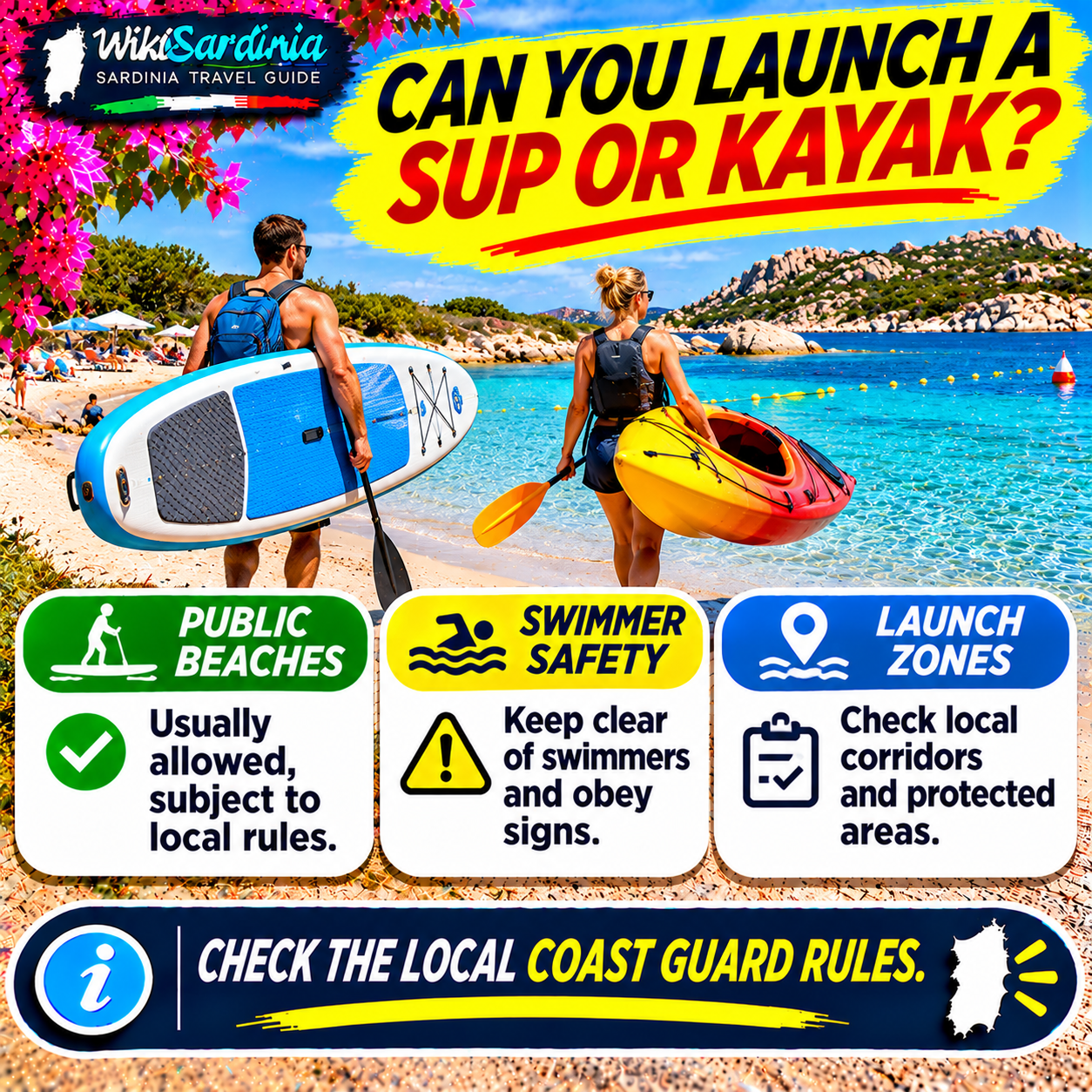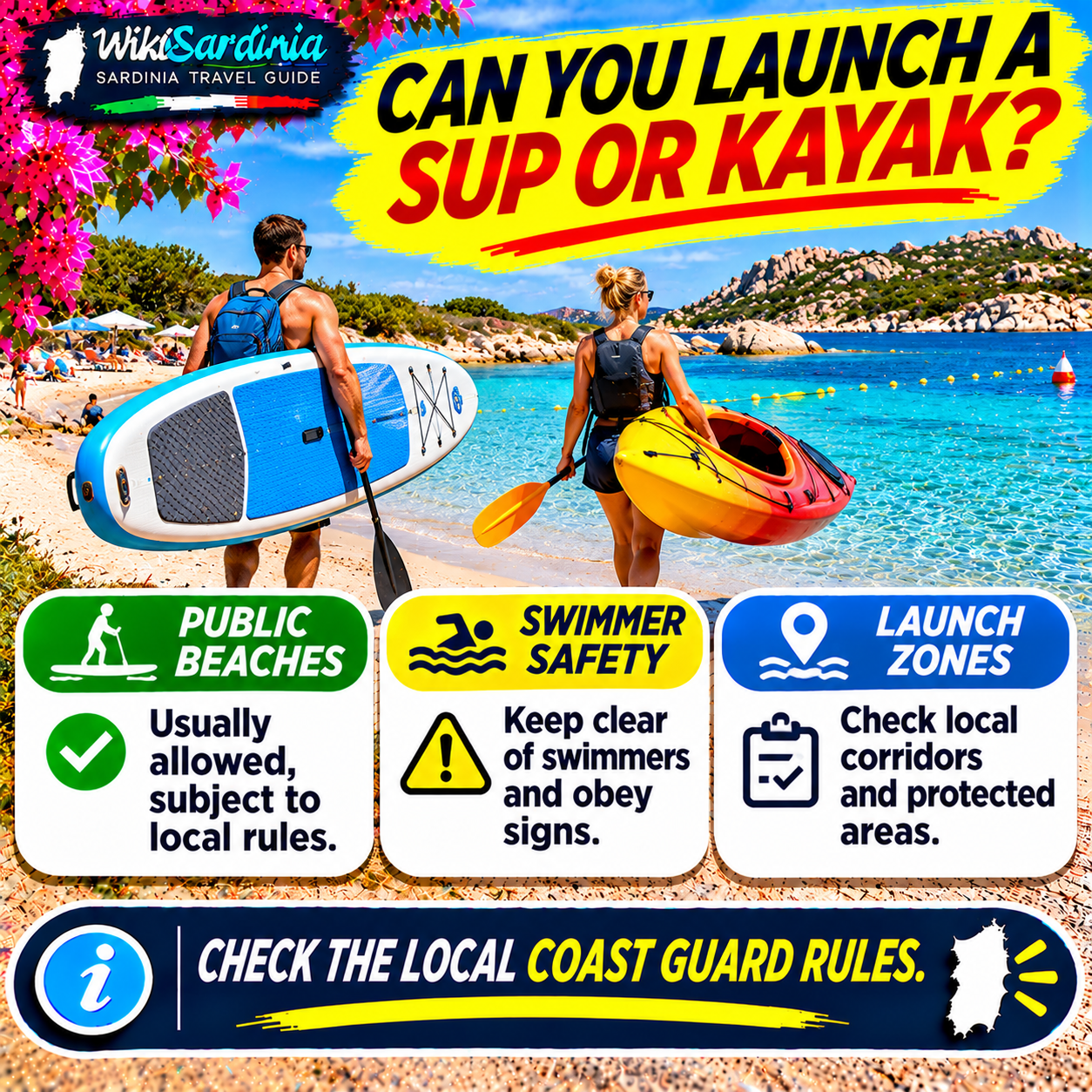
Yes, you can generally bring your own stand-up paddleboard (SUP) or paddle kayak to a public beach in Sardinia, but launching is not automatically permitted at every point along the shore. Rules depend on the local Coast Guard's bathing-safety ordinance, the regional beach ordinance, any municipal restrictions and protected-area regulations. In some maritime districts, non-motorized SUPs and canoes are expressly allowed to move cautiously through swimming areas; other craft must use designated launch corridors. The safest approach is to check signs at the beach and the ordinance for that particular stretch of coast before entering the water.
Are SUPs and kayaks allowed on free public beaches?
A spiaggia libera means the public beach is not reserved exclusively for paying beach-club customers; it does not mean all water sports can take place without restrictions. A paddle-powered SUP or kayak may generally be carried to a public beach if access is open and you do not obstruct paths, rescue operations, swimmers or the shoreline. The Sardinian Region's 2026 beach ordinance notice confirms that beach use and activities in coastal waters are regulated. Local Coast Guard rules add important detail about craft movement and launch corridors.
What is a launch corridor (corridoio di lancio)?
A corridoio di lancio or corridoio di atterraggio is a designated route through nearshore waters that allows authorized craft to reach or leave the beach without mixing unpredictably with swimmers. Corridors are generally marked by buoys and may have signs at their landward end. Swimming, anchoring or blocking a designated corridor is normally prohibited or restricted, and craft must transit cautiously under the applicable ordinance. Do not assume that a corridor is available on every beach or that it is intended for every type of equipment.
Must a SUP or kayak always use a corridor?
Not necessarily. The 2025 bathing-safety ordinance for the relevant Sardinian maritime district expressly exempted paddle craft such as canoes and SUP boards from a general transit ban within the swimmer-reserved area, provided all necessary precautions were taken. Other craft had to use corridors or specific low-impact methods. That illustrates why a universal “SUPs must always launch through a corridor” rule would be misleading. However, this example does not override more restrictive provisions elsewhere or newer ordinances. Check the exact local rule before your trip.
What is the difference between SUP, kayak, windsurf and motorboat rules?
Rules often distinguish simple paddle-powered craft from motorboats, sailing craft, windsurf, kitesurf and other water-sports equipment. Motorboats are generally excluded from areas reserved for bathers except under specific permitted circumstances, while some ordinances permit carefully controlled transit by canoes and SUPs. Windsurf and kitesurf may be subject to separate launch zones, distance requirements and prohibitions. Do not apply a kayak exception to a motorized inflatable boat or a kiteboard.
How far from the shore is the swimming area?
The Porto Torres Coast Guard's 2026 bathing-safety ordinance summary describes waters reserved for bathing as extending 200 metres from sandy shores and 100 metres from rocky or steep coastlines in its jurisdiction. These distances help explain the layout of swimmer zones, but the exact ordinance and any local signs govern your chosen beach. Do not assume that crossing beyond the buoys makes a trip automatically safe: wind, boat traffic and distance from assistance still matter.
Can I carry a kayak across the sand and leave it there?
Carry equipment without blocking public access, the water's edge, lifeguard routes or emergency paths. Do not drag heavy craft through protected dunes or vegetation. The Sardinian Region's 2026 beach-protection guidance emphasizes protection of dunes and sensitive coastal habitats. Beach ordinances also regulate leaving equipment on the sand and obstructing the strip close to the shoreline. Remove your SUP or kayak after use unless an authorized storage arrangement exists.
Are protected beaches and marine parks different?
Yes. Marine protected areas, national parks and beaches with controlled visitor access may impose additional restrictions on launching, landing, navigation, anchoring and access to specific zones. A permitted public-beach launch elsewhere in Sardinia does not automatically authorize paddling into a protected cove. Check the management authority's official zoning map and regulations for your route, especially around Tavolara–Punta Coda Cavallo, La Maddalena and other protected coastal areas. Ask whether a permit, registered operator or designated entry point is required for the activity you plan.
Can I launch from Cala Brandinchi, La Pelosa or another famous beach?
Do not assume you can. Popular beaches may have reservation systems, seasonal access limits, environmental protections and local water-use rules. For Cala Brandinchi, confirm both the beach-access reservation requirements and whether personal SUP or kayak launching is permitted at your intended point. For La Pelosa and other sensitive sites, verify current municipal rules and any protected-area requirements. A beach ticket or parking reservation does not itself grant a boating or paddling authorization.
How do I check the rules before leaving?
- Identify the exact beach and municipality, not just the nearest town.
- Read signs at the beach entrance and near the shoreline, including any marked corridors.
- Find the current ordinanza di sicurezza balneare from the relevant Capitaneria di Porto or Ufficio Circondariale Marittimo.
- Check the municipality's beach ordinance and any marine protected area rules.
- If the wording is unclear, ask the local Coast Guard office or an authorized beach operator before launching.
The 2026 Porto Torres ordinance announcement is an example of an official local source; its rules should not be applied blindly to every Sardinian coast. For 2027 and later visits, consult the newly applicable ordinances.
Do I need a boating license for a paddle SUP or kayak?
A normal, unpowered recreational SUP or paddle kayak does not ordinarily require an Italian motorboat license. This does not remove the obligation to follow navigation, safety and protected-area rules. A craft fitted with an engine or used commercially can fall into a different legal category. If you are renting equipment, ask the provider what local rules and safety equipment apply.
Do I need a life jacket, leash or other safety gear?
Requirements can vary with the craft, location, distance offshore and applicable ordinance. Wearing an appropriately fitted personal flotation device is strongly recommended, particularly for children, less experienced paddlers and open-water outings. For SUP, use a suitable leash only when appropriate for the conditions; leashes can create hazards in moving water or around obstacles. Carry a communication device in a waterproof case, check the weather and avoid paddling alone on exposed stretches. Follow any mandatory equipment provisions in the local ordinance.
What if the beach is crowded?
Do not weave between swimmers or launch through a densely occupied bathing area. Choose a quieter permitted point or a designated corridor, move at a slow controlled pace and give bathers plenty of space. Never use a corridor as a place to stop and rest. If there is no safe way to enter the water without putting others at risk, postpone the activity or choose a different beach.
What about wind and offshore conditions?
Sardinia can experience strong winds, including the Maestrale, and an offshore wind can push an inflatable SUP away from land faster than a beginner can paddle back. Check wind direction and strength, not just the sunshine forecast. Avoid paddling in thunderstorms, poor visibility or rough seas. A calm-looking sheltered cove may become exposed once you round a headland. Tell someone your intended route and return time, and turn back early if conditions deteriorate.
Can I paddle into caves or remote coves?
Only when access is legal and conditions are suitable. Some caves, cliffs and remote beaches present rockfall, swell, boat-traffic or rescue-access hazards, while protected areas may restrict landing. Do not attempt a long crossing or remote cove trip merely because the destination appears close on a map. For unfamiliar routes, a qualified local guide can be a safer choice.
Can I rent a SUP or kayak directly at the beach?
Some beaches have authorized seasonal rental operators, but availability, equipment, age limits, deposit requirements and prices vary. A rental operator's launch point may be part of an authorized concession; that does not mean independent visitors can use every reserved facility. Ask where you are allowed to enter and exit, whether a life jacket is supplied, how far you may paddle and what happens if the wind changes.
What should I do in an emergency?
If someone is in immediate danger at sea, contact the emergency services. The Coast Guard's official information lists 1530 as the Italian maritime emergency number; 112 is the general emergency number. Give your exact location, number of people involved, craft type, visible landmarks and the nature of the problem. Never put yourself in danger attempting an untrained rescue.
Useful Italian phrases
“Posso portare il mio SUP su questa spiaggia?” — Can I bring my SUP onto this beach? “Dov'è il corridoio di lancio?” — Where is the launch corridor? “È consentito mettere in acqua il kayak qui?” — Can I launch the kayak here? “Ci sono divieti nell'area marina protetta?” — Are there restrictions in the marine protected area? “Qual è l'ordinanza della Capitaneria?” — Which Coast Guard ordinance applies?
Before you launch: practical checklist
- Confirm the exact beach's local rules and protected-area restrictions.
- Look for designated corridors and keep clear of swimmers.
- Check the weather, especially offshore wind.
- Carry appropriate flotation and communication equipment.
- Keep dunes, beach paths and emergency access clear.
- Plan a safe return and know the maritime emergency number, 1530.
The WikiSardinia takeaway
Bringing your own paddleboard or kayak to a public Sardinian beach is generally possible, but launching and paddling are regulated locally. SUPs and canoes may be treated differently from motorboats and wind-powered craft, and not every beach requires the same launch procedure. Respect swimmer zones, protected habitats and local Coast Guard signs. When in doubt, ask before entering the water.