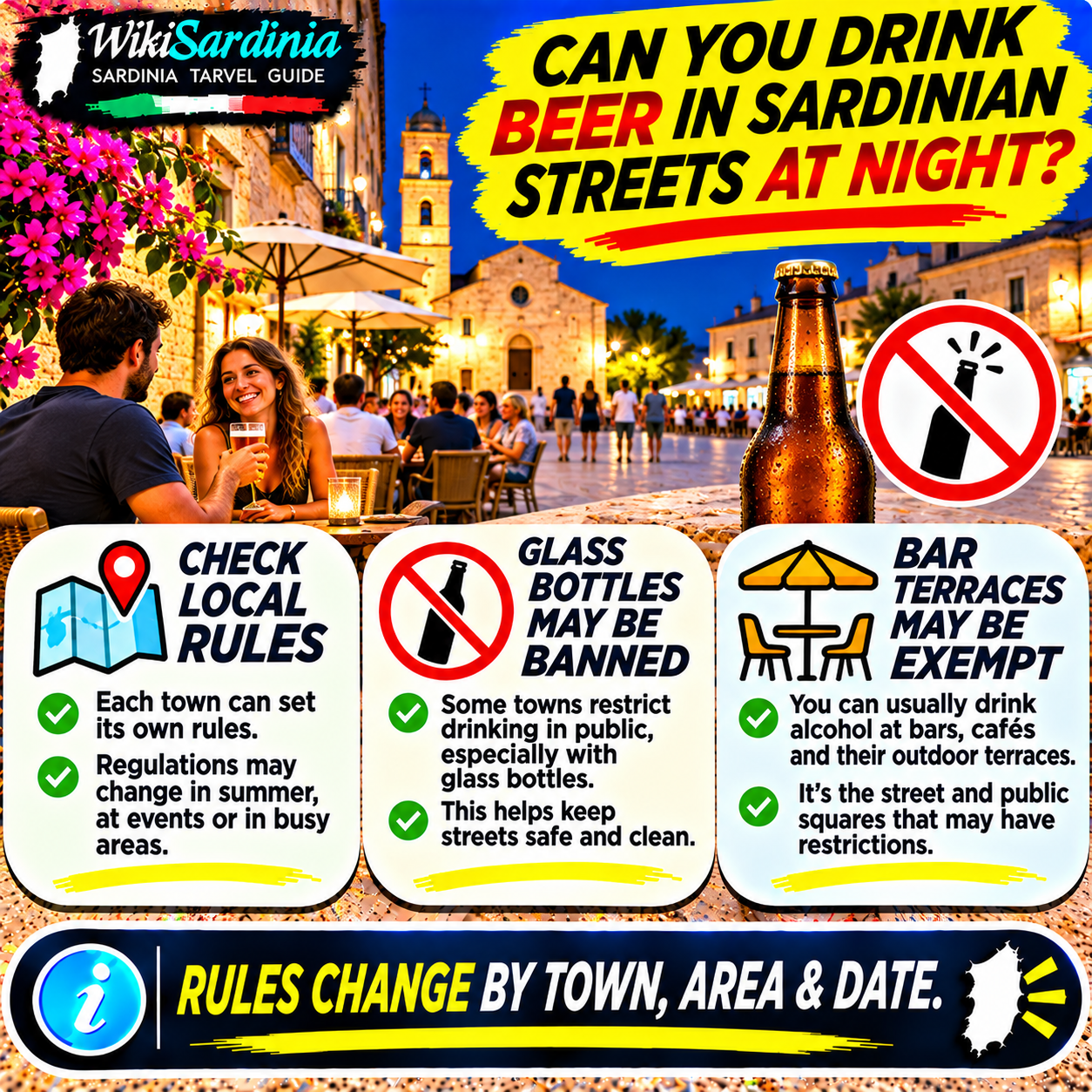
Sometimes yes, sometimes no. Sardinia does not have one simple island-wide rule saying that every adult may drink beer on every street or in every piazza at night. Local authorities can restrict public alcohol consumption, takeaway sales, glass bottles and cans in specific areas, during certain hours or for public events. A beer enjoyed at a licensed bar terrace is not necessarily treated the same way as a bottle opened on a public bench.
Is drinking alcohol outdoors illegal in Sardinia?
There is no blanket nationwide prohibition on every instance of responsible adult drinking in public. However, municipal ordinances can prohibit alcohol consumption in designated streets, squares, waterfronts or parks. Some measures apply only after a particular hour, while others cover an entire day or a special event. Always check the current municipality's notices and posted signs rather than relying on general assumptions about Italy.
Can I open a beer bottle in a town square?
First check whether the square is covered by a public-drinking ban, a glass-container ban or an event-specific restriction. In some places, opening and drinking beer from a glass bottle may violate a local ordinance even when drinking at a nearby licensed café table is permitted. Switching to a plastic cup does not necessarily solve the problem: an ordinance may ban alcohol consumption itself, regardless of container.
What has happened in Cagliari?
As an example of how specific these rules can be, Cagliari's municipal ordinance No. 44 of 31 May 2022 prohibited drinking alcohol in specified public streets and squares in districts including Marina, Stampace, Castello and Villanova between 10 p.m. and 6 a.m. during the period from 1 June to 31 October 2022, while making exceptions for authorized serving areas. It also restricted certain takeaway sales and glass containers. This is a historical example, not evidence that the same order is in force in 2026. Check the Comune di Cagliari for any current restrictions.
What about Olbia?
Olbia has also used anti-alcohol ordinances for busy nightlife areas. Restrictions reported in 2024 covered public consumption in parts of its historic center and surrounding streets. More recently, the Comune di Olbia issued special rules for Ferragosto 2026, covering the evening of 14 August into the early hours of 15 August and restricting certain beverage containers and consumption in public areas, including beaches and streets. Those dates matter: a festival ordinance should not be described as a permanent town-wide ban. Check the municipality's official website before your visit.
Are bar and restaurant terraces different?
Often, yes. Municipal restrictions may explicitly exempt licensed outdoor serving areas, known as dehors or plateatici. If you buy a beer at a bar, ask whether you can take the glass outside and where the authorized seating area ends. A table in the square may be covered by the bar's permission, while the public steps across the street are not.
Do glass bottles have special restrictions?
Yes, in some places and at some times. Glass bottles and cans may be restricted because broken glass and discarded containers create hazards in crowded public spaces. A local rule may prohibit takeaway sales, possession or consumption from specified containers, sometimes even for non-alcoholic drinks. Read the wording carefully: a container ban is not always the same as an alcohol ban.
What about beaches, festivals and summer nights?
Expect extra restrictions during concerts, festivals, major holidays and busy summer periods. They may apply to beaches, seafront promenades and public squares as well as town centers. A rule in force during a festival weekend may not apply the following week. Conversely, a beach with no obvious signs is not proof that no municipal ordinance applies.
How do you check the rule for tonight?
Search the official municipality website for “ordinanza alcolici”, “divieto consumo bevande alcoliche”, “divieto vetro” or “ordinanza movida” alongside the town name and date. Check the geographic boundaries, dates, hours, container types and exceptions. Look for notices displayed near the piazza or ask the local police (Polizia Locale) or a bar owner. A useful phrase is “Si può bere una birra in questa piazza?” (“Can I drink a beer in this square?”).
What happens if you ignore a restriction?
Depending on the ordinance and applicable law, violations can lead to administrative fines and other enforcement measures. There is no reliable single fine that applies to every Sardinian municipality. Read the actual order rather than assuming a standard penalty. Never leave bottles behind, and avoid noise or behavior that disturbs residents.
Frequently asked questions
Can I drink an Ichnusa while walking through Alghero?
Do not assume that every street and time is unrestricted. Check the latest Comune di Alghero ordinances and any posted signs. If uncertain, enjoy your beer in a licensed bar or restaurant area.
Is beer treated differently from wine or spirits?
Local ordinances may cover all alcoholic drinks regardless of strength. Check the precise wording.
Can I drink outside after midnight?
That depends on the town, area and current ordinance. Some restrictions have specifically covered late-night hours; others have applied for longer periods.
Can I drink from a plastic cup if glass is banned?
Only if the restriction concerns the container and alcohol consumption itself remains permitted. A general public-alcohol ban still applies to plastic cups.
Can tourists be fined?
Yes. Local rules generally apply to visitors as well as residents.
The takeaway
Enjoying a beer in a Sardinian town square can be perfectly ordinary, but it is not automatically permitted everywhere at night. Local rules can restrict alcohol, glass containers or both. The simplest low-risk option is a licensed café or bar terrace; if you want to drink in the street, check the municipality's current rules for the exact location and date.
Sources: Comune di Cagliari — 2022 ordinance example; Comune di Olbia — Ferragosto 2026 ordinances; Comune di Alghero for local notices.