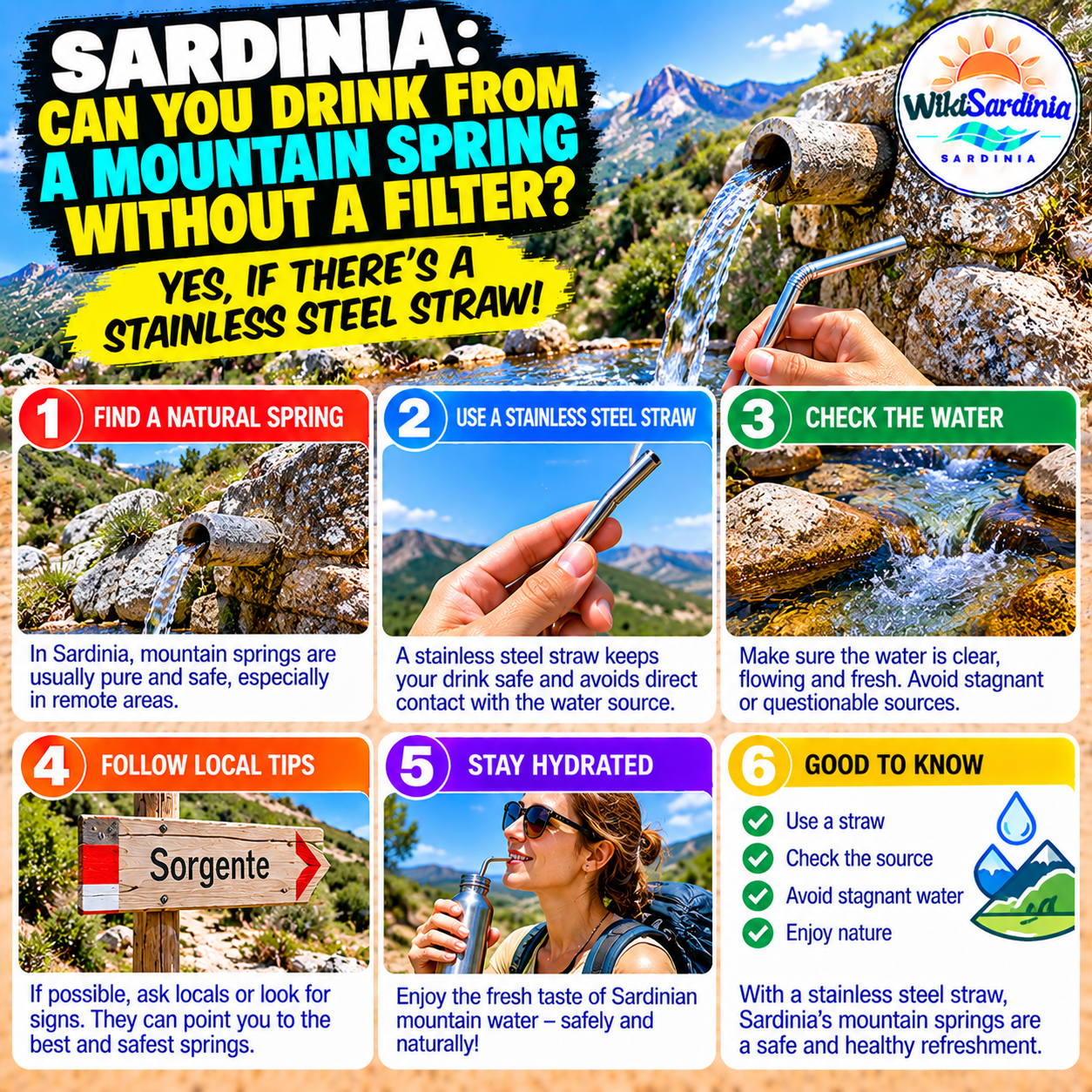
Finding a clear spring while hiking in Sardinia can feel like discovering a perfect natural water stop. You may see water flowing from a metal pipe—sometimes called a cannuccia—but the pipe itself does not prove that the water is safe to drink. Water can look clear and still contain bacteria, parasites or chemical contaminants.
Does a metal pipe mean the spring is safe?
No. A pipe may channel water from a spring, but it does not tell you whether the source is tested, protected from contamination or officially considered potable. The water could be affected by livestock, wildlife, septic systems, agricultural runoff, heavy rain or damage to the source. Do not rely on the appearance of the water or the material of the outlet.
1. Look for official information
Check for a clear sign stating that the water is potable (acqua potabile) or non-potable (acqua non potabile). If there is no sign, that does not automatically mean the water is safe. When possible, check with the municipality, a local visitor centre or the land manager responsible for the spring.
If a sign says acqua non potabile, do not drink the water. If the status is unclear or there is no reliable confirmation, choose another source.
2. Do not judge water by its appearance
Clear, cold water is not necessarily safe. Microorganisms and some chemical contaminants cannot be seen, smelled or tasted. A clean-looking spring surrounded by rocks and trees can still be contaminated, so visual checks are not a substitute for reliable information or appropriate treatment.
3. Be extra cautious after heavy rain
Heavy rain can wash animal waste, soil and other pollutants into a spring or its catchment. Flooding, landslides or damaged infrastructure may also affect a source. After heavy rain, avoid drinking untreated spring water unless its safety has been confirmed by the responsible authority.
4. Can a portable filter make it safe?
That depends on the device and the contaminants. Some filters reduce certain bacteria and protozoa, but ordinary portable filters may not remove viruses, dissolved chemicals or other pollutants. Read the manufacturer’s specifications and follow the instructions carefully. In situations where microbiological contamination is a concern, a suitable treatment method may be needed in addition to filtration.
Boiling can inactivate many disease-causing organisms, but it does not remove chemical contamination and may concentrate some dissolved substances. If the source may be chemically contaminated, do not try to make it safe by boiling alone.
5. Plan water stops before a hike
- Carry enough drinking water for the route, weather and length of the walk.
- Refill only at sources confirmed as potable.
- Do not assume a spring is maintained simply because it has a pipe or basin.
- Have a backup supply, especially on remote trails where shops and services may be far away.
- If you are unsure about a source, do not drink from it.
Useful Italian phrases
- “Quest’acqua è potabile?” — Is this water safe to drink?
- “La sorgente è controllata?” — Is the spring tested or monitored?
- “Dove posso trovare acqua potabile?” — Where can I find drinking water?
The safe rule for mountain springs in Sardinia
A metal pipe is only an outlet, not a safety certificate. Drink from a mountain spring only when reliable official information confirms that the water is potable. If the source is unmarked, its status is uncertain or conditions may have changed after heavy rain, use treated or bottled water instead. A little preparation is worth it when you are exploring Sardinia’s countryside.