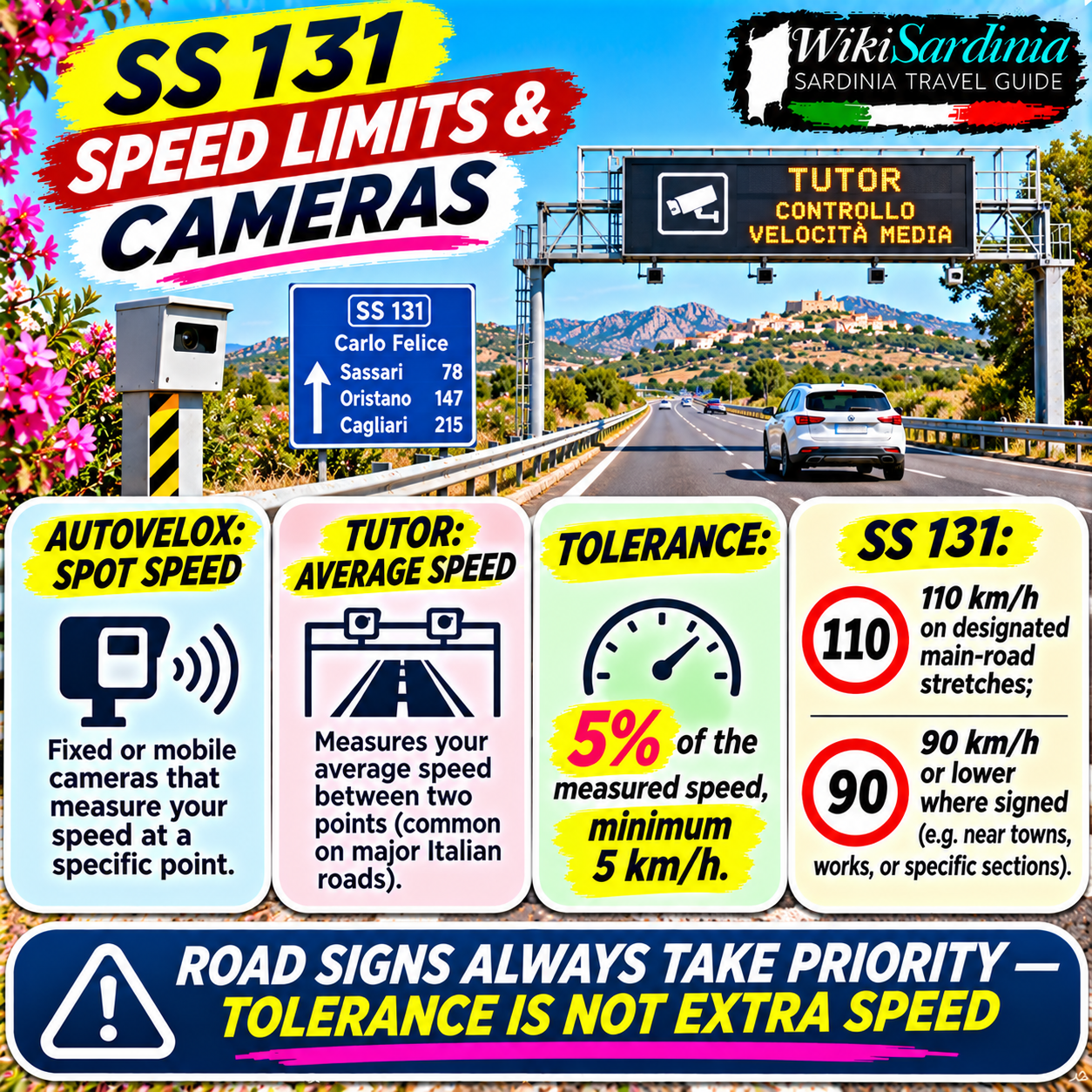
Italy's Autovelox and Tutor speed-enforcement systems apply a measurement deduction of 5%, with a minimum of 5 km/h. On Sardinia's SS 131 Carlo Felice, the legal speed limit depends on the particular section and its road signs. Do not assume the entire road has a 110 km/h limit: some sections are posted at 90 km/h or less.
Autovelox versus Tutor: what's the difference?
An Autovelox measures a vehicle's speed at a particular point, using fixed or mobile equipment. A Tutor system measures average speed over a defined section using the time between detection points. Italy's traffic police also describe other average-speed equipment, including Vergilius Plus. The same statutory measurement deduction applies to both point and average-speed enforcement; Italy's Court of Cassation confirmed this for Tutor in decision 15894/2025.
What is the speed-camera tolerance in Italy?
Article 345(2) of the implementing regulation of the Italian Highway Code requires that measured speed be reduced by 5%, with a minimum deduction of 5 km/h. The deduction accounts for instrument tolerance. It is applied to the recorded speed when determining whether a violation occurred; it does not increase the legal speed limit.
| Posted limit | Example recorded speed | Deduction | Speed used for enforcement |
|---|---|---|---|
| 50 km/h | 58 km/h | 5 km/h | 53 km/h |
| 70 km/h | 78 km/h | 5 km/h | 73 km/h |
| 90 km/h | 99 km/h | 5 km/h | 94 km/h |
| 110 km/h | 120 km/h | 6 km/h | 114 km/h |
These examples explain the calculation, not recommended driving speeds. A driver should obey the posted limit rather than aim for a theoretical enforcement threshold. The vehicle's speedometer and measurement systems also differ, so there is no reliable 'free extra speed' to exploit.
How fast can you legally drive on the SS 131 Carlo Felice?
Under Article 142 of the Italian Highway Code, the general maximum is 110 km/h on roads classified as strade extraurbane principali and 90 km/h on strade extraurbane secondarie. Specific road signs can impose lower limits, for example at junctions, work zones, narrow sections or other hazards. The SS 131 includes different road conditions and signed restrictions; a dual carriageway by itself does not prove that every stretch is legally classified for 110 km/h.
For the current road segment, follow the posted speed limit. Do not rely on an old blog post, a generic route planner or the road number alone. If the sign says 90, your legal limit is 90, even if another section of the SS 131 permits 110.
Does rain change the speed limit?
Yes, on extraurban main roads the Italian Highway Code lowers the general maximum from 110 to 90 km/h in precipitation. Other posted limits and the obligation to drive at a safe speed remain applicable. Reduced visibility, standing water and traffic conditions may require driving considerably more slowly than the maximum.
Where are speed checks on the SS 131?
The Italian State Police publishes weekly schedules of mobile speed-enforcement operations and information about fixed equipment. The official page was updated in November 2026. Third-party mapping data checked in November 2026 identify fixed camera locations around Monastir with a 90 km/h posted limit, but map listings are incomplete and cannot establish whether a particular camera is active. Police mobile checks can occur elsewhere along the route. Do not assume that only mapped cameras matter.
Are there Tutor cameras on the SS 131?
Not every overhead gantry is a Tutor, and not every camera is a speed camera. The State Police lists the types of point and average-speed systems it uses, but this guide does not establish an exhaustive, currently active Tutor inventory for every kilometre of the SS 131. Check the official police listings and on-road notices for specific controlled sections. Whether the device measures instantaneous or average speed, respect the applicable limit throughout.
What happens if you exceed the limit?
Italian penalties depend on the amount by which the adjusted speed exceeds the posted limit. Article 142 distinguishes infringements up to 10 km/h over the limit, more than 10 up to 40, more than 40 up to 60, and more than 60 km/h. Higher categories can involve licence-point consequences and suspension. Exact fines can change through statutory updates, so consult the current official law rather than relying on a static amount.
What should tourists in rental cars know?
Speeding tickets can be sent after a holiday. Rental companies may identify the driver to authorities and charge a separate administration fee under the rental contract. Visitors should not assume they are exempt from fines because they hold a foreign driving licence. Check the contract, monitor any subsequent notifications and use official channels if you need to dispute a penalty.
Practical SS 131 driving tips
- Read each speed-limit sign as you enter a new section, especially near junctions and roadworks.
- Do not treat 110 km/h as the default for every kilometre of the SS 131.
- Slow down for rain, poor visibility, congestion and merging traffic.
- Keep a safe following distance and use the right lane except when overtaking as required.
- Remember that Tutor systems assess average speed, while Autovelox measure speed at a point.
- Use a speed limiter or cruise control only when road and traffic conditions make it safe.
- Consult official police updates rather than relying on a crowdsourced camera map as an exhaustive list.
Useful Italian phrases
- “Qual è il limite di velocità su questo tratto?” — What is the speed limit on this section?
- “C'è un controllo della velocità media?” — Is there average-speed enforcement?
- “Il limite è di novanta chilometri orari.” — The limit is 90 kilometres per hour.
- “Ci sono lavori in corso sulla statale?” — Are there roadworks on the state road?
- “La multa è stata notificata alla società di autonoleggio?” — Was the fine sent to the rental company?
Frequently asked questions
What is the Autovelox tolerance in Italy in 2026?
5% of the measured speed, with a minimum deduction of 5 km/h, under Article 345 of the Highway Code implementing regulation.
Does Tutor have a different tolerance?
No. The same deduction applies to Tutor average-speed measurements, as confirmed by Italy's Court of Cassation in 2025.
Is the SS 131 speed limit always 110 km/h?
No. Only qualifying sections have the 110 km/h general limit; other sections may be 90 km/h or lower, as signed.
Can I drive at 115 km/h in a 110 zone?
No. The legal maximum remains 110 km/h. The measurement deduction is not permission to drive faster.
What is the limit on an extraurban main road in rain?
The general maximum falls to 90 km/h in precipitation, subject to any lower applicable limits and safe-driving obligations.
Are all cameras on the SS 131 active?
Not necessarily. Public maps cannot confirm the live operating status of every device. Mobile enforcement may also take place.
Can a rental-car driver receive a speeding ticket after leaving Sardinia?
Yes. Rental firms can provide driver information to authorities and may charge an administration fee according to the contract.
How do I find official speed-control information?
Consult the State Police's Autovelox and Tutor information page and read current road signs.
The bottom line
Italy applies a 5% speed-measurement deduction, minimum 5 km/h, to Autovelox and Tutor readings—but the legal limit never increases because of that tolerance. On Sardinia's SS 131 Carlo Felice, expect 110 km/h only where the road classification and signs permit it, and 90 km/h or less on other sections. The posted limit and driving conditions always govern.