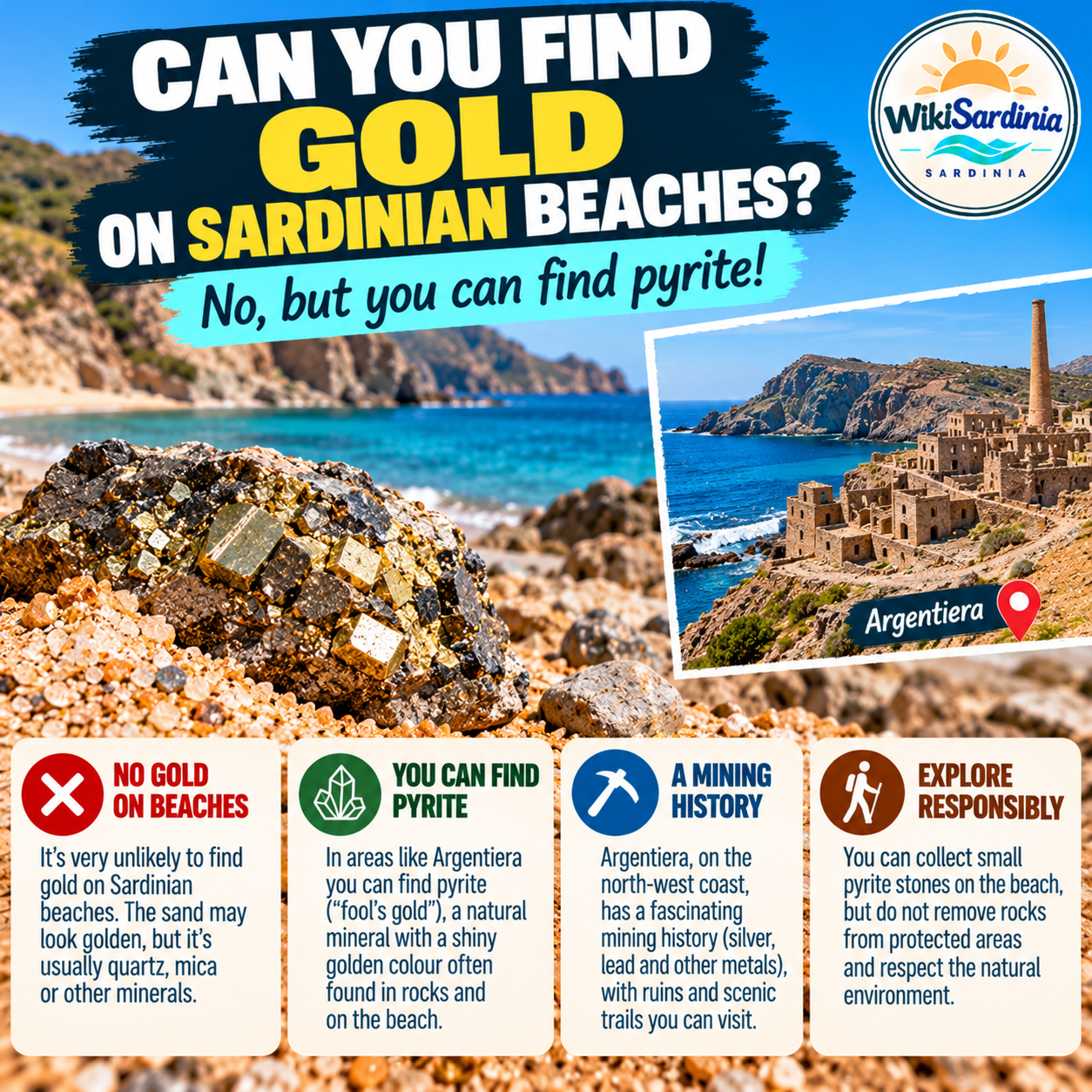
Could you discover gold while walking along a Sardinian beach? It is a fun idea, but there is no good reason to expect ordinary beach sand to yield visible gold. Shiny yellow grains are more likely to be minerals such as pyrite, sometimes called “fool’s gold,” or other reflective fragments. Colour alone is not enough to identify a mineral.
What about Argentiera?
Argentiera, on Sardinia’s north-west coast, is known for its historic mining settlement and its mining heritage. The area’s industrial history is chiefly associated with silver, lead and zinc ores—not with a public beach where visitors can reliably find gold. It is an interesting place for anyone curious about geology and mining history, but it should not be presented as a gold-hunting destination.
Gold or pyrite: how can you tell?
Pyrite can have a bright brass-yellow shine that looks like gold in sunlight. Gold is usually more malleable, while pyrite is brittle and tends to break or crumble; however, you should not identify an unknown mineral by handling or damaging it alone. Reliable identification may require examining several physical properties or consulting a geologist.
- Do not trust colour alone: golden colour does not prove a grain is gold.
- Avoid breaking unknown minerals: sharp fragments can cause injury, and some mine waste may contain hazardous materials.
- Do not enter mine workings: old shafts, tunnels and industrial remains can be unstable or contaminated.
- Check local rules: collecting minerals or sediment may be restricted on protected land or at heritage sites.
Can you pan for gold in Sardinia?
Do not assume recreational gold panning is allowed wherever a stream or beach is accessible. Rules can depend on land ownership, protected-area status and the type of collection activity. Before removing sediment or minerals, check with the relevant local authority and respect any restrictions. Never collect material from protected sites or old mine dumps without explicit permission.
How to enjoy Sardinia’s geology responsibly
If you visit Argentiera, focus on the landscape, the remains of the mining village and the story of the island’s mineral resources. Stay on permitted paths, observe warning signs and keep away from fenced-off industrial areas. For hands-on mineral identification, a guided geology activity or a reputable mineral collection is safer than testing unknown material from a beach or mine site.
The short answer
You should not expect to find gold on Sardinia’s ordinary beaches. A golden sparkle may be pyrite or another mineral, and Argentiera is better known for its historic silver-lead-zinc mining. Enjoy the island’s geology, but identify minerals carefully and check the rules before collecting anything.