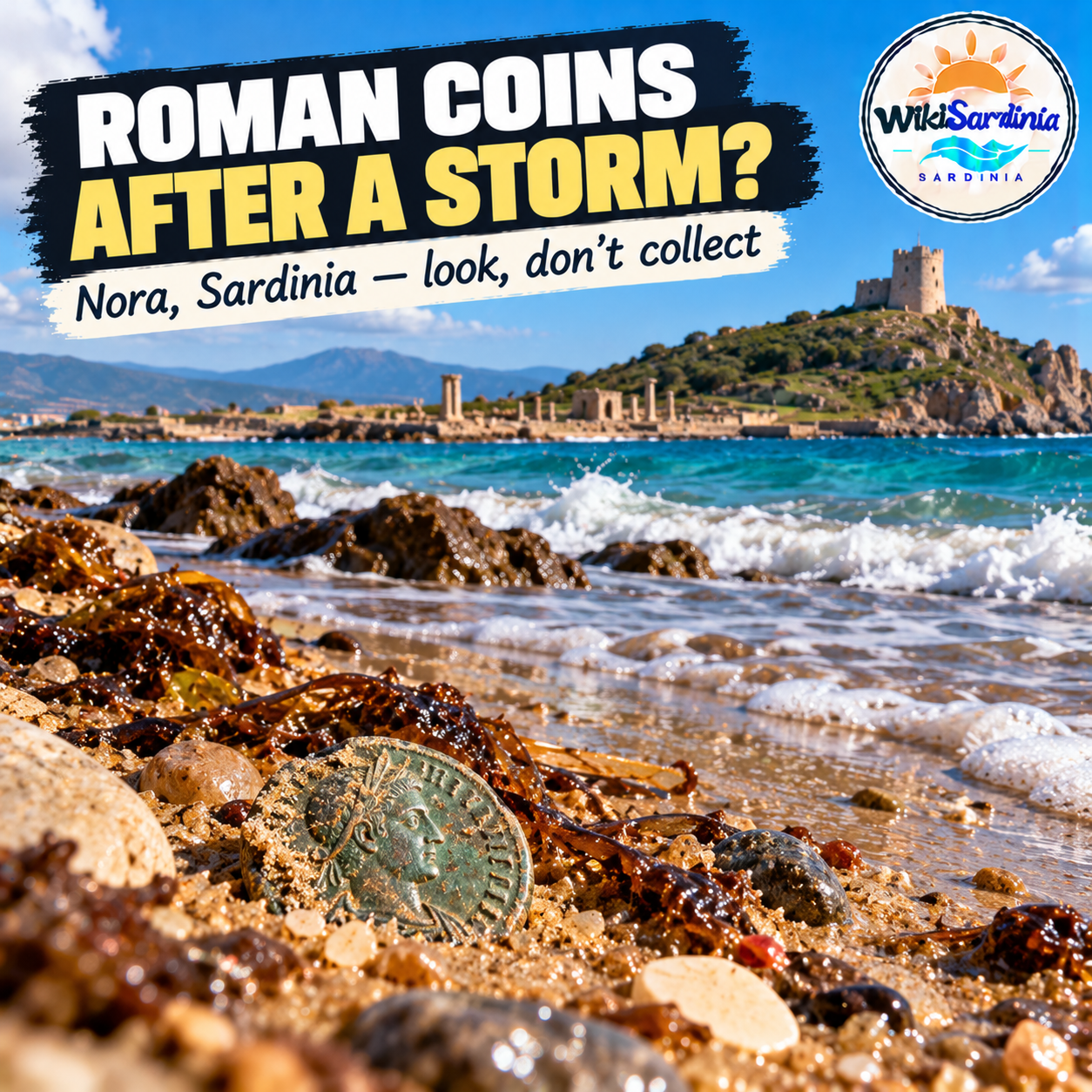
After a strong sea storm, the beach at Nora near Pula can look different: sand shifts, stones move and parts of the shoreline may be exposed. Could you find a Roman coin? It is possible for coastal erosion to uncover archaeological material, but there is no reliable evidence that Roman coins routinely appear on Nora beach after a Libeccio storm. Treat the idea as a possibility, not a treasure-hunting tip.
Has the sea ever revealed archaeology at Nora?
Yes. Nora is an ancient Phoenician, Punic and Roman settlement on the coast near Pula. The Italian Ministry of Culture records that a strong sea storm in the late nineteenth century exposed the site’s tophet, helping lead to archaeological investigations beginning in 1889. That is a documented example of a storm revealing important remains—but it does not mean coins will be found after every storm, or that a visible object is necessarily Roman.
Learn more from the Regional Museums of Sardinia’s official Nora page and the Ministry of Culture’s Nora archaeological area guide.
Why storms can expose ancient objects
Waves and currents can remove or redistribute sand and sediment, temporarily exposing materials that were previously buried. The same process can also damage archaeological layers and carry objects away from their original context. Even if an object looks like a coin, it can be difficult to identify its age, material or significance from a quick glance on the beach.
What should you do if you spot a possible Roman coin?
- Leave it where it is: do not pocket it, dig around it, scrape it clean or remove nearby objects.
- Take a photograph in place: if safe and permitted, photograph it without touching or moving it.
- Record the location: note the nearest landmark or use your phone’s location without entering a restricted area.
- Notify the authorities: contact the Carabinieri or the competent archaeological Soprintendenza and follow their instructions.
- Respect closures: if the area is cordoned off or archaeological work is under way, keep out.
Italian cultural-heritage law requires people who make a chance discovery of archaeological or culturally significant objects to notify the relevant authorities within the prescribed time. Do not assume that a small or corroded object is insignificant.
Can you use a metal detector on the beach?
This article is not a recommendation to search for ancient coins with a metal detector. Deliberately searching for archaeological objects can raise legal issues and may damage the context that allows archaeologists to understand a find. Around an important site such as Nora, do not dig or conduct targeted searches for artefacts. If you are interested in the area’s history, visit the authorised archaeological park or join a permitted guided activity.
Is Nora worth visiting even without a coin?
Absolutely. The archaeological area preserves streets, public buildings, mosaics, thermal complexes and a Roman theatre, set against a dramatic coastal landscape. The site is much more than the possibility of a chance find: it offers a way to understand how an ancient settlement developed beside the sea and how coastal change continues to affect its remains.
Check current opening and access information before travelling, especially after severe weather, because erosion or conservation work can affect parts of the shoreline.
The real lesson after a storm
A storm can reveal traces of the past, as Nora’s history demonstrates, but finding a Roman coin on the beach is neither guaranteed nor a reason to start searching. Enjoy the shoreline, leave possible artefacts in place and report them to the authorities. Protecting an object’s original location helps preserve the archaeological story for everyone.
Useful official references: Ministry of Culture — Nora archaeological area; Regional Museums of Sardinia — Nora; Italian Cultural Heritage Code (Legislative Decree 42/2004).