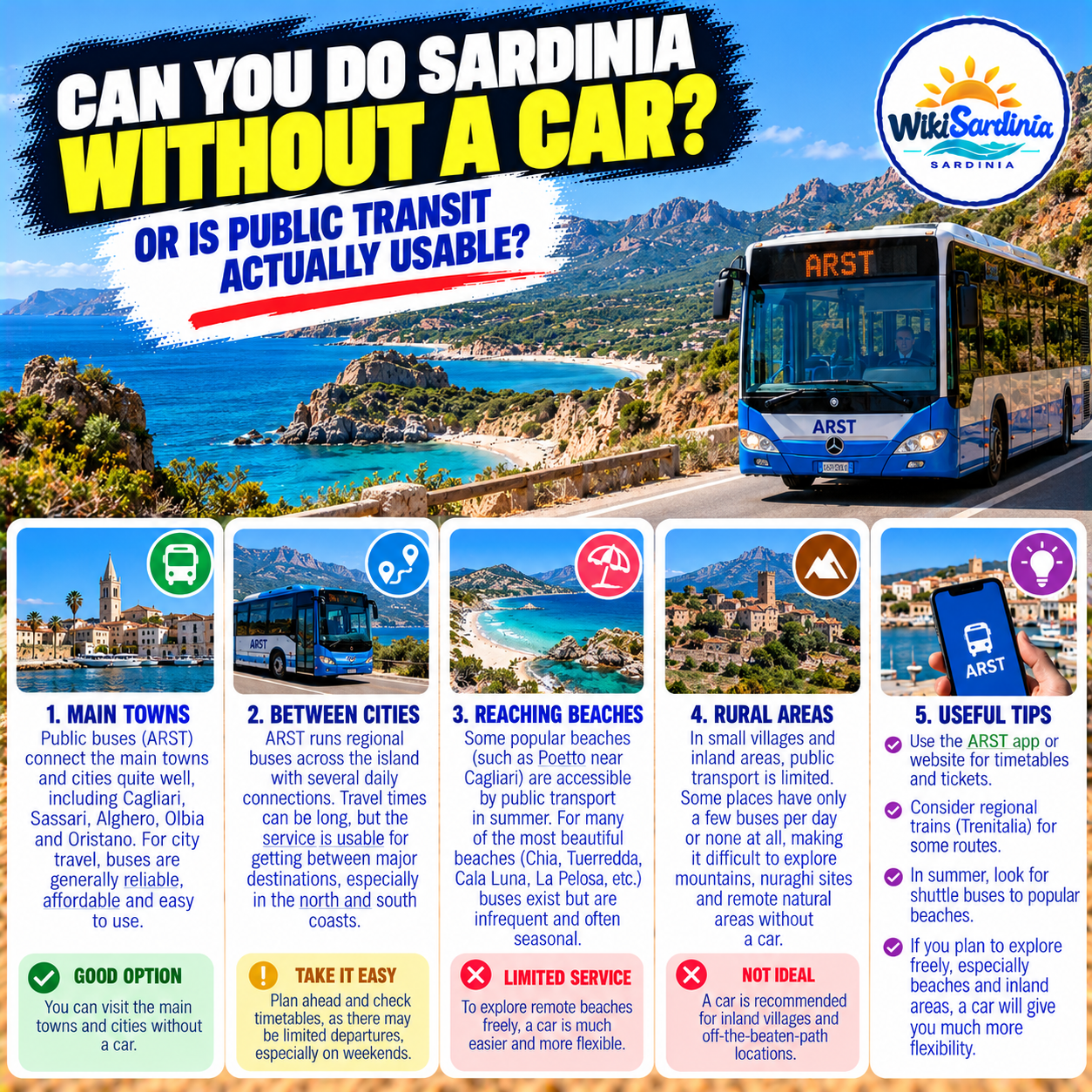
Can you visit Sardinia without renting a car? Absolutely. But whether it feels easy or frustrating depends on where you stay, which beaches you want to visit and how much flexibility you expect. Sardinia has real public transport—regional trains, intercity buses and local urban networks—but it was not designed to deliver tourists to every secluded cove on demand.
For travellers planning a city break or a holiday based in one well-connected town, public transport can work very well. For anyone hoping to see remote beaches, archaeological sites and mountain villages in a few days, a car—or a combination of public transport and organised excursions—usually makes the trip much easier.
Is public transport in Sardinia actually usable?
Yes. The island has an established regional transport network. Trenitalia operates services along key railway corridors, while ARST, Sardinia's regional transport company, provides bus connections across much of the island and rail services on certain secondary routes. Larger cities also have their own urban transport systems.
The important distinction is between coverage and frequency. A village may have a bus connection but only a handful of departures on a typical day, sometimes with different schedules on school days, Sundays and public holidays. A route that looks straightforward on a map may require a long wait or an inconvenient transfer.
Which Sardinian cities are easiest without a car?
Cagliari is one of the most practical bases. Its urban transport network, walkable central districts and connections to the airport and railway make it possible to enjoy a varied holiday without driving. The city also has access to Poetto beach by public transport, although exact routes and frequencies should always be checked.
Alghero is another good choice, especially for visitors who want an atmospheric historic centre, seafront walks and a relatively compact town. The airport has public transport connections, and some nearby coastal destinations can be reached by seasonal or regular services depending on the period.
Olbia works as an arrival point and a base for certain excursions, although reaching the most famous Costa Smeralda beaches without a car can involve more planning. Sassari and Oristano also have urban services and intercity connections, making them reasonable choices for visitors interested in local culture rather than a different remote beach every day.
Are Sardinia's trains useful for tourists?
They are useful along the main railway network, particularly for journeys linking important towns. Trenitalia's regional routes connect major centres such as Cagliari, Oristano, Sassari and Olbia through the island's rail corridors. However, the railway does not run around the entire coast, and many celebrated seaside resorts have no railway station.
That means trains are best seen as a backbone for longer journeys, not a complete solution for reaching every destination. Check journey times, service changes and connections on the official Trenitalia website before booking accommodation.
What about ARST buses?
ARST is essential to understanding travel without a car in Sardinia. Its buses connect many towns that trains do not serve and provide an important transport link for local residents. Some routes can be very useful for tourists, while others are organised primarily around everyday travel needs.
For a successful trip, check the actual timetable in both directions. It is not enough to confirm that a bus reaches a beach or village: you must also know whether a return service operates at a convenient time. Pay special attention to school-day notes, weekend schedules and seasonal changes.
Can you get to Sardinia's beaches without a car?
Yes, some beaches are accessible by bus, but not all of them. Beaches close to cities and established resort towns are generally easier to reach. Poetto, near Cagliari, is a practical example. Around Alghero, certain coastal areas may have transport connections, especially in the summer tourist season.
Remote coves are a different story. Some require a boat, a substantial walk, a private transfer or a combination of services. A beach that appears close to a town on a map may still be difficult to reach because of terrain, limited road access or infrequent departures.
Popular destinations such as La Pelosa, Cala Luna and parts of the Chia coastline have their own access arrangements, which may include seasonal buses, boat services, reservation rules or restrictions. Always verify the specific destination rather than assuming there is a daily bus throughout the year.
Does public transport work in the countryside?
Many inland towns are served by regional buses, but schedules can be sparse and journeys can take considerably longer than driving. This matters if you want to visit nuraghi, mountain trails, archaeological areas or small villages outside the main routes. A place may be connected to a nearby town but not directly to your hotel or chosen trailhead.
For a rural day trip, it is often worth comparing the bus timetable with the cost of a local guided excursion. A tour or transfer may allow you to visit a destination that would otherwise require an overnight stay.
Can you travel from Sardinia's airports without a car?
All three principal commercial airport gateways—Cagliari, Olbia and Alghero—have ground transport options. Cagliari Elmas has a railway station near the terminal, connected by a pedestrian route, while Olbia and Alghero rely on road-based connections for many journeys. Routes and operators vary, and late arrivals may not line up with the final public service of the day.
If your flight lands late at night, verify your onward journey before reserving accommodation. A hotel that seems inexpensive can become less attractive if reaching it requires a long taxi ride.
How much does public transport cost?
Public buses and regional trains can be significantly less expensive than renting a car, particularly for solo travellers or couples staying in one area. But prices vary by operator, distance and ticket type. It is better to check current fares on official booking channels than rely on an old blog post quoting a fixed ticket price.
Remember that the cheapest ticket is not always the cheapest overall plan: a missed last bus, a private transfer or an extra night's accommodation can change the calculation.
Seven practical tips for a car-free Sardinia holiday
- Choose one or two bases rather than changing accommodation every night.
- Stay near a station or useful bus stop, not merely somewhere described as “central.”
- Plan return journeys first, especially for beaches and villages.
- Check Sundays and public holidays separately because schedules can differ.
- Verify seasonal routes rather than assuming a summer beach shuttle runs in winter.
- Keep a flexible day in your itinerary for weather, delays or service changes.
- Use occasional guided trips or transfers for remote highlights instead of trying to force every excursion onto public transport.
Where should you check timetables?
Use the official operator sites: ARST for regional bus services and some rail routes; Trenitalia for regional trains; CTM Cagliari for urban transport in the Cagliari area; and ATP Nuoro for Nuoro's urban network. For other towns, look up the relevant local operator. Mapping apps can help plan a route, but the operator's current timetable should be the final reference when services are limited.
Is it better to rent a car?
That depends on your travel style. If your ideal holiday means strolling through Alghero's old town, enjoying Cagliari's museums and eating near the waterfront, you can have a wonderful trip without driving. If your dream is to discover several remote beaches, stop at viewpoints and visit scattered inland villages, renting a car usually offers far more freedom.
The verdict: yes, Sardinia is possible without a car
Sardinia's public transport is genuinely usable, but it is not equally convenient everywhere. Choose well-connected bases, build your itinerary around confirmed schedules and accept that some spectacular places will require a boat, an excursion or a private transfer. With those expectations, travelling without a car can be affordable, enjoyable and a great way to experience Sardinian towns at a slower pace.