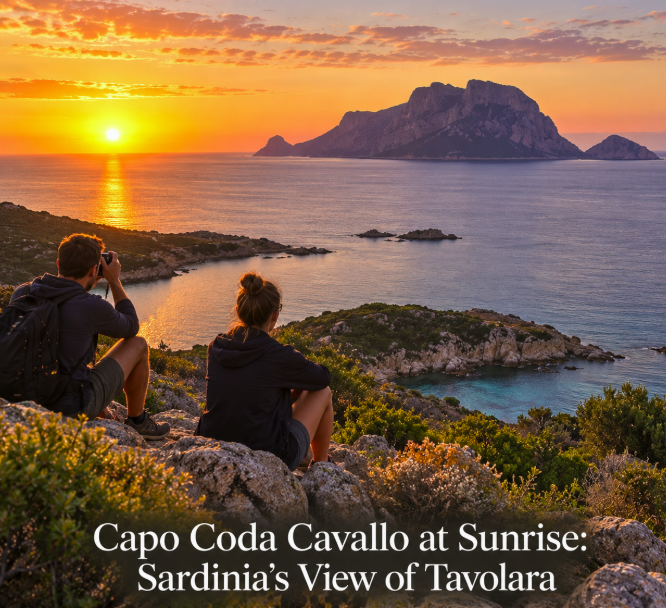
Capo Coda Cavallo is one of northeast Sardinia’s most rewarding places to be awake before breakfast. The headland faces the island-dominated seascape of Tavolara and Molara, so the first light of the day can turn the water, granite and limestone silhouettes into a completely different scene from the bright turquoise coastline visitors see at midday. For photographers staying around San Teodoro, Porto San Paolo or Olbia, it is a natural sunrise destination.
The setting is also protected. Capo Coda Cavallo lies within the Tavolara–Punta Coda Cavallo Marine Protected Area, which safeguards roughly 15,000 hectares of sea and a long stretch of northeast Sardinian coastline from Capo Ceraso south toward Cala Finocchio, including Tavolara, Molara and Molarotto. citeturn0search4turn0search6
Why sunrise works so well here
Capo Coda Cavallo projects into the sea east of San Teodoro, giving broad views across the protected marine landscape. Tavolara is the dominant landmark: its high limestone mass rises abruptly from the water and becomes especially graphic when seen in silhouette or side light around dawn.
The exact position of the rising sun changes throughout the year, so it should not be expected to emerge from precisely the same point beside Tavolara in every season. What remains consistent is the open eastern light. Before sunrise, the island can appear almost black against a gradually brightening sky; after the sun appears, warmer light begins to reveal the coastline and smaller islands.
Clouds can make the scene more dramatic rather than ruining it. A completely clear morning produces clean color gradients and strong silhouettes, while scattered clouds can catch pink, orange and gold light above the horizon. Wind is another important variable: calm mornings can produce softer reflections, while stronger conditions create a more textured sea.
When should you arrive?
Do not plan to reach the viewpoint at the published sunrise time. For photography, arriving roughly 30 to 45 minutes earlier gives time to settle in safely, choose a composition and photograph the blue and pastel light before the sun reaches the horizon.
Sunrise time changes considerably between midsummer and the quieter months, so check the exact time for San Teodoro or Capo Coda Cavallo on the date of your visit. Also remember that the most photogenic light is often before and immediately after the official sunrise rather than at one precise minute.
Early arrival has another advantage in the warmer season: the coast is quieter. Beaches and access roads that become busy later in the day can feel almost empty at dawn, although parking and access arrangements should still be respected.
How to photograph Tavolara at dawn
A phone is enough for a memorable photograph, especially with modern night and HDR modes. Tap the bright sky to avoid overexposing the sunrise and try including a little foreground — rock, Mediterranean scrub or the curve of the coastline — rather than photographing only the distant island.
With a camera, a moderate wide-angle lens works well for the full marine landscape, while a short telephoto lens can make Tavolara appear more dominant in the frame. A tripod is useful before sunrise when light levels are low, but it should be positioned where it does not damage vegetation or obstruct paths.
For a more natural photograph, resist pushing saturation too far. Northeast Sardinia already produces strong color at dawn, and Tavolara’s silhouette is often more effective against restrained pastel light than an artificially intense orange sky.
Remember that this is a protected coast
The beauty of the view is connected to the conservation status of the surrounding sea and islands. The Tavolara–Punta Coda Cavallo Marine Protected Area has different protection zones and specific rules for activities including navigation, anchoring and fishing. In Zones B and C, for example, anchoring is prohibited except on sandy or pebbly seabeds or in designated equipped areas; underwater fishing and jet skis are prohibited within the protected area. citeturn0search10turn0search24
Those regulations matter more to boaters than to someone standing onshore with a camera, but they are a reminder that Capo Coda Cavallo is not simply a scenic viewpoint. The management authority describes its mission as protecting and enhancing the marine environment while supporting environmental education, research and sustainable tourism. citeturn0search9
On land, visitors should use established access routes, avoid trampling coastal vegetation and take all rubbish away. Do not move rocks, create new paths or climb into fragile areas merely to reproduce a social-media photograph.
Combining sunrise with a day around San Teodoro
A dawn visit works particularly well if you are staying in San Teodoro or elsewhere along the northeast coast. After sunrise, the same stretch of coastline includes well-known beaches and coves around Capo Coda Cavallo, while the protected seascape continues north toward Porto San Paolo and Tavolara.
The marine protected area officially extends across the coastal territories associated with Olbia, Loiri Porto San Paolo and San Teodoro. Its ecological importance includes well-preserved Posidonia oceanica meadows and diverse marine habitats, giving the landscape more significance than its appearance alone suggests. citeturn0search6
If the objective is photography, however, avoid trying to cover too many locations before breakfast. One carefully chosen viewpoint with Tavolara in the distance is often more rewarding than racing between beaches while the light changes.
Capo Coda Cavallo earns its reputation as a sunrise location because the ingredients are unusually simple: open eastern sea, rugged Sardinian coastline and the unmistakable outline of Tavolara. Arrive before the sun, respect the protected environment and allow the changing light to do most of the work.