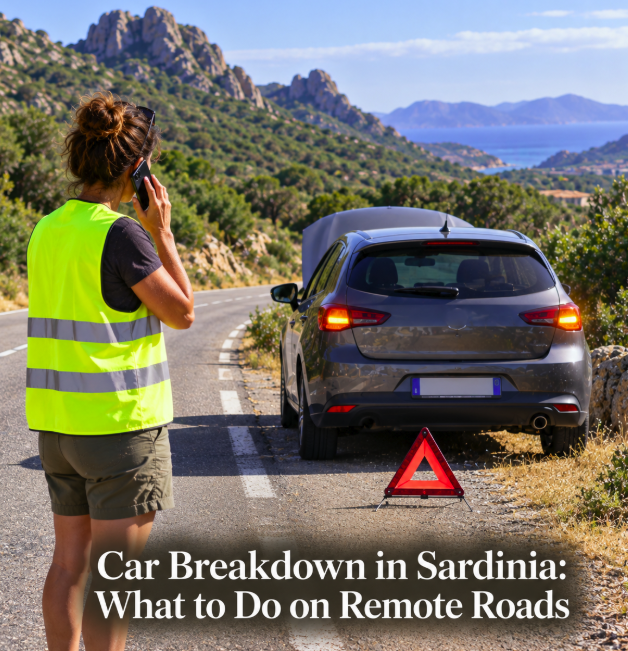
A car breakdown in Sardinia can feel very different from one in a city. Away from Cagliari, Sassari, Olbia and the main towns, some roads cross long stretches of mountains, Mediterranean scrub and sparsely populated countryside. If the car stops, the priorities are simple: get yourself out of traffic danger, make the vehicle visible, identify your exact location and contact the assistance provider responsible for the car.
For a rental vehicle, the first roadside-assistance number to use is normally the one supplied by the rental company. For other motorists, ACI operates roadside assistance across Italy, including ordinary roads and motorways, 24 hours a day. The current ACI assistance number in Italy is 803 116.
First, move the car somewhere safer if you can
If the vehicle is still moving and it is safe to do so, avoid stopping in the traffic lane or immediately after a blind bend. Use the hazard lights and move as far from moving traffic as reasonably possible. Do not continue driving a vehicle when doing so could cause further damage or create a safety risk.
Once stopped, switch on the hazard lights. Before stepping into or close to the roadway, put on a high-visibility vest. Italian road rules require high-visibility clothing when occupants leave a stopped vehicle outside built-up areas at night and also during the day when visibility is poor, including on emergency lanes and lay-bys.
Keep the vest inside the passenger compartment rather than buried underneath suitcases in the trunk. That allows you to put it on before leaving the car.
Use the warning triangle when required
Vehicles in Italy must carry an approved warning triangle. ACI guidance for visiting motorists says it should be placed at least 50 metres behind a stationary vehicle when the road permits, or otherwise in the most visible safe position.
On fast roads, personal safety comes first. Do not expose yourself to traffic simply to achieve an exact distance. ACI's breakdown guidance emphasizes getting occupants to a protected position, particularly beyond a guardrail where one exists and where doing so is safe.
If the car is stopped in a dangerous location, such as a blind bend or active traffic lane, tell the assistance operator immediately. If there is an immediate danger to people, use the emergency services rather than treating the situation as an ordinary mechanical problem.
112 is for emergencies, not an ordinary flat battery
The European emergency number is 112. Use it when there is an accident with injuries, fire, immediate danger or another genuine emergency requiring police, medical or fire services.
A routine puncture, dead battery or mechanical failure with the vehicle safely off the road is normally a roadside-assistance matter rather than a 112 emergency. Contact the rental company, insurer or roadside-assistance provider instead.
If circumstances change — for example, someone is injured or the disabled vehicle creates an immediate hazard — explain that clearly when contacting emergency services.
ACI roadside assistance in Sardinia
ACI's current service operates 24 hours a day, 365 days a year across Italy's ordinary road and motorway network. The Italian assistance number is 803 116. ACI says its roadside service can include repair on the spot where possible, vehicle recovery and towing.
The ACI Space app can also request roadside help using geolocation. This can be especially useful in Sardinia when you cannot confidently pronounce or identify the nearest road or village.
Coverage and cost depend on whether you have an ACI membership or another entitlement, so do not assume every tow is free. Rental-car customers should generally follow the rental company's assistance procedure first because unauthorized towing or repairs can complicate reimbursement and vehicle replacement.
If you are driving a rental car
Open the rental agreement or the company's app and find the emergency or roadside-assistance number. Many rental companies have a dedicated procedure for breakdowns, punctures, lost keys and accidents.
Tell the operator whether the car can move, whether you are in a safe position and what warning lights or symptoms appeared. Do not authorize a garage to perform major repairs unless the rental company instructs you to do so.
Ask what happens after towing. Depending on the contract and the fault, the company may arrange repair, a replacement vehicle or transport to another location. Tire damage, incorrect fuel, lost keys and damage caused by driving on unsuitable roads may be treated differently from an ordinary mechanical failure, so check the rental terms.
Your exact location matters more than the nearest town
On a remote Sardinian road, saying “somewhere near Baunei” or “in the mountains near Orgosolo” may leave a tow operator with a large search area. Give precise information whenever possible.
Use your phone's map application to obtain GPS coordinates or share a location pin. Note the road number, direction of travel, nearest junction and any kilometre marker visible nearby. ACI specifically recommends providing precise location information, including kilometre references or GPS coordinates.
Take screenshots of the location while the phone still has data coverage. If the signal later disappears, the coordinates remain available.
What if there is little or no mobile signal?
Remote parts of Sardinia can have inconsistent mobile coverage. Before a long drive through the interior, mountains or isolated coastal areas, download an offline road map and save the roadside-assistance numbers in the phone.
If you lose data but still have cellular voice service, a normal phone call may work even when navigation apps cannot load. If you have no usable connection and the vehicle is safely positioned, avoid wandering long distances along an unfamiliar road unless there is a clear safe reason to do so.
On motorways, ACI guidance notes that SOS posts can be used to request assistance. Sardinia itself has no conventional toll motorway network like mainland Italy, so visitors are more likely to encounter breakdowns on state, provincial or local roads where a charged phone and accurate location information are particularly important.
Prepare for heat and isolation
A mechanical failure in July or August can become a heat problem before it becomes a towing problem. Carry drinking water in the car, especially when driving into inland Sardinia or along long scenic routes away from towns.
Do not wait inside an unsafe vehicle exposed to traffic merely for air conditioning. Conversely, do not abandon a safely parked car to walk several kilometres in extreme heat without a clear plan. Choose the safest waiting location available and tell the assistance operator if children, older passengers or anyone with medical needs is present.
At night, visibility and temperature create different problems. Keep a flashlight or charged phone light accessible, along with the reflective vest.
A simple breakdown kit for Sardinia
- High-visibility vests stored inside the passenger compartment.
- The vehicle's approved warning triangle.
- A charged phone and car charger or power bank.
- Rental-company or insurance roadside-assistance number.
- Offline map of the area you are driving through.
- Drinking water, particularly in warm weather.
- Flashlight for evening or night driving.
- Photos or digital copies of the rental agreement and relevant insurance details.
Do not improvise repairs beside fast traffic
Changing a wheel on a quiet, level and safely separated area is very different from attempting the same job beside fast-moving traffic or on a narrow mountain bend. If the location is dangerous, professional recovery is the safer option.
Similarly, do not open a hot cooling system or crawl under a disabled vehicle at the roadside. Modern rental cars can also have tire-repair kits rather than spare wheels, and using them incorrectly may not solve a sidewall tear or other serious tire damage.
If a dashboard warning indicates a serious engine, oil-pressure, brake or overheating problem, stopping can prevent a minor mechanical issue from becoming a major failure.
Before driving into remote Sardinia
Check the rental company's breakdown procedure before leaving the airport rather than discovering it on the roadside. Locate the warning triangle and reflective vest, save the assistance number and confirm whether the car has a spare wheel or puncture kit.
For drives through areas such as the Supramonte, Barbagia, Ogliastra or sparsely populated stretches of the southwest, start with adequate fuel and water. Download maps in advance and let someone know your route when the day involves especially isolated roads.
A breakdown in Sardinia is usually a logistical inconvenience rather than a crisis. The situation becomes much easier to manage when the vehicle is visible, passengers are away from traffic, the tow operator receives accurate coordinates and the correct assistance provider is contacted before anyone attempts an improvised repair.