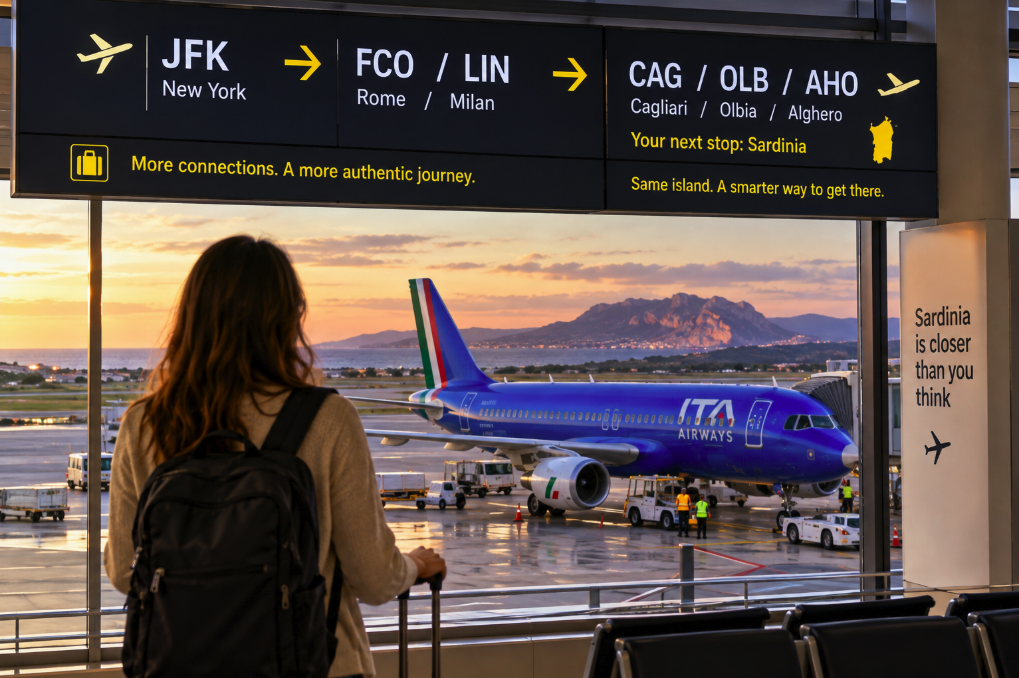
New York finally has a nonstop flight to Sardinia in 2026, but the direct route is not automatically the best choice for every traveller. Delta launched seasonal service between JFK and Olbia on May 20, operating four times a week during the summer. For travellers comparing fares, dates or different parts of the island, however, flying through Rome or Milan can open up many more combinations — and sometimes a lower total fare.
The direct option: JFK to Olbia
Delta’s new JFK–Olbia service is a major change for Sardinia’s North American connectivity. The airline lists the route among its new Mediterranean services for summer 2026, with four weekly flights from New York to Olbia.
The advantage is obvious: no European connection and arrival directly in north-eastern Sardinia, convenient for Olbia, the Costa Smeralda, Gallura and onward travel towards places such as San Teodoro or Santa Teresa Gallura. The trade-off is that a seasonal nonstop has fewer departure dates than the much larger networks serving Rome and Milan, and the direct fare may not always fit a budget traveller’s plans.
Rather than assuming the nonstop costs a fixed amount, travellers should compare live fares for their actual dates. Airfares change continuously according to demand, booking class and season, so figures such as “$1,200” should be treated as a search result for particular dates, not the normal price of the route.
Why Rome can be the useful alternative
Rome Fiumicino is one of the principal gateways between mainland Italy and Sardinia. Under Sardinia’s air continuity system in force since March 29, 2026, scheduled connections link Rome Fiumicino with all three main Sardinian airports: Cagliari, Olbia and Alghero.
That creates a simple strategy for travellers from New York: compare a JFK–Rome itinerary followed by a domestic connection to the Sardinian airport closest to the final destination. Cagliari is the natural arrival point for southern Sardinia, Olbia for much of the north-east, and Alghero for the north-west.
For 2026, the Sardinian regional government states that Aeroitalia operates the public-service routes Cagliari–Rome, Olbia–Rome and Alghero–Rome. This is important for travellers searching old advice online: ITA Airways should not automatically be assumed to operate the Sardinia leg simply because the transatlantic flight reaches Rome.
And what about connecting through Milan?
Milan is another option, but airport geography deserves attention. New York long-haul services commonly use Milan Malpensa, while Sardinia’s public-service connections are based at Milan Linate. A cheap-looking itinerary that requires changing from Malpensa to Linate is not a normal airside connection: it involves travelling across the Milan metropolitan area and should be planned with a generous time margin.
From Linate, the 2026 continuity network connects Milan with Cagliari and Olbia through Aeroitalia. Alghero–Linate is the exception during most of the 2026 summer season: the Sardinian regional government says ITA Airways continues operating that route under the previous continuity arrangement until October 24, 2026.
For this reason, Milan can work well when a search engine produces a genuinely convenient itinerary, but travellers should inspect the airport codes carefully. MXP and LIN are different airports.
One ticket or separate tickets?
The cheapest result is not always the safest connection. A through ticket normally provides more protection when the first flight is delayed and a connection is missed. Buying the transatlantic flight and Sardinia flight separately can reduce the price, but it can also mean collecting checked baggage, checking in again and carrying the risk of a missed second flight.
This is particularly important when mixing airlines that do not protect one another’s separate bookings. Travellers building their own connection should leave substantial time between flights and check baggage rules independently for each ticket.
There is another detail worth understanding. Sardinia’s continuity fares are designed primarily around residents and specified eligible categories, not as a blanket low fare for every international tourist. The regional government’s 2026 rules extend discounted categories beyond residents — including certain workers, younger and older travellers, relatives of residents and other defined groups — but visitors should not assume that the published subsidised fare automatically applies to them.
Search the island, not just one airport
One of the easiest ways to find a better itinerary is to search Cagliari (CAG), Olbia (OLB) and Alghero (AHO) separately. A traveller planning a road trip may discover that arriving at one airport and departing from another saves money or avoids driving back across the island.
For Alghero and north-west Sardinia, AHO is normally the most practical airport. Olbia is usually better for the Costa Smeralda and north-east. Cagliari serves the south and is often useful for itineraries extending into central or south-western Sardinia.
It is also worth comparing an open-jaw itinerary — for example, New York to Rome, onward to Cagliari, then returning from Olbia — against a conventional round trip. The result depends entirely on dates, but the three-airport strategy gives travellers more possibilities than searching only for “JFK to Sardinia.”
The arrival of Delta’s nonstop has made Sardinia easier to reach from New York, especially for travellers headed to the north-east. But travellers who value price or flexibility should still compare Rome and Milan connections. The smartest itinerary is often not simply the flight with the fewest stops; it is the combination of fare, connection risk, baggage rules and the Sardinian airport that puts you closest to where the holiday actually begins.