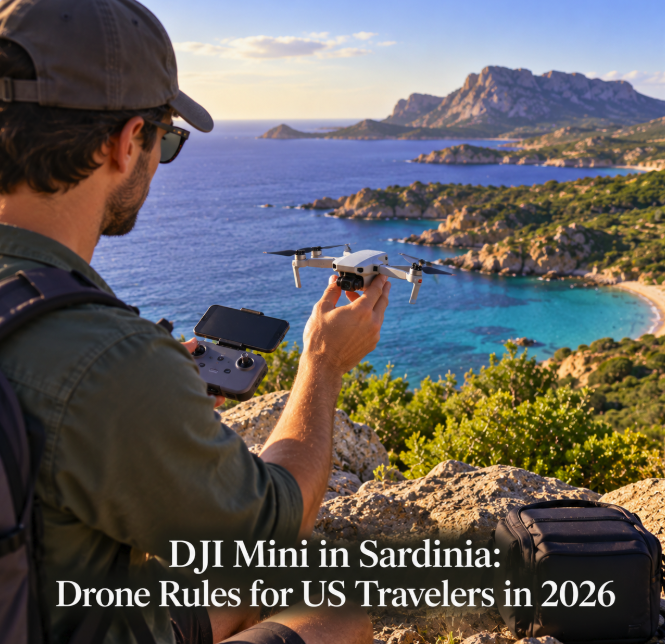
A DJI Mini weighing under 250 grams is one of the easiest camera drones to travel with in Sardinia, but “under 250g” does not mean “no rules.” For an American visitor flying a camera-equipped Mini in Italy in 2026, the key requirements are operator registration, liability insurance, compliance with the Open category and a check of the official D-Flight airspace map before every flight. The good news is that a remote-pilot certificate is generally not required for Open-category operations with a sub-250g camera drone.
The rules come from the European UAS framework and Italy’s aviation authority, ENAC. They apply in Sardinia just as they do on mainland Italy, while local airspace restrictions can make a beautiful-looking beach, archaeological site or coastal viewpoint unsuitable for flying.
Under 250g does not exempt a DJI Mini with a camera
ENAC states that operators of drones below 250 grams equipped with a camera do not need a remote-pilot certificate for Open-category operations, but registration is still required. The operator must also have appropriate third-party liability insurance and comply with the geographical-zone rules.
This is an important distinction for US travelers accustomed to focusing primarily on the drone’s weight. The camera matters for operator registration because it can collect personal data. A sub-250g drone without a camera or other personal-data sensor is treated differently, while a toy meeting the relevant toy directive has separate exemptions. A DJI Mini with a camera is not simply exempt because its box says 249g.
American visitors must register in Europe
EASA’s current guidance for non-EU residents says a visitor must register as a drone operator with the national aviation authority of the first EASA member country in which they intend to operate. Once obtained, that European operator registration is valid across EASA member states.
If Italy is your first European country for drone operations, ENAC directs operators to the D-Flight system. The operator receives a European identification code, represented through the Italian system as a QR code, which must be placed on the drone.
If you have already completed valid operator registration in another EASA member state, you should not create a second operator registration merely because you travel to Sardinia. The European registration is intended to work across the system.
An FAA registration or US remote-pilot credential does not replace the European operator-registration requirement. ENAC also explains that certificates issued under a non-EU national system are not automatically converted or recognized as EU pilot certificates. For a sub-250g Mini in the Open category this is less of a problem, because ENAC says no remote-pilot certificate is required for that weight class.
Insurance is required in Italy
ENAC requires UAS operators to have liability insurance appropriate to their operations. Its English-language guidance specifically repeats this requirement for drones weighing less than 250 grams.
Before traveling, verify that your policy covers recreational drone operation in Italy and that the geographic coverage includes Sardinia. Do not assume a US homeowners policy, travel policy or drone membership automatically satisfies Italian requirements.
Keep proof of coverage available while traveling. The exact policy you choose is a private insurance decision, but the ENAC requirement itself is not optional simply because the drone is small.
D-Flight is the map to check before every flight
ENAC instructs Open-category operators to check the geographical zones on D-Flight before each flight. These zones can contain prohibitions, altitude restrictions, validity periods and instructions or contacts for access.
This is especially important in Sardinia. The island has airports, controlled airspace, military activity, protected locations and other areas where the rules can differ sharply from one viewpoint to another. A location being remote or scenic does not prove that it is legal for a drone.
Do not rely solely on the DJI app’s geofencing display. Manufacturer geofencing can be useful operationally, but D-Flight is the Italian reference ENAC tells operators to consult for UAS geographical zones.
Check the map again on the actual day of the flight. D-Flight publishes geographical-zone information with temporal validity and applicable rules, so an old screenshot saved weeks before the trip is not the best basis for a flight decision.
The basic Open-category limits still apply
A typical DJI Mini under 250g operates in subcategory A1 when the operation remains within the Open-category conditions. EASA’s rules for C0 drones include a maximum flight height of 120 metres above the surface and prohibit flight over assemblies of people.
For legacy sub-250g drones placed on the market before 2024, EASA also permits A1 operation. Such drones may fly over uninvolved people under the applicable framework, although this should be avoided when possible; they cannot fly over assemblies of people.
The precise treatment therefore depends not only on the weight but also on whether your Mini carries a C0 class marking or is an older legacy model. Travelers should identify the exact model and class marking before departure rather than treating every product named “DJI Mini” as legally identical.
Open-category flying also means keeping the drone within visual line of sight and staying within the operational limits. A cinematic flight far down the coast until the aircraft is no longer visible is not transformed into a legal flight by the drone’s long advertised transmission range.
Beaches are not automatically free-fly zones
A quiet Sardinian beach may look ideal from the air, but several separate issues can affect a flight. First check D-Flight for the airspace. Then consider people on the beach: even with a lightweight drone, flying above a dense crowd or assembly is prohibited.
Privacy matters too. ENAC lists privacy compliance among the responsibilities of UAS operators, including respect for the GDPR framework. Avoid hovering close to strangers, filming into private properties or turning a beach flight into unwanted surveillance of sunbathers.
Protected natural areas, archaeological sites and other managed locations may also have rules affecting takeoff, landing or activities on the ground in addition to aviation restrictions. The D-Flight map is essential for airspace, but it does not eliminate the need to respect lawful site-management restrictions.
Do not assume 120 metres is always available
The European Open-category ceiling is normally 120 metres above the surface, but a geographical zone can impose a lower limit or prohibit flight. In other words, “120m” is a maximum framework limit, not a promise that every point in Sardinia allows a Mini to climb to that height.
This matters around airports in particular. Sardinia’s main airports at Cagliari, Olbia and Alghero create obvious reasons to check the official map carefully, but smaller aviation sites and other restricted areas should not be guessed from memory.
What changes if the flight leaves the Open category?
The simple sub-250g rules described here assume the flight qualifies for the Open category. ENAC classifies higher-risk operations outside those criteria under the Specific category. Examples include flying beyond visual line of sight, above 120 metres or conducting other operations that exceed Open-category limits.
Specific-category operations can require a standard-scenario declaration or an operational authorization, depending on the operation. ENAC also notes that Italy’s old national standard scenarios IT-STS01 and IT-STS02 ceased to be usable from January 1, 2026; European standard-scenario and authorization procedures now matter for operations that require them.
A vacationer with a DJI Mini normally has no reason to make the trip this complicated. Keep the flight inside the Open-category rules and choose a different location if the desired shot would require special authorization.
A pre-flight checklist for Sardinia
- Identify your exact DJI Mini model, weight and C-class marking.
- Complete the required European operator registration if you are not already registered in an EASA member state.
- Display the operator identification required by the Italian registration system on the drone.
- Carry valid third-party liability insurance covering drone operation in Italy.
- Check the exact launch area on D-Flight before every flight.
- Read the geographical-zone altitude and access conditions rather than relying on the general 120m ceiling.
- Stay within visual line of sight and do not fly over assemblies of people.
- Respect privacy and any legitimate restrictions imposed by the site or protected area.
- Set up the aircraft and map while safely stopped, not while driving between viewpoints.
The DJI Mini’s low weight is genuinely useful in Europe: for a camera-equipped drone below 250g, ENAC says a pilot certificate is not required for normal Open-category operation. But three obligations remain particularly important in Italy — operator registration, liability insurance and checking D-Flight.
For an American visiting Sardinia, those are the details to arrange before chasing a sunrise over the coast. A small drone can simplify the regulatory category, but it does not turn Sardinia into unrestricted airspace.