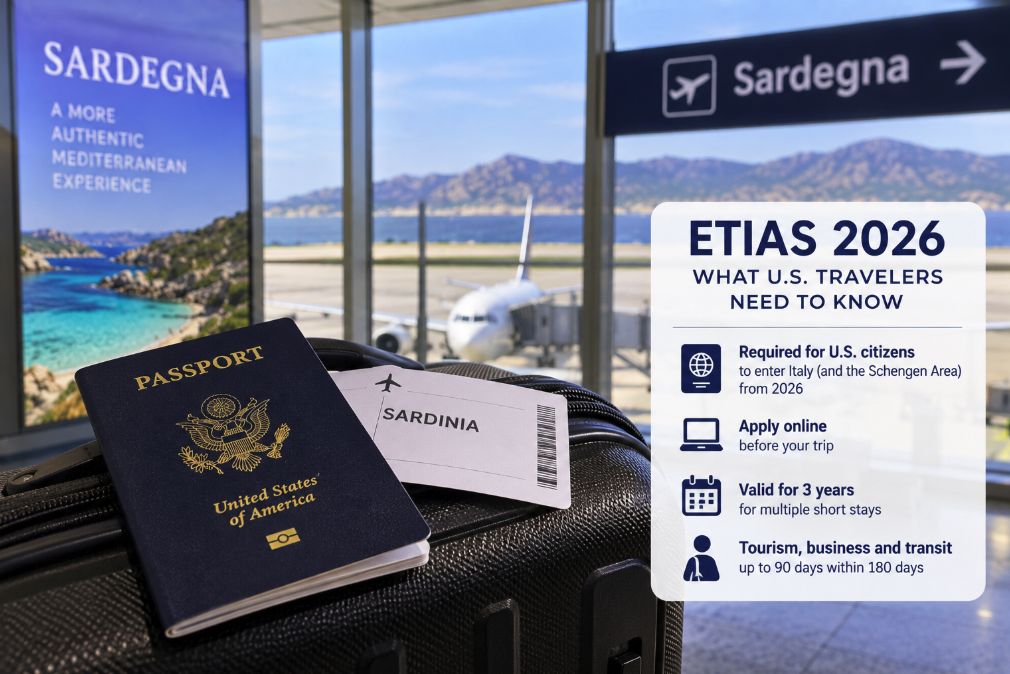
Americans traveling to Sardinia in September 2026 do not need an ETIAS authorization yet. Despite headlines and social-media posts suggesting that “ETIAS is required for Europe in 2026,” the European Union says the system is still not operating and is scheduled to start in the last quarter of 2026. The exact launch date has not yet been announced. Once ETIAS becomes operational, U.S. citizens traveling visa-free to Italy — including Sardinia — will fall within the system.
This distinction matters for anyone with an upcoming flight to Olbia, Cagliari or Alghero. ETIAS is a real EU travel requirement, but travelers cannot currently apply for it. The European Commission explicitly states that no ETIAS applications are being collected at this point and that the specific launch date will be communicated before operations begin.
Does Sardinia have separate ETIAS rules?
No. Sardinia is part of Italy, so a U.S. citizen visiting the island follows the same immigration rules as someone visiting Rome, Florence or Milan. There is no separate Sardinian travel authorization.
Italy is part of the Schengen Area. Americans can currently travel to Italy visa-free for short stays, subject to the normal Schengen entry conditions and the 90-days-in-any-180-day-period limit. Italy's Ministry of Foreign Affairs states that travelers entering from outside Schengen must hold a recognized travel document and meet the applicable entry conditions, including being able to justify the purpose and circumstances of their stay when required.
When ETIAS begins operating, it will apply to visa-exempt travelers from countries including the United States who make short visits to the participating European countries. It is a travel authorization, not a traditional visa.
ETIAS is not the same as EES
Much of the current confusion comes from two European border systems arriving on different schedules. The Entry/Exit System, or EES, is already fully operational across the Schengen countries as of 10 April 2026. ETIAS is not.
EES records border crossings by non-EU nationals making short stays and replaces much of the old passport-stamping process with electronic registration. At an external Schengen border, travelers may have their passport information and biometric data recorded.
ETIAS works differently. Once it launches, visa-exempt travelers will apply online for authorization before beginning their trip. Airlines and other carriers will be able to verify that authorization before departure.
For an American flying from New York to Rome and then connecting to Sardinia, the external Schengen border is normally reached in Rome, not on arrival at the Sardinian airport. A traveler arriving in Sardinia via another Schengen country would similarly complete the relevant external-border formalities at the first Schengen entry point.
When will Americans actually need ETIAS?
The European Commission currently says ETIAS is scheduled for the last quarter of 2026, but the exact start date remains to be officially communicated. That means it is inaccurate to tell every American traveling to Sardinia “in 2026” that an ETIAS is already required.
There is another important detail that often disappears from simplified travel warnings. The ETIAS regulation provides for a transitional period after the system begins operating. Under the current EU legal text, for six months from the start of operations, use of ETIAS is optional and the requirement to possess a valid authorization does not apply. The Commission can extend that transitional period under the regulation.
Travelers should therefore rely on the official EU launch announcement and the rules applying to their actual travel dates rather than assuming that a generic 2026 deadline tells the whole story.
How will ETIAS work when it launches?
U.S. citizens will apply online through the official EU ETIAS website or official mobile application. The EU specifically warns travelers to use official channels because third-party websites may charge additional fees or misuse personal information.
The EU Delegation to the United States currently describes ETIAS as an authorization for visa-exempt short-term travelers, valid for up to three years or until the travel document used in the application expires, whichever comes first. It is intended for short visits rather than residence, employment or other activities that require a different immigration status.
The current published fee is €20 for most applicants. Because ETIAS is not yet operational, travelers should not pay anyone now for an alleged active ETIAS authorization. A website claiming to issue a valid ETIAS today cannot be using the live EU system because the EU is not currently accepting applications.
What should Americans traveling to Sardinia now do?
If your Sardinia trip takes place before ETIAS becomes operational, do not try to obtain an ETIAS. Instead, check that your passport and itinerary meet Italy's current entry requirements and allow extra time for the newer EES border procedures, particularly when entering the Schengen Area through a major connecting airport.
If your trip is scheduled for late 2026 or 2027, check the official EU ETIAS information shortly before departure. Do not rely on an old travel blog, viral video or search result that gives an ETIAS launch date without confirming it against the European Commission.
The simplest rule is this: U.S. citizens will need to deal with ETIAS for Sardinia once the EU system is operational and the applicable transition rules make authorization necessary, but ETIAS is not required today, September 13, 2026.
Why the confusion is understandable
ETIAS has been discussed for years and its planned introduction has shifted more than once. At the same time, EES is now active, so Americans arriving in Europe are genuinely encountering new border procedures in 2026. It is easy for the two systems to be merged into a single headline even though they do different things.
Recent EU legal work on the ETIAS Central System also shows that preparations are advancing. A Commission implementing decision concerning access to and management of ETIAS Central System data was adopted on 7 September 2026 and published in the EU Official Journal on 8 September. That is evidence of ongoing implementation, not evidence that travelers can already apply.
For Sardinia-bound Americans, there is no reason for panic. The practical task is simply to distinguish what is already active from what is coming next: EES is operating now; ETIAS is scheduled for later in 2026, with its exact operational date still to be announced. Before flying, check the official EU ETIAS portal and Italy's Ministry of Foreign Affairs for the rules applying on your specific travel date.